
Short Answer
Definition of JWST’s Orbit
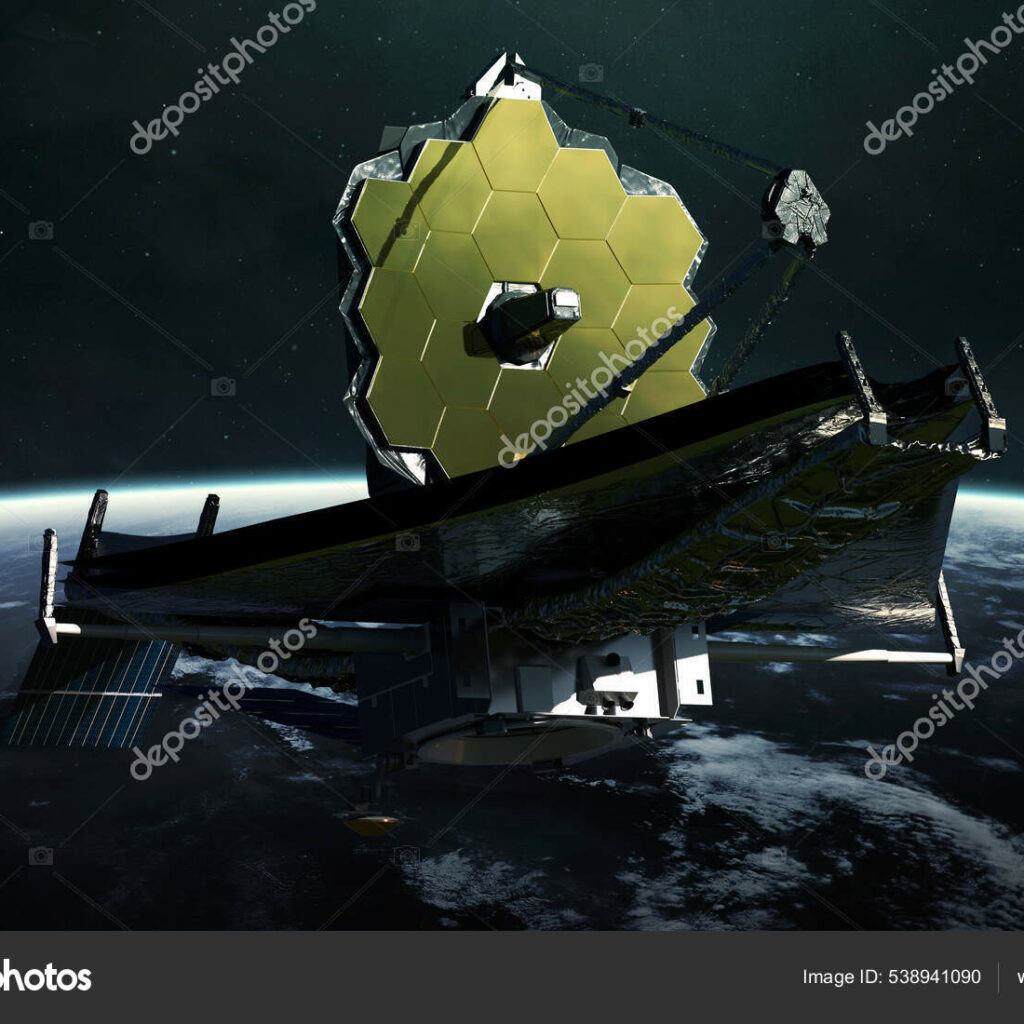
The James Webb Space Telescope (JWST) operates in a unique orbital configuration that distinguishes it from traditional Earth-orbiting satellites. Rather than circling Earth directly, JWST is positioned at a gravitationally stable point in space known as the second Lagrange point (L2), approximately 1.5 million kilometers away from Earth on the side opposite the Sun. This location allows JWST to orbit the Sun while maintaining a fixed relative position with respect to both Earth and the Sun.
- JWST’s Orbit:
The telescope orbits the Sun, not Earth, while residing near the Earth-Sun L2 point. - L2 Point:
A gravitational equilibrium where the combined forces of Earth and the Sun allow a spacecraft to maintain a stable position with minimal fuel use.
Understanding Lagrange Points and Their Significance
Lagrange points are specific locations in a two-body system, such as Earth and the Sun, where gravitational forces and the orbital motion of a smaller object balance out. There are five such points, but L2 is particularly important for space observatories like JWST.
- Gravitational Balance:
At L2, the gravitational pull from Earth and the Sun counteracts the centripetal force needed for orbit, enabling a spacecraft to “hover” relative to these bodies. - Operational Stability:
This balance reduces the need for frequent propulsion adjustments, conserving fuel and extending mission duration. - Thermal Environment:
L2 allows JWST to keep its sunshield oriented away from both the Sun and Earth, maintaining the ultra-cold temperatures essential for infrared observations.
How JWST’s Orbit Differs from Earth-Orbiting Telescopes
Unlike the Hubble Space Telescope, which orbits Earth at low Earth orbit (LEO) roughly every 97 minutes, JWST’s orbit is heliocentric, meaning it revolves around the Sun. This distinction is crucial for its mission and operational requirements.
- Distance from Earth:
JWST is stationed about 1.5 million kilometers away, far beyond Earth’s immediate gravitational influence. - Environmental Conditions:
Earth’s low orbit exposes satellites to reflected sunlight, atmospheric drag, and radiation belts, which can interfere with sensitive instruments. JWST’s L2 orbit avoids these issues. - Communication:
Despite the greater distance, JWST maintains reliable communication with Earth through advanced deep space networks.
Scientific Advantages of JWST’s Orbital Position
The choice of the L2 point for JWST’s orbit is driven by the need to optimize its scientific capabilities, particularly in infrared astronomy.
- Thermal Stability:
Constant solar illumination from one direction allows JWST’s sunshield to block heat and light, keeping instruments near cryogenic temperatures. - Reduced Interference:
The stable environment minimizes thermal noise and radiation exposure, enhancing the telescope’s sensitivity to faint cosmic signals. - Extended Mission Life:
The minimal need for orbit corrections conserves fuel, potentially enabling JWST to operate for a decade or longer.
Orbital Mechanics and the Halo Orbit Around L2
JWST does not remain fixed at a single point but follows a halo orbit around the L2 point. This three-dimensional orbit allows the telescope to maintain a stable position relative to Earth and the Sun while avoiding Earth’s shadow.
- Halo Orbit:
A periodic orbit around L2 that provides continuous sunlight and an unobstructed view of space. - Fuel Efficiency:
The gravitational balance at L2 reduces the frequency and magnitude of propulsion maneuvers needed to maintain orbit.
Common Misconceptions About JWST’s Orbit
JWST orbits Earth like the Hubble Space Telescope.
JWST orbits the Sun while positioned near the Earth-Sun L2 point, not Earth itself.
JWST’s distance from Earth makes communication difficult.
Advanced deep space communication systems ensure steady data transmission despite the greater distance.
JWST’s orbit is unstable and requires constant adjustments.
The L2 point provides a gravitationally stable environment, minimizing the need for frequent orbit corrections.
Why JWST’s Orbit Is Crucial for Its Mission
The orbital strategy of JWST is fundamental to its ability to conduct groundbreaking science. By orbiting the Sun at L2, JWST achieves the environmental conditions necessary for its sensitive infrared instruments to detect faint heat signatures from the early universe, exoplanet atmospheres, and other distant phenomena.
- Enhanced Sensitivity:
The cold, stable environment reduces background noise, allowing JWST to observe faint cosmic signals. - Longevity:
Reduced fuel consumption extends the telescope’s operational lifespan, maximizing scientific return. - Uninterrupted Observations:
Continuous sunlight and an unobstructed view of space enable long-duration observations without Earth’s interference.
Real-World Impact and Future Implications
JWST’s innovative orbital placement exemplifies a shift in space exploration from Earth-centric missions to more complex heliocentric configurations. This approach opens new frontiers for scientific discovery and technological advancement.
- Deep Space Exploration:
JWST’s orbit allows humanity to probe the universe’s earliest epochs and study celestial phenomena previously beyond reach. - Technological Innovation:
The mission demonstrates sophisticated orbital mechanics and engineering solutions that will inform future space observatories. - Scientific Collaboration:
Data from JWST enriches global understanding of cosmology, planetary science, and astrophysics.
Conclusion
The James Webb Space Telescope’s orbit around the Sun at the Earth-Sun L2 point represents a paradigm shift in how space observatories are positioned and operated. This gravitationally balanced orbit provides the thermal stability, minimal interference, and fuel efficiency essential for JWST’s ambitious scientific goals. Recognizing that JWST does not orbit Earth but instead participates in a complex celestial dance around the Sun enhances our appreciation of the mission’s ingenuity and its profound contributions to humanity’s exploration of the cosmos.


Leave a Reply