
Short Answer
Understanding Dark Matter
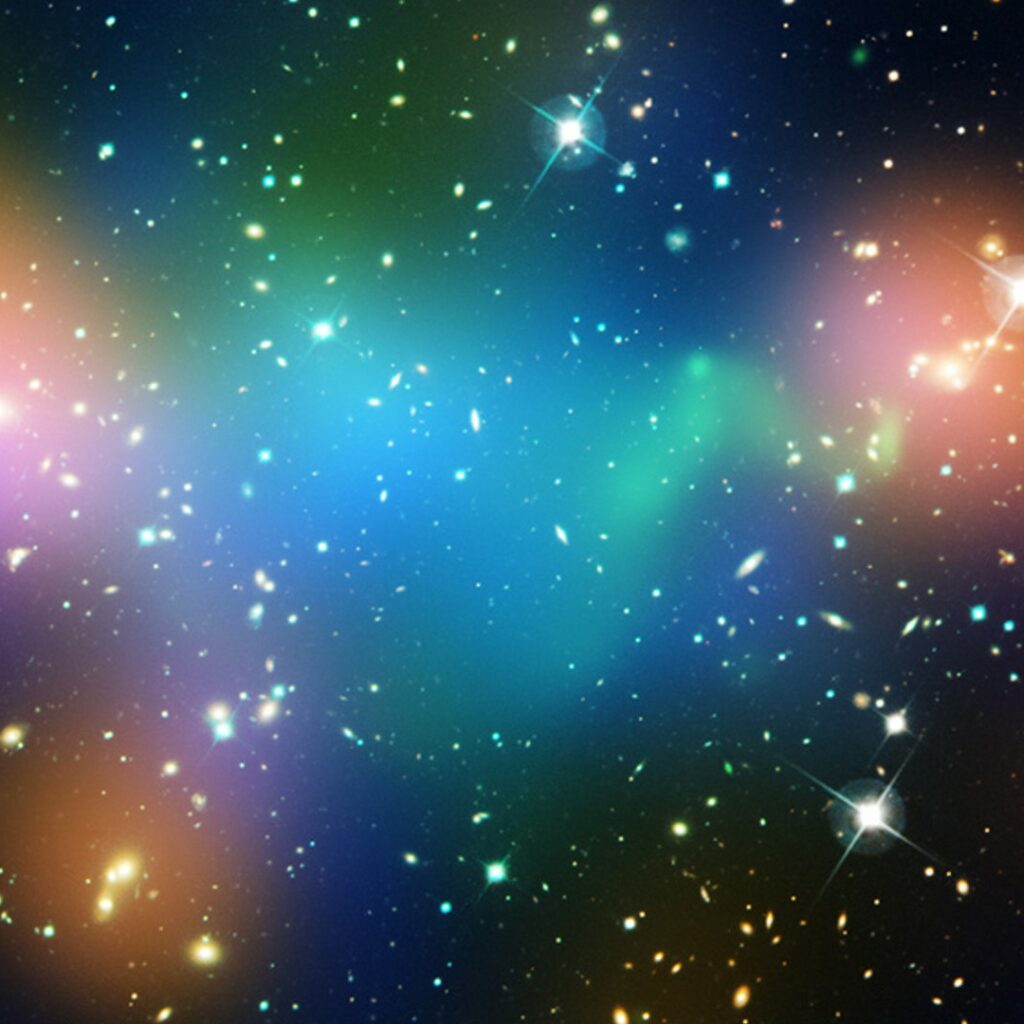
Dark matter is a mysterious and invisible form of matter that constitutes approximately 85% of the total matter in the universe. Unlike ordinary matter, which interacts through electromagnetic forces and forms the stars, planets, and galaxies we observe, dark matter does not emit, absorb, or reflect light, making it undetectable by conventional telescopes. Its presence is inferred primarily through gravitational effects on visible matter, radiation, and the large-scale structure of the cosmos.
Fundamental Characteristics of Dark Matter
- Non-luminous Nature:
Dark matter neither emits nor absorbs electromagnetic radiation, rendering it invisible across the entire electromagnetic spectrum. - Gravitational Interaction:
It interacts predominantly through gravity, influencing the motion of galaxies and the formation of cosmic structures. - Lack of Electromagnetic Interaction:
Unlike baryonic matter, dark matter does not participate in nuclear fusion or radiative cooling processes essential for star and planet formation.
Dark Matter’s Role in Cosmic Structure Formation
On the grandest scales, dark matter plays a crucial role in shaping the universe’s architecture. It forms extensive, diffuse halos that envelop galaxies and clusters, providing the gravitational scaffolding necessary for baryonic matter to accumulate and form luminous structures. These halos influence galaxy rotation curves and stabilize galactic formations, yet remain non-luminous and spread out rather than compact.
Challenges to Dark Matter Forming Compact Astronomical Bodies
The prospect of dark matter condensing into stars, planets, or galaxies faces significant theoretical obstacles. A key limitation is the absence of electromagnetic interactions, which in ordinary matter allow energy to be radiated away, enabling cooling and collapse into dense objects. Dark matter particles, often described as “cold” or “warm,” possess velocity dispersions that prevent them from efficiently losing energy and contracting into compact bodies like stars or planets.
Hypotheses on Complex Dark Matter Structures
Some speculative models propose the existence of “dark atoms,” hypothetical particles that could interact via forces analogous to electromagnetism but hidden from current detection methods. If such interactions exist, dark matter might form bound states, cool, and condense into compact objects, potentially giving rise to “dark stars” and entire “dark galaxies” composed of these exotic particles. These shadowy galaxies would be invisible to traditional observation but might be inferred through their gravitational influence.
Potential Features of Dark Stars and Dark Galaxies
- Dark Stars:
Hypothetical stellar objects formed from dark matter particles, possibly emitting unique particle radiation or gravitational waves instead of electromagnetic light. - Dark Galaxies:
Entire galaxies composed predominantly of dark matter atoms, undergoing star formation cycles through unknown mechanisms distinct from baryonic processes.
Observational Constraints and Experimental Efforts
Current astrophysical observations, including measurements of the cosmic microwave background, gravitational lensing, and galaxy clustering, impose strict limits on the properties of dark matter, particularly regarding self-interactions and dissipative behavior. Despite these constraints, ongoing experiments in particle physics and astronomy strive to detect subtle signals that could reveal complex dark matter dynamics, employing underground detectors, cosmic surveys, and gravitational wave observatories.
Dark Matter and Planetary Formation
Forming planet-like structures from dark matter is even more challenging due to the small mass of dark matter particles and their weak interactions. Planet formation in baryonic matter relies heavily on cooling and aggregation processes facilitated by electromagnetic forces, which dark matter lacks. While small-scale dark matter clumps or microhalos might exist, their detection remains beyond current observational capabilities, and their gravitational binding into compact planetary analogs is highly speculative.
Interplay Between Dark Matter and Ordinary Matter
The dynamic relationship between dark matter and baryonic matter shapes the visible universe. Baryonic matter’s ability to radiate energy allows it to collapse into dense, luminous structures at galactic centers, whereas dark matter remains distributed in extended halos. This complementary interaction under gravity forms the cosmic landscape, with dark matter acting as an invisible framework supporting the formation and evolution of stars and planets.
Significance of Exploring Dark Matter’s Potential to Form Celestial Bodies
Investigating whether dark matter can create its own stars, planets, or galaxies pushes the boundaries of astrophysics and particle physics. Understanding these possibilities could unveil new physics beyond the Standard Model and deepen our comprehension of the universe’s hidden components. Such research not only challenges existing paradigms but also inspires innovative detection methods that may one day reveal the elusive nature of dark matter’s role in cosmic evolution.
Common Misconceptions About Dark Matter and Structure Formation
Dark matter can form stars and planets just like ordinary matter.
Dark matter lacks electromagnetic interactions necessary for cooling and collapsing into compact objects, making star and planet formation highly unlikely under standard models.
Dark matter is completely inert and does not clump.
Dark matter does cluster gravitationally on large scales, forming halos that influence galaxy formation, but it remains diffuse and non-luminous.


Leave a Reply