
Short Answer
Definition of Binding Energy and Strong Nuclear Force
In the field of subatomic physics, understanding the forces that govern particle interactions is essential. Two critical concepts in this domain are binding energy and the strong nuclear force, both of which play vital roles in atomic and nuclear structures.
- Binding Energy:
This refers to the energy necessary to separate a system of particles into individual components. In nuclear physics, it specifically denotes the energy required to break apart nucleons-protons and neutrons-within an atomic nucleus. When nucleons combine to form a nucleus, energy is released, indicating a stable arrangement. This released energy, typically measured in mega-electronvolts (MeV), is what we call the binding energy. - Strong Nuclear Force:
This is the fundamental interaction responsible for holding nucleons together inside the nucleus. It acts over extremely short distances, roughly 1 femtometer (10-15 meters), and is the most powerful of the four fundamental forces, surpassing electromagnetic and gravitational forces. The strong force is mediated by gluons, which facilitate interactions between quarks-the elementary particles that make up protons and neutrons.
Mechanism of the Strong Nuclear Force
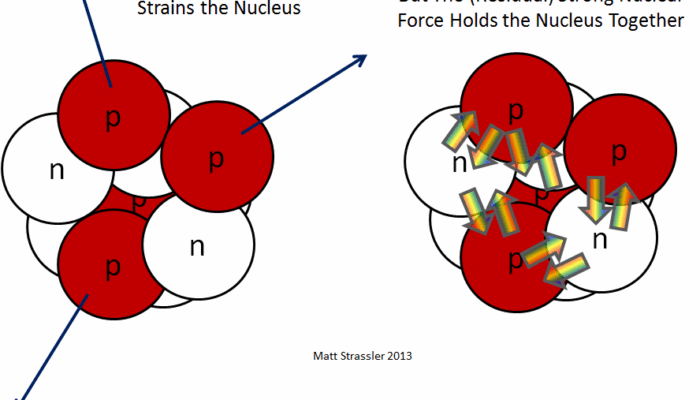
The strong nuclear force operates by exchanging gluons between quarks, binding them tightly within protons and neutrons. This force intensifies as quarks come closer, ensuring the cohesion of nucleons. At the nuclear level, the strong force overcomes the electromagnetic repulsion between positively charged protons, maintaining the integrity of the nucleus. Its short-range nature means it is effective only within the confines of the nucleus, making it crucial for nuclear stability.
Relationship Between Binding Energy and the Strong Nuclear Force
While binding energy and the strong nuclear force are closely connected, they are not identical. Binding energy is the measurable energy released when nucleons bind together, serving as an indicator of the strong force’s effectiveness in counteracting repulsive forces within the nucleus. Essentially, binding energy quantifies the net result of the strong nuclear force’s action, reflecting the stability of the nucleus.
The stability of an atomic nucleus depends on a delicate balance: the strong nuclear force pulls nucleons together, while electrostatic forces push protons apart. The binding energy represents this equilibrium, with higher binding energies corresponding to more stable nuclei due to the strong force’s dominance over repulsive interactions.
Mass-Energy Equivalence and Nuclear Stability
Einstein’s mass-energy equivalence principle, expressed by the equation E=mc², provides a deeper insight into binding energy. The mass defect of a nucleus-the difference between the combined mass of free nucleons and the actual mass of the nucleus-corresponds to the binding energy. This means that the energy released during nucleon binding is stored as a reduction in mass. The greater the binding energy, the larger the mass defect, which directly correlates with nuclear stability.
Applications and Significance in Astrophysics and Technology
Binding energy and the strong nuclear force have far-reaching implications beyond nuclear stability. In astrophysics, these concepts underpin stellar nucleosynthesis, the process by which stars create heavier elements. The varying binding energies of elements influence their formation and abundance in the universe, shaping cosmic evolution from hydrogen fusion in stars to the creation of complex elements found on planets.
In technology, understanding binding energy is fundamental to nuclear energy production. Nuclear fission releases energy by splitting heavy nuclei into lighter ones with higher binding energies, while nuclear fusion combines light nuclei, releasing substantial energy as well. These processes are central to power generation, medical treatments such as radiotherapy, and ongoing research into sustainable fusion energy.
Common Misconceptions
Binding energy is the same as the strong nuclear force.
Binding energy is the energy released due to the strong nuclear force but is not the force itself. It quantifies the effect of the strong force in stabilizing the nucleus.
The strong nuclear force acts over long distances.
The strong force is effective only at extremely short ranges, approximately 1 femtometer, and does not influence particles beyond the nucleus.
Importance of Binding Energy and the Strong Nuclear Force
The study of binding energy and the strong nuclear force is fundamental to our comprehension of matter’s structure and stability. These concepts explain how atomic nuclei hold together despite repulsive forces, influencing everything from elemental formation in stars to practical applications in energy and medicine. Their interplay reveals the underlying principles that govern the subatomic world, highlighting the intricate forces that compose the universe’s fabric.
FAQ
What is binding energy?
Binding energy is the energy required to separate a system of particles into individual components, specifically in nuclear physics referring to the energy to break apart protons and neutrons within an atomic nucleus.
How does the strong nuclear force work?
The strong nuclear force binds nucleons (protons and neutrons) together in the nucleus by mediating interactions through gluons, effective only at very short distances.
Are binding energy and strong nuclear force the same?
No, binding energy quantifies the energy released due to the strong nuclear force but is not the force itself.
What is the significance of binding energy in astrophysics?
Binding energy influences stellar nucleosynthesis, affecting the formation and abundance of elements in the universe.






Leave a Reply