
Short Answer
Definition of Electromagnetic Field
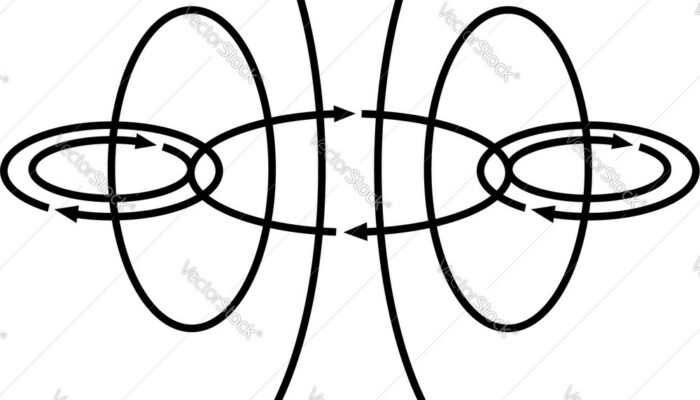
An electromagnetic field (EMF) is a physical field produced by electrically charged objects, encompassing both electric and magnetic components. These components are interdependent and can propagate through space, influencing charged particles and currents. The EMF is a fundamental concept in classical physics, bridging the phenomena of electricity and magnetism into a unified framework.
Understanding Vector Fields in Physics
In physics, a vector field is a mathematical entity that assigns a vector-characterized by both magnitude and direction-to every point in a given space. Vector fields are essential for describing physical quantities that vary spatially, such as velocity fields in fluid dynamics or force fields in electromagnetism.
- Magnitude:
The size or strength of the vector at a point. - Direction:
The orientation in space that the vector points toward.
Electromagnetic Field Components as Vector Fields
The electromagnetic field consists of two primary vector fields:
- Electric Field (E):
This vector field represents the force exerted on a positive test charge at any point in space. It is described by Maxwell’s equations and points in the direction a positive charge would be pushed. - Magnetic Field (B):
Also a vector field, the magnetic field influences moving charges, with the force direction depending on both the magnetic field orientation and the velocity of the charged particle.
When considered together, these two vector fields form the classical electromagnetic field, which can be viewed as a combined vector field in three-dimensional space.
Electromagnetic Field Tensor: A More Comprehensive Description
Beyond the classical vector field description, the electromagnetic field is more accurately represented by the electromagnetic field tensor (F), a mathematical object from tensor calculus. This tensor encapsulates both electric and magnetic fields into a single framework that is invariant under changes in the observer’s inertial frame, making it essential in the theory of special relativity.
- Electromagnetic Field Tensor (F):
A rank-2 antisymmetric tensor combining E and B fields, allowing a unified description of electromagnetism consistent with relativistic principles.
This tensorial approach reveals that the EMF’s nature transcends simple vector field classification, highlighting its multidimensional and observer-dependent characteristics.
Electromagnetic Fields in Different Media
The behavior of electromagnetic fields changes when interacting with various materials such as dielectrics and conductors. In these media, phenomena like polarization, magnetization, and anisotropy affect the field’s properties and complicate its vector field interpretation.
- Polarization Effects:
The alignment of dipoles within a material can modify the local electric field. - Anisotropic Materials:
Direction-dependent properties cause the field to behave differently along various axes, challenging the notion of uniform vector fields.
Electromagnetic Fields in Quantum and Relativistic Frameworks
In advanced physics, such as quantum electrodynamics (QED) and general relativity, the classical vector field description of EMFs evolves significantly:
- Quantum Electrodynamics:
The EMF is treated as a quantum field with particle-wave duality, where photons mediate electromagnetic interactions. The classical vector field picture gives way to probabilistic wave functions and operator fields. - General Relativity:
The curvature of spacetime influences electromagnetic field behavior, requiring tensorial descriptions that incorporate gravitational effects, thus complicating the simple vector field model.
Mathematical Representation of Electromagnetic Fields
The classical electric and magnetic fields are often expressed using Maxwell’s equations, which govern their dynamics:
- Gauss’s Law for Electricity:
∇·E = ρ/ε₀, where ρ is charge density and ε₀ is the permittivity of free space. - Gauss’s Law for Magnetism:
∇·B = 0, indicating no magnetic monopoles. - Faraday’s Law of Induction:
∇×E = -∂B/∂t, describing how changing magnetic fields induce electric fields. - Ampère-Maxwell Law:
∇×B = μ₀J + μ₀ε₀∂E/∂t, relating magnetic fields to electric currents (J) and changing electric fields.
Here, E and B are vector fields, while the electromagnetic field tensor F combines these into a relativistically consistent form.
Practical Applications and Examples
Electromagnetic fields are ubiquitous in technology and nature:
- Wireless Communication:
Radio waves, a form of EMF, transmit information through space. - Electric Motors:
Utilize magnetic and electric fields to convert electrical energy into mechanical motion. - Medical Imaging:
Techniques like MRI rely on strong magnetic fields to visualize internal body structures.
Common Misconceptions About Electromagnetic Fields
The electromagnetic field is purely a vector field.
While the electric and magnetic components are vector fields, the full electromagnetic field is more accurately described by a tensor, especially in relativistic contexts.
Electromagnetic fields behave identically in all materials.
Material properties such as anisotropy and polarization significantly influence EMF behavior, altering its classical vector characteristics.
Quantum mechanics eliminates the concept of fields.
Quantum electrodynamics extends the field concept into quantum realms, where fields are quantized and exhibit particle-wave duality.
Significance of Electromagnetic Fields
Electromagnetic fields are foundational to understanding and harnessing a vast array of physical phenomena. They underpin modern electrical engineering, telecommunications, medical technologies, and fundamental physics research. The study of EMFs bridges classical and quantum physics, providing insights into the nature of forces, energy transfer, and the structure of the universe itself.
Conclusion: Beyond Simple Classification
Although the electric and magnetic components of the electromagnetic field can be individually classified as vector fields, the complete electromagnetic field embodies a richer, more complex structure. Its representation as a tensor field, its behavior in diverse media, and its quantum and relativistic interpretations demonstrate that the EMF transcends a straightforward vector field classification. This complexity invites ongoing exploration into the fundamental nature of fields and their role in the fabric of reality.
FAQ
What is an electromagnetic field?
An electromagnetic field is a physical field produced by electrically charged objects that combines electric and magnetic components.
How do electric and magnetic fields relate?
Electric and magnetic fields are interdependent and together form the electromagnetic field, described by Maxwell’s equations.
What are the practical applications of electromagnetic fields?
Electromagnetic fields are used in technologies like wireless communication, electric motors, and medical imaging.






Leave a Reply