
Short Answer
Definition of Cosmic Rays and Thunderstorm Electric Fields
Cosmic rays are high-energy particles, predominantly protons and atomic nuclei, that travel through space at nearly the speed of light. Originating from powerful cosmic events such as supernova explosions and active galactic nuclei, these particles continuously bombard Earth’s atmosphere. Thunderstorm electric fields, on the other hand, are intense electric potentials generated within storm clouds due to the separation of electrical charges caused by atmospheric dynamics.
- Cosmic Rays:
Energetic particles from outer space that interact with Earth’s atmosphere, producing secondary particle cascades. - Thunderstorm Electric Fields:
Electric potentials formed inside storm clouds due to charge separation, which can lead to lightning discharges.
Interaction Between Cosmic Rays and Thunderstorm Electric Fields
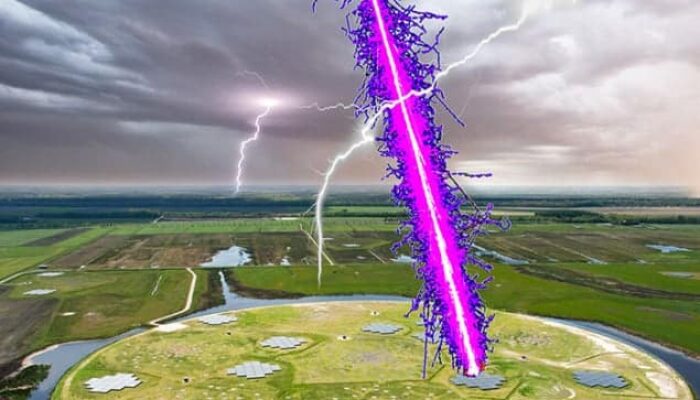
When cosmic rays penetrate Earth’s atmosphere, they collide with air molecules, initiating a chain reaction known as an air shower-a cascade of secondary particles spreading through the atmosphere. The presence of strong electric fields within thunderstorms can modify the behavior of these particle showers. Specifically, the electric fields influence the energy and trajectories of the secondary particles, imprinting unique signatures that can be detected and analyzed.
Mechanism of Influence
Thunderstorm electric fields arise from the separation of positive and negative charges within clouds, driven by updrafts and downdrafts. These fields can accelerate or decelerate charged particles in cosmic ray air showers, altering their intensity and spatial distribution. By studying these modifications, scientists can infer properties of the electric fields, such as their strength and spatial configuration.
Scientific Techniques for Detection and Analysis
Modern research employs advanced detection arrays capable of simultaneously monitoring cosmic ray showers and thunderstorm activity. These instruments are strategically placed to capture coincident events, enabling the correlation of cosmic ray intensity fluctuations with the dynamics of thunderstorm electric fields. Data from these detectors provide a window into the otherwise invisible electric structures within storm clouds.
Air Shower Characteristics
The particle cascades generated by cosmic rays, known as air showers, are sensitive to environmental electric fields. Variations in the shower’s particle count, energy distribution, and arrival times serve as indicators of the electric field’s influence. Decoding these patterns allows researchers to reconstruct the electric field’s properties and track the evolution of thunderstorms.
Challenges in Research and Data Interpretation
Studying the interplay between cosmic rays and thunderstorm electric fields involves several complexities:
- Variability of Storms:
Each thunderstorm exhibits unique characteristics influenced by location, climate, and time, requiring extensive data collection and sophisticated statistical analysis to ensure meaningful conclusions. - Background Noise:
Atmospheric and terrestrial noise can mask cosmic ray signals, complicating the extraction of clear data. - Interdisciplinary Collaboration:
Addressing these challenges necessitates cooperation among atmospheric scientists, particle physicists, and data analysts.
Implications for Meteorology and Climate Science
Understanding how cosmic rays interact with thunderstorm electric fields has significant potential to enhance weather prediction models. Incorporating cosmic ray data could improve the accuracy of storm tracking and lightning forecasting, offering meteorologists new tools for anticipating severe weather events. Furthermore, as climate change alters atmospheric conditions, the dynamics of thunderstorms and their electric fields may shift, influencing cosmic ray interactions and potentially affecting lightning frequency and intensity.
Climate Change Considerations
Changes in temperature, humidity, and atmospheric composition driven by global climate trends can modify thunderstorm behavior. These environmental shifts may alter the way cosmic rays interact with storm electric fields, highlighting the importance of ongoing research to understand future weather patterns and their cosmic influences.
Real-World Applications and Future Prospects
The study of cosmic rays as probes for thunderstorm electric fields opens promising avenues for both scientific discovery and practical applications. Enhanced detection methods could lead to breakthroughs in predicting thunderstorms with unprecedented precision. This interdisciplinary field exemplifies how combining astrophysics and atmospheric science can yield innovative solutions to complex environmental challenges.
Common Misconceptions
Cosmic rays directly cause thunderstorms.
Cosmic rays do not initiate thunderstorms but interact with the electric fields within them, providing valuable information about storm dynamics.
Thunderstorm electric fields are static and uniform.
Electric fields in thunderstorms are highly variable and complex, influenced by dynamic atmospheric processes.
Why Understanding Cosmic Ray and Thunderstorm Interactions Matters
Exploring the relationship between cosmic rays and thunderstorm electric fields enriches our comprehension of atmospheric phenomena and cosmic influences on Earth. This knowledge not only advances fundamental science but also holds practical importance for improving weather forecasting, mitigating natural hazards, and adapting to climate change. By bridging the gap between astrophysics and meteorology, this research fosters innovative approaches to studying our planet’s dynamic environment.
FAQ
What are cosmic rays?
Cosmic rays are high-energy particles, mostly protons and atomic nuclei, originating from cosmic events like supernovae, that travel through space and interact with Earth's atmosphere.
How do thunderstorms generate electric fields?
Thunderstorms create electric fields through the separation of positive and negative charges within storm clouds caused by atmospheric updrafts and downdrafts.
Can cosmic rays be used to study thunderstorms?
Yes, by analyzing how cosmic ray air showers are modified by thunderstorm electric fields, scientists can infer properties of the electric fields and better understand storm dynamics.
What challenges do researchers face in this field?
Researchers must contend with the variability of storms, background noise interference, and the need for interdisciplinary collaboration to accurately interpret data.




Leave a Reply