
Short Answer
Definition of Quantum Mechanics
Quantum mechanics is a sophisticated branch of physics that investigates the behavior and interactions of matter and energy at the smallest scales-namely, the atomic and subatomic levels. Unlike classical physics, which describes the macroscopic world with predictable laws, quantum mechanics reveals a realm governed by probabilities and phenomena that defy everyday intuition. This field fundamentally transforms our understanding of nature by exploring how particles and waves coexist and interact in ways that challenge traditional concepts of reality.
The Quantum Domain: An Unfamiliar Landscape
Quantum mechanics operates within a domain vastly different from the world we experience daily. In this microscopic universe, particles do not have fixed positions or velocities as classical physics would suggest. Instead, they exist in superpositions-states where multiple possibilities coexist simultaneously until an observation is made. This probabilistic nature is vividly demonstrated by experiments such as the double-slit experiment, which reveals the dual wave-particle behavior of quantum entities.
Wave-Particle Duality Explained
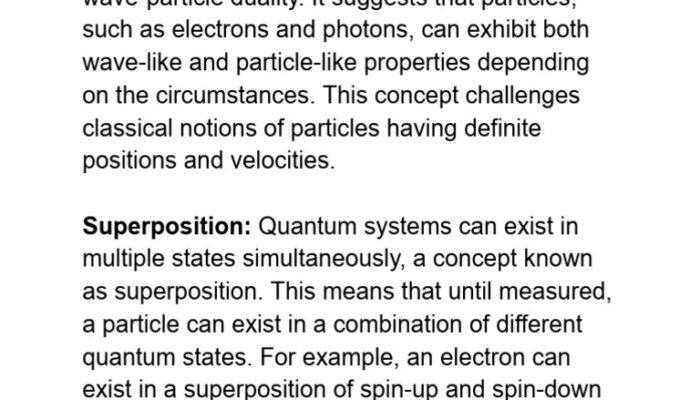
One of the cornerstone concepts in quantum mechanics is wave-particle duality, which describes how entities like light and electrons exhibit both wave-like and particle-like properties depending on the experimental context. For instance, light behaves as a wave in phenomena such as interference and diffraction but also manifests as discrete particles called photons. Similarly, electrons, traditionally considered particles, can display wave characteristics under certain conditions. This duality challenges the classical categorization of matter and energy, prompting deeper philosophical questions about the fundamental nature of reality.
Superposition: Multiple States at Once
The principle of superposition states that a quantum system can simultaneously occupy multiple states until it is measured. For example, an electron may exist in several orbital paths concurrently, only settling into a definite state upon observation. This concept is not merely theoretical; it underpins the operation of quantum computers. Quantum bits, or qubits, exploit superposition to represent and process a vast number of possibilities simultaneously, enabling computations that far exceed the capabilities of classical bits.
Quantum Entanglement: Instantaneous Connections
Entanglement is a remarkable quantum phenomenon where two or more particles become linked such that the state of one instantly influences the state of another, regardless of the distance separating them. Albert Einstein famously described this as “spooky action at a distance.” This interconnectedness defies classical ideas of locality and causality, suggesting that information may be shared instantaneously across space. Entanglement has profound implications for quantum communication and cryptography, as well as our understanding of the fabric of the universe.
The Measurement Problem: Observation and Reality
The measurement problem in quantum mechanics addresses the puzzling question of how and why the act of measurement causes a quantum system to transition from a superposition of states to a single definite outcome. This raises philosophical debates about whether quantum properties exist independently of observation or if measurement itself brings these properties into being. The Copenhagen interpretation, one of the most widely accepted views, holds that quantum mechanics predicts probabilities rather than certainties. Alternative interpretations, such as the Many-Worlds theory, propose that every quantum event spawns multiple branching realities, complicating our understanding of existence.
Mathematical Framework of Quantum Mechanics
Quantum mechanics is mathematically formulated using wave functions and operators within the framework of linear algebra and complex probability amplitudes. The fundamental equation governing quantum systems is the Schrödinger equation:
iħ ∂ψ/∂t = Ĥψ
- ψ (psi): The wave function representing the quantum state of a system.
- i: The imaginary unit.
- ħ (h-bar): Reduced Planck’s constant.
- Ĥ (Hamiltonian operator): Represents the total energy of the system.
- ∂/∂t: Partial derivative with respect to time.
This equation describes how the quantum state evolves over time, encapsulating the probabilistic nature of quantum phenomena.
Applications of Quantum Mechanics in Modern Technology
Quantum mechanics is not confined to theoretical physics; it has catalyzed revolutionary advancements in technology. Quantum cryptography utilizes principles like entanglement and superposition to create communication systems that are virtually impervious to eavesdropping. In materials science, quantum theory guides the design of novel materials with tailored electronic and magnetic properties. Quantum computing, still in its developmental stages, promises to transform industries by solving complex problems in fields such as drug discovery, logistics, and artificial intelligence with unprecedented speed and efficiency.
Philosophical Implications of Quantum Mechanics
The strange and counterintuitive aspects of quantum mechanics have profound philosophical consequences. They challenge classical ideas about determinism, causality, and the nature of reality itself. Philosophers and scientists alike debate the meaning of quantum phenomena, exploring questions about free will, the role of the observer, and the structure of the universe. These discussions continue to influence both scientific inquiry and metaphysical thought, highlighting the deep connection between physics and philosophy.
Common Misunderstandings About Quantum Mechanics
- Misconception: Quantum mechanics implies that particles can be in two places at once in a classical sense.
Correction: Superposition means particles exist in a combination of states described by a wave function, not classical simultaneous locations. - Misconception: Entanglement allows faster-than-light communication.
Correction: While entangled particles exhibit correlated states instantaneously, this cannot be used to transmit information faster than light.
Significance of Quantum Mechanics
Quantum mechanics is foundational to modern science and technology, reshaping our understanding of the universe at its most fundamental level. It provides the theoretical basis for numerous technological innovations and continues to inspire new fields of research. Beyond its practical applications, quantum mechanics challenges and expands our philosophical perspectives on reality, knowledge, and existence, making it a pivotal area of study in both science and human thought.
FAQ
What is quantum mechanics?
Quantum mechanics is a branch of physics that deals with the behavior of matter and energy at atomic and subatomic levels.
What is superposition?
Superposition is a principle stating that a quantum system can exist in multiple states simultaneously until measured.
What is entanglement?
Entanglement is a phenomenon where particles become interconnected, such that the state of one instantly influences the state of another, regardless of distance.




Leave a Reply