
Short Answer
Definition of Quantum Computing
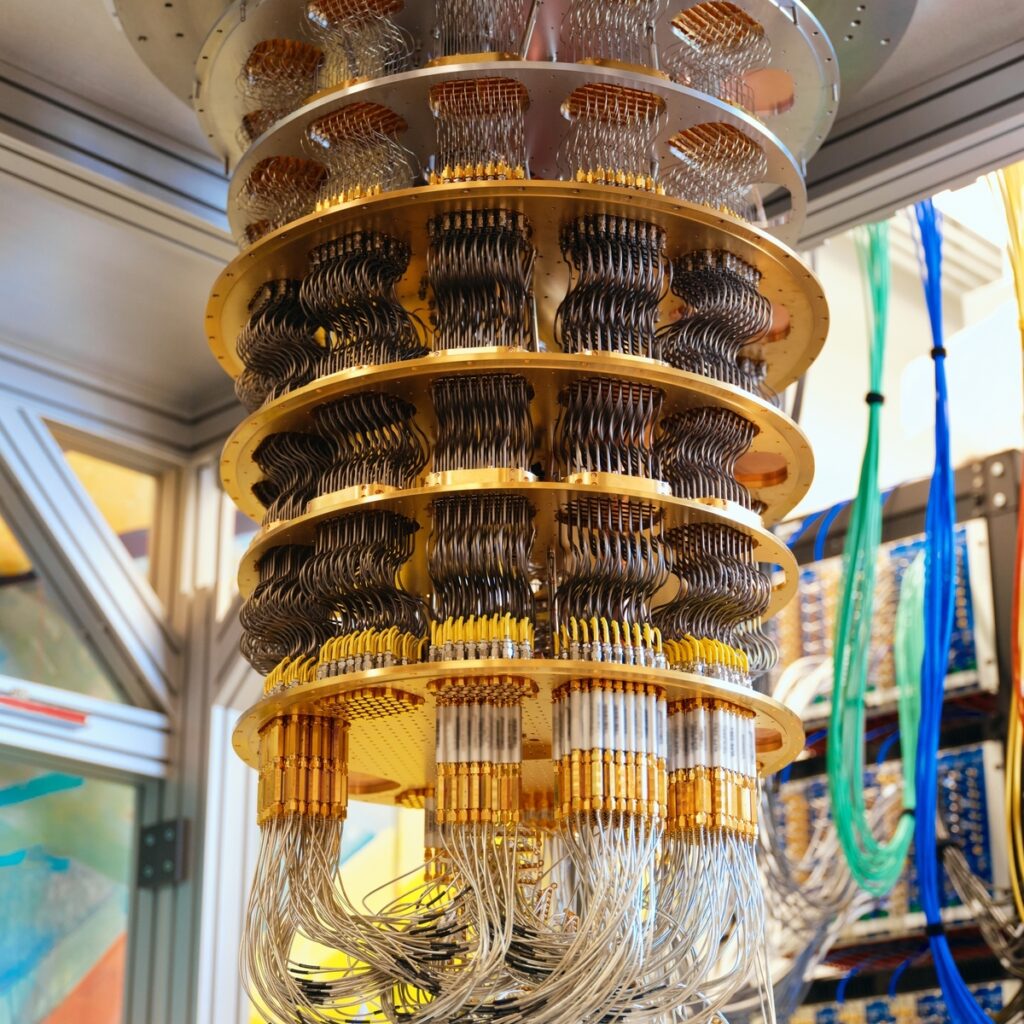
Quantum computing is an innovative computational approach that harnesses the principles of quantum mechanics to process information in ways fundamentally distinct from classical computing. By utilizing quantum phenomena such as superposition and entanglement, quantum computers can perform complex calculations more efficiently, potentially transforming various scientific and technological fields.
Fundamental Concepts of Quantum Computing
At the heart of quantum computing lies the quantum bit, or qubit, which differs significantly from the classical bit. While classical bits exist strictly as 0 or 1, qubits can simultaneously occupy multiple states due to superposition. Additionally, entanglement links qubits in such a way that the state of one instantly influences another, regardless of the distance between them. These unique properties enable quantum computers to process information in parallel and solve problems that are intractable for classical machines.
- Superposition:
A qubit’s ability to be in multiple states at once, allowing quantum systems to explore many possibilities simultaneously. - Entanglement:
A quantum correlation between qubits that creates instantaneous connections, facilitating complex computations and communication protocols.
Architectural Models of Quantum Computers
Quantum computers are built upon various architectures, each tailored to specific computational needs. The three primary models include gate-based quantum computers, quantum annealers, and topological quantum computers, each employing distinct mechanisms to manipulate qubits and perform calculations.
Gate-Based Quantum Computers
This model mirrors classical computing structures but replaces traditional logic gates with quantum gates. Quantum gates perform unitary transformations on qubits, preserving their quantum states while enabling the execution of sophisticated algorithms. Notable examples include Shor’s algorithm for integer factorization and Grover’s algorithm for database searching, both demonstrating quantum advantage over classical counterparts.
Quantum Annealers
Quantum annealers specialize in optimization problems by seeking the system’s lowest energy configuration. Through a process called quantum annealing, qubits start in a superposition of all possible states and gradually evolve toward the ground state, revealing optimal or near-optimal solutions. Although less versatile than gate-based systems, quantum annealers excel in specific applications such as combinatorial optimization and certain machine learning tasks.
Topological Quantum Computers
Topological quantum computing is an emerging approach that leverages exotic particles known as non-Abelian anyons, which exist in two-dimensional spaces. By manipulating these anyons through braiding operations, this architecture aims to enhance fault tolerance and reduce susceptibility to environmental noise, addressing one of the major challenges in quantum error correction and stability.
Mechanisms Behind Quantum Computation
Quantum computers operate through the principle of quantum parallelism, which allows them to evaluate numerous possibilities simultaneously. For instance, a system with n qubits can theoretically process 2n states at once, an exponential increase compared to classical bits. This capability underpins the concept of quantum supremacy, where quantum devices outperform classical computers in specific computational tasks.
Mathematical Foundations and Quantum Algorithms
Quantum operations are mathematically represented by unitary matrices acting on qubit state vectors. The general state of a qubit can be expressed as:
|ψ⟩ = α|0⟩ + β|1⟩, where α and β are complex probability amplitudes satisfying |α|² + |β|² = 1.
Quantum gates correspond to unitary transformations U such that:
|ψ’⟩ = U|ψ⟩, preserving the norm of the state vector.
Algorithms like Shor’s and Grover’s exploit these transformations to achieve exponential speedups in factoring and searching problems, respectively.
Applications of Quantum Computing
Cryptography and Security
Quantum computers pose both challenges and solutions in the field of cryptography. They threaten classical encryption schemes by efficiently factoring large numbers, potentially compromising data security. Conversely, quantum key distribution (QKD) leverages entanglement to enable theoretically unbreakable communication channels, heralding a new era of secure information exchange.
Material Science and Drug Discovery
Quantum simulations allow researchers to model molecular interactions with unprecedented accuracy, surpassing the capabilities of classical computers. This facilitates the design of novel materials and pharmaceuticals by providing insights into complex quantum systems, accelerating innovation in these domains.
Artificial Intelligence and Machine Learning
Quantum computing can enhance AI and ML by improving data processing speeds and pattern recognition efficiency. Quantum algorithms can tackle large datasets more effectively, potentially revolutionizing how machine learning models are trained and applied.
Challenges in Quantum Computing Development
Despite its promise, quantum computing faces significant obstacles. Decoherence, the loss of quantum information due to environmental interference, remains a critical issue. Additionally, high error rates necessitate sophisticated error correction techniques, which increase the complexity and resource demands of quantum circuits.
Future Prospects and Interdisciplinary Collaboration
Advancements in quantum computing depend on the collaborative efforts of physicists, computer scientists, and engineers. Progress in qubit fabrication, coherence time extension, and error correction methods will be pivotal in transitioning quantum technology from experimental setups to practical applications, unlocking new computational capabilities.
Significance of Quantum Computing
Quantum computing represents a transformative leap in computational power, with the potential to revolutionize science, technology, and everyday life. By exploiting the unique properties of qubits, it promises breakthroughs in cryptography, materials science, artificial intelligence, and beyond, offering profound insights into the nature of the universe and expanding human technological horizons.
FAQ
What is a quantum computer?
A quantum computer is a device that uses quantum bits (qubits) and quantum mechanics principles to perform computations faster than classical computers for certain tasks.
How does superposition enhance quantum computing?
Superposition allows a qubit to exist in multiple states simultaneously, enabling quantum computers to process many possibilities at once.
What is quantum annealing used for?
Quantum annealing is used for solving optimization problems by finding the lowest energy state of a system.
Why is error correction important in quantum computing?
Quantum systems are prone to errors due to decoherence and noise, so error correction is essential to maintain reliable computations.
Can quantum computers break current encryption?
Yes, quantum computers have the potential to break many classical encryption methods but also enable new secure communication protocols like quantum key distribution.






Leave a Reply