
Short Answer
Definition of Dark Energy
Dark energy is a mysterious and invisible form of energy that permeates all of space, driving the accelerated expansion of the universe. It is distinct from ordinary matter and dark matter, representing a dominant component of the cosmos whose exact nature remains elusive. Dark energy is thought to exert a repulsive gravitational effect, counteracting the attractive force of gravity and causing galaxies to move away from each other at an increasing rate.
Composition of the Universe
The universe’s total energy content is divided primarily into three categories:
- Ordinary Matter:
This includes all visible objects such as stars, planets, and interstellar gas, making up about 5% of the universe. - Dark Matter:
An invisible form of matter that interacts gravitationally but not electromagnetically, accounting for roughly 27% of the cosmic inventory. - Dark Energy:
Constituting approximately 68-70% of the universe, this enigmatic energy drives the accelerated expansion of space.
Evidence Supporting Dark Energy
Multiple lines of observational data underpin the existence of dark energy. Key evidence includes:
- Supernovae Observations:
Measurements of distant Type Ia supernovae reveal that the universe’s expansion is accelerating rather than slowing down. - Cosmic Microwave Background (CMB):
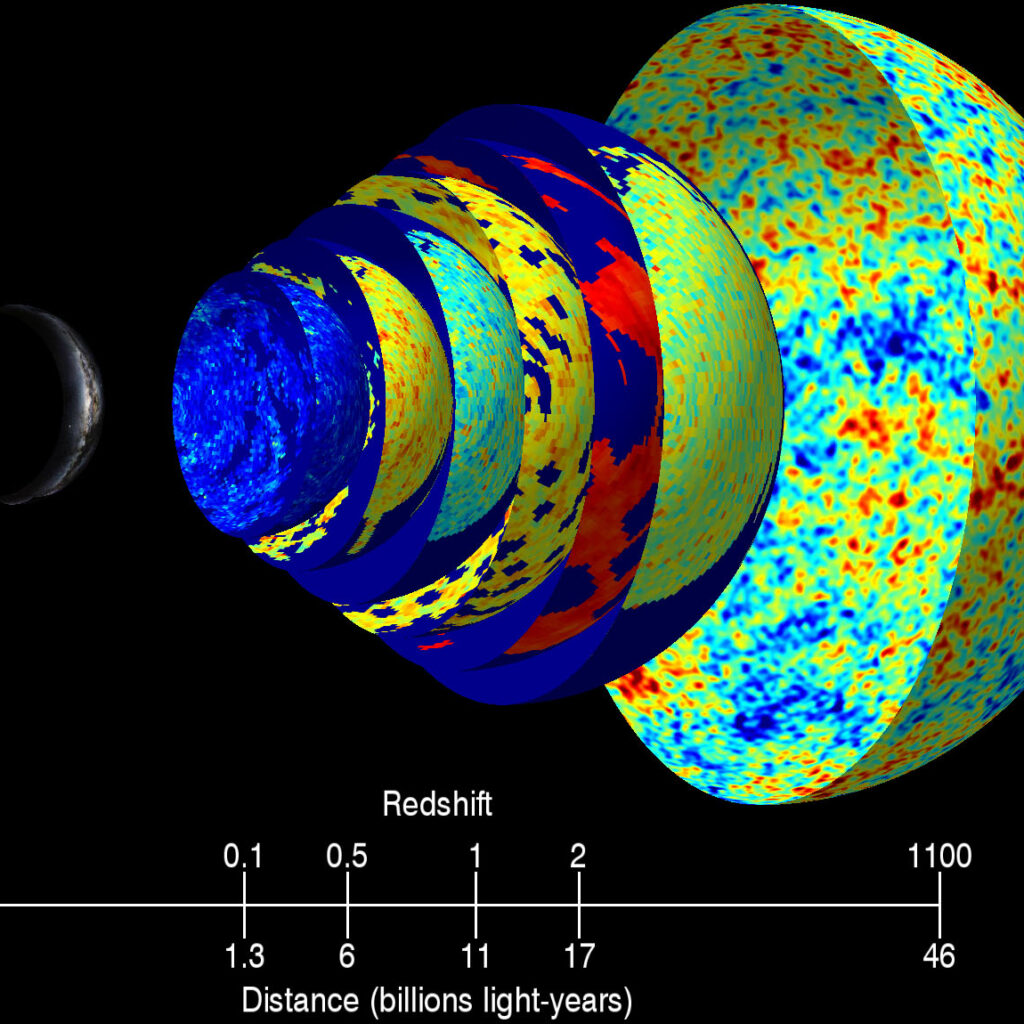
Precise mapping of the CMB radiation provides insights into the universe’s composition and supports the presence of dark energy. - Large-Scale Structure:
The distribution and clustering of galaxies align with models that incorporate dark energy’s influence on cosmic expansion.
These observations collectively indicate a near-certain probability (99.996%) that dark energy exists and dominates the universe’s energy budget.
Characteristics and Behavior of Dark Energy
Unlike matter and dark matter, which tend to cluster due to gravitational attraction, dark energy is remarkably uniform throughout space. This homogeneity means it does not form structures but instead exerts a consistent repulsive force that accelerates the expansion of the cosmos. This phenomenon challenges previous assumptions that cosmic expansion should be decelerating under gravity’s pull.
Measuring Dark Energy
The quantification of dark energy relies heavily on understanding the universe’s expansion rate, expressed by the Hubble constant. Scientists use “standard candles” such as Type Ia supernovae to measure cosmic distances accurately. By analyzing how the expansion rate changes over time, researchers infer the density and properties of dark energy. This approach combines observational data with theoretical models to estimate that dark energy comprises about 70% of the total energy density in the universe.
Theoretical Models Explaining Dark Energy
Several hypotheses attempt to describe the nature of dark energy:
- Cosmological Constant (Λ):
Proposed by Einstein, this model treats dark energy as a constant energy density inherent to the fabric of space itself. - Quintessence:
A dynamic field that varies over time and space, offering a more flexible explanation than a fixed cosmological constant. - Other Exotic Theories:
These include modifications to gravity or new fundamental fields, though none have yet been conclusively validated by observations.
Despite numerous proposals, the true essence of dark energy remains one of the most profound puzzles in modern physics.
Implications for the Universe’s Fate
Dark energy’s dominance shapes the ultimate destiny of the cosmos. If its repulsive effect continues unabated, the universe may expand forever, leading to a “Big Freeze” scenario where galaxies drift apart, stars burn out, and the cosmos becomes cold and dark. Alternatively, if dark energy evolves or changes its properties, it could trigger different cosmic outcomes, including potential contraction or other exotic fates. Understanding dark energy is therefore crucial to predicting the long-term evolution of the universe.
Philosophical and Scientific Questions
The overwhelming prevalence of dark energy raises deep questions:
- Why is dark energy so dominant?
Its abundance surpasses all visible and invisible matter combined, prompting inquiries into whether this is a mere coincidence or indicative of fundamental cosmic principles. - What does dark energy reveal about the universe’s origin and structure?
Exploring dark energy intersects with metaphysical considerations and challenges our understanding of the cosmos at the most fundamental level.
Future Prospects in Dark Energy Research
Advancements in technology promise to refine our knowledge of dark energy. Upcoming telescopes and space missions aim to improve measurements of cosmic expansion and detect subtle phenomena such as gravitational waves. These efforts may uncover new properties of dark energy or even revolutionize our understanding of physics by bridging gravity and quantum mechanics. The pursuit to decode dark energy remains a dynamic and evolving frontier in astrophysics.
Summary
Dark energy constitutes approximately 68-70% of the universe’s total energy, driving its accelerated expansion with profound implications for cosmology. While its existence is strongly supported by observational evidence, its fundamental nature continues to elude scientists. The ongoing quest to measure and comprehend dark energy not only seeks to quantify this invisible force but also to unravel the deeper workings of the universe, enriching our grasp of the cosmic tapestry in which humanity resides.
FAQ
What is dark energy?
Dark energy is a mysterious form of energy that makes up about 68-70% of the universe and is responsible for its accelerated expansion.
How do scientists measure dark energy?
Scientists measure dark energy by observing cosmic expansion using ‘standard candles’ like Type Ia supernovae and analyzing the changes over time.
What are the theoretical models explaining dark energy?
The main models include the Cosmological Constant, Quintessence, and other exotic theories that explore modifications to gravity.
What are the implications of dark energy for the universe's fate?
Dark energy’s effects could lead to various outcomes, including a perpetual expansion of the universe or other exotic scenarios in its evolution.



Leave a Reply