
Short Answer
Understanding Atoms and Molecules
In the microscopic domain, a fundamental inquiry arises: how much larger is a molecule compared to an atom? This question captivates both scientific enthusiasts and learners of chemistry and physics alike. To appreciate the differences in size and complexity, it is essential to first understand what atoms and molecules are, their structures, and their roles in matter.
Definition of Atoms
Atoms are the fundamental units of matter, often described as the building blocks of everything around us. Each atom consists of three primary subatomic particles:
- Protons:
Positively charged particles located in the nucleus. - Neutrons:
Neutral particles also found in the nucleus, contributing to atomic mass. - Electrons:
Negatively charged particles orbiting the nucleus within electron clouds.
The size of an atom varies depending on its atomic number and electron configuration, typically ranging from 30 to 300 picometers (pm) in diameter. This scale is far beyond the reach of the naked eye, emphasizing the atom’s incredibly small dimensions.
Definition of Molecules
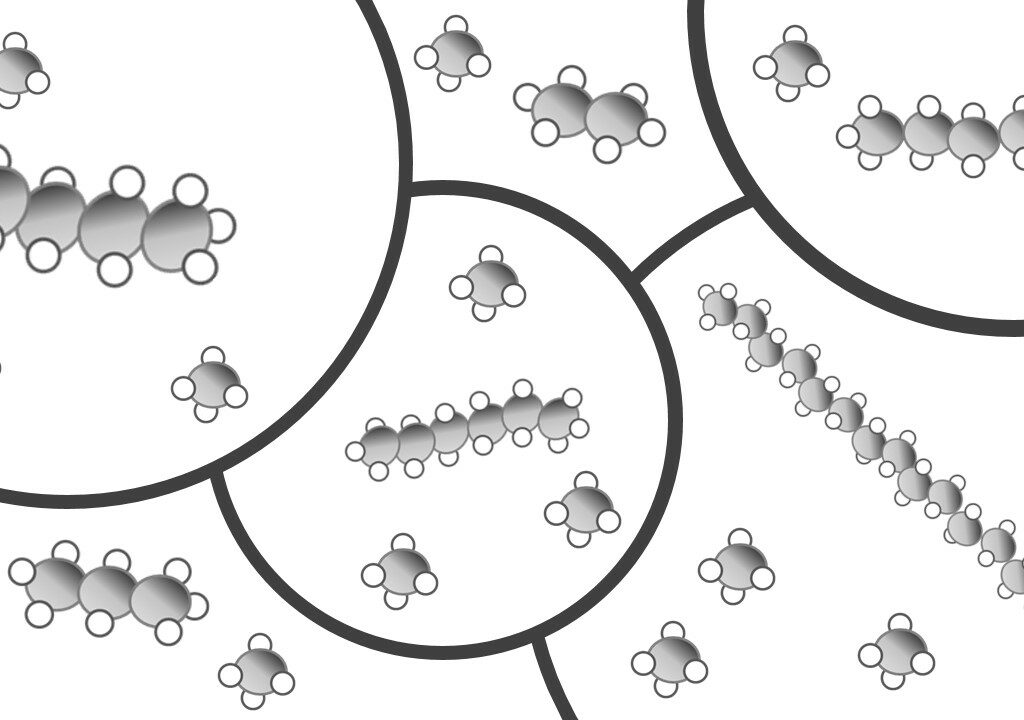
Molecules are assemblies of two or more atoms bonded together through covalent bonds, forming distinct chemical entities with unique properties. These structures can be as simple as diatomic molecules, such as hydrogen (H2), or as complex as large biomolecules like proteins and synthetic polymers. The size of molecules varies widely, from a few angstroms (Å) to several nanometers (nm), depending on the number and arrangement of atoms involved.
Size Comparison Between Atoms and Molecules
Given that atoms measure between 30 and 300 picometers, how does this translate to molecular dimensions? Small molecules generally span a few angstroms (1 Å = 0.1 nm), while larger molecules, such as proteins or polymers, can extend into the nanometer range. For example:
- Water molecule (H2O):
Approximately 0.275 nanometers (2.75 Å) in size. - Protein molecules:
Typically range from 1 to 10 nanometers or more.
This illustrates that molecules can be exponentially larger than individual atoms, especially in biological and synthetic chemistry contexts.
Structural Complexity and Dimensionality of Molecules
Molecules are composed of atoms arranged with precise spatial relationships, influenced by the types of chemical bonds and atomic distances. The overall molecular size depends on the sum of atomic sizes and the bond lengths between them. This structural complexity allows molecules to adopt a vast array of shapes and sizes, which in turn affects their chemical properties such as polarity, reactivity, and physical state.
Examples Illustrating Size Differences
To better understand the scale difference, consider the following examples:
- Carbon dioxide (CO2):
A small molecule made of three atoms (one carbon and two oxygen atoms) with a size around 0.33 nanometers. - Polyethylene:
A synthetic polymer consisting of thousands of repeating ethylene units, which can reach lengths exceeding 100 nanometers.
These examples highlight the vast range of molecular sizes, from simple triatomic molecules to extensive polymer chains.
Scientific Significance of Atomic and Molecular Sizes
Understanding the size differences between atoms and molecules is crucial in various scientific fields. Atoms form the basis of elemental structure and govern atomic interactions, while molecules provide the framework for complex chemical reactions, material properties, and biological functions. The molecular scale enables innovations in drug design, material science, and nanotechnology, demonstrating the practical importance of these size distinctions.
Common Misconceptions About Atomic and Molecular Sizes
Molecules are only slightly larger than atoms.
Molecules can be many times larger than atoms, especially in the case of macromolecules and polymers.
All molecules have similar sizes.
Molecular sizes vary widely, from tiny diatomic molecules to enormous biomolecules and synthetic polymers.
Conclusion: The Scale of the Microscopic World
While atoms are minuscule entities measured in picometers, their molecular counterparts can expand into nanometer-scale structures and beyond. This dramatic difference in size reflects the intricate principles of chemistry, where atomic interactions give rise to the diverse and complex molecular world. Exploring these size relationships opens a window into the fundamental fabric of the universe, revealing the elegance and complexity hidden within the microscopic realm.
FAQ
What are atoms?
Atoms are the fundamental units of matter, consisting of protons, neutrons, and electrons.
What are molecules?
Molecules are groups of two or more atoms bonded together, forming distinct chemical entities.





Leave a Reply