
Short Answer
Definition of Protons and Neutrons
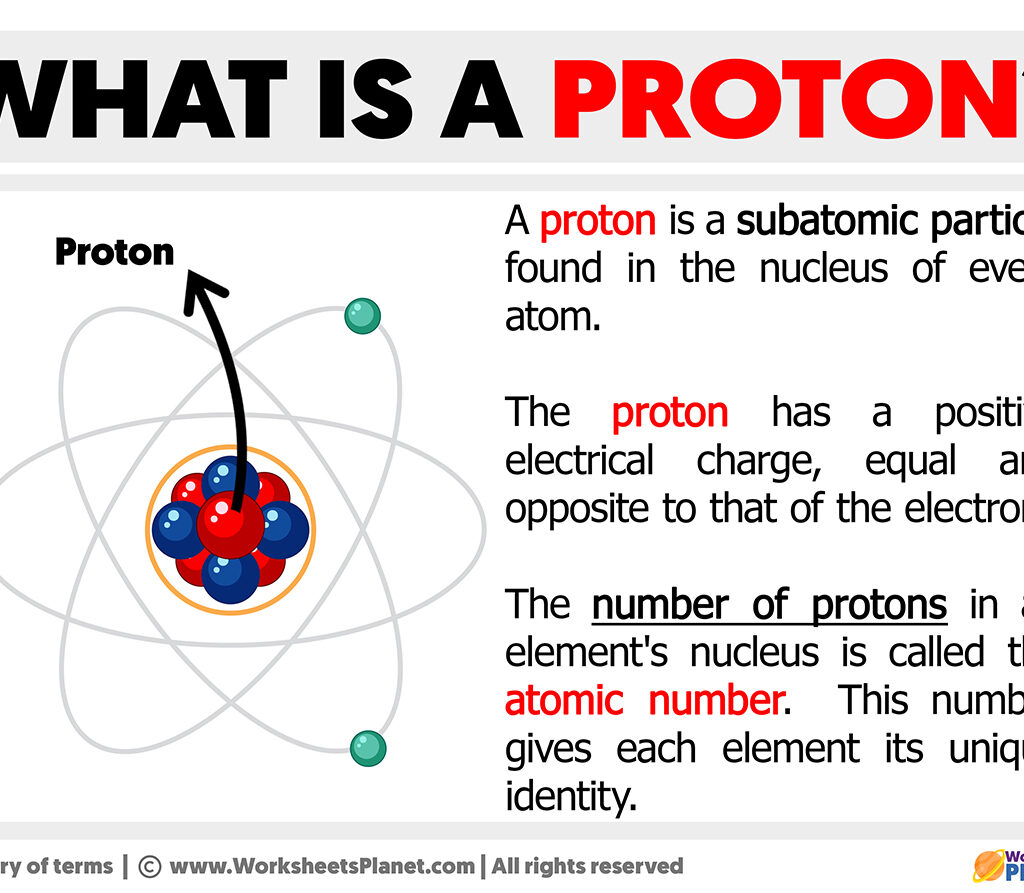
Protons and neutrons are subatomic particles that form the core components of an atom’s nucleus. Collectively known as nucleons, these particles are essential to the structure and stability of matter. While protons carry a positive electric charge, neutrons are electrically neutral. Despite this difference, they share many fundamental properties and play complementary roles within the atomic nucleus.
- Proton:
A positively charged particle found in the nucleus, determining the atomic number and identity of an element. - Neutron:
A neutral particle residing alongside protons in the nucleus, influencing isotopic variation and nuclear stability.
Composition and Fundamental Structure
Both protons and neutrons belong to a class of particles called baryons, which are composite particles made up of quarks. These quarks are elementary particles bound together by the strong nuclear force, mediated by gluons. The difference in quark composition between protons and neutrons accounts for their distinct charges and slight mass variations.
- Proton Composition:
Consists of two up quarks and one down quark (uud). - Neutron Composition:
Composed of one up quark and two down quarks (udd).
This subtle difference in quark arrangement results in the proton’s positive charge and the neutron’s neutrality, while their overall structure remains fundamentally similar.
Mass and Spin Characteristics
Protons and neutrons have comparable masses, with the neutron being marginally heavier. The proton’s mass is approximately 938.3 MeV/c², whereas the neutron’s mass is about 939.6 MeV/c². Although this difference is slight, it has significant implications in nuclear processes such as beta decay.
Both particles possess a spin quantum number of ½, classifying them as fermions. This spin property influences how they interact and arrange themselves within the nucleus, adhering to the Pauli exclusion principle which governs the behavior of fermions.
Role in Nuclear Forces and Stability
The strong nuclear force is the fundamental interaction that binds protons and neutrons together within the nucleus. This force is extremely powerful but acts only over very short distances, effectively overcoming the electromagnetic repulsion between positively charged protons. The interplay of protons and neutrons under this force ensures the cohesion and stability of atomic nuclei.
Due to their similar masses and spins, protons and neutrons often behave interchangeably in nuclear interactions, which is why they are collectively referred to as nucleons. Their combined presence and interaction are crucial for maintaining the integrity of atoms across the periodic table.
Electrical Charge and Its Implications
The primary distinction between protons and neutrons lies in their electric charge. Protons carry a positive charge, which directly affects the electromagnetic interactions with electrons surrounding the nucleus. This interaction defines the chemical properties of elements and their behavior in chemical reactions.
Neutrons, being electrically neutral, play a vital role in moderating the forces within the nucleus. They help reduce the repulsive forces between protons, contributing to the overall balance of nuclear forces and enhancing nuclear stability.
Isotopes and Atomic Identity
The number of protons in an atom’s nucleus determines its elemental identity, while variations in neutron count give rise to isotopes. Isotopes are atoms of the same element that differ in neutron number, leading to differences in nuclear stability and physical properties.
This variability in neutron number, alongside a constant proton count, highlights the adaptability of atomic nuclei and the versatile roles that protons and neutrons play in defining atomic behavior and characteristics.
Significance in Astrophysics and Quantum Mechanics
The similarities and differences between protons and neutrons have far-reaching consequences beyond atomic structure. In astrophysics, nuclear fusion processes within stars depend on the interactions between these particles, where the balance of forces governs energy production and elemental synthesis.
In quantum mechanics, the decay of unstable isotopes-often involving transformations between protons and neutrons-illustrates the dynamic nature of subatomic particles. These decay processes emit radiation, which has practical applications in medicine, energy generation, and materials science.
Common Misconceptions
Protons and neutrons are elementary particles.
Both are composite particles made of quarks, not fundamental particles themselves.
Neutrons have no effect on atomic properties.
Neutrons influence nuclear stability and isotopic characteristics, which affect atomic behavior and reactions.
Why Understanding Protons and Neutrons Is Important
Grasping the nature of protons and neutrons is essential for comprehending the fundamental principles of matter and the universe. Their complementary roles underpin atomic structure, chemical properties, and nuclear phenomena. This knowledge is foundational in fields ranging from chemistry and physics to astrophysics and applied sciences, enabling advancements in technology, medicine, and energy.
By studying the nuanced relationship between these nucleons, scientists gain insight into the forces that govern the subatomic world, fostering a deeper appreciation of the intricate balance that sustains the material universe.
FAQ
What makes protons and neutrons similar?
Both are baryons composed of quarks, have nearly the same mass and spin, and are bound together in atomic nuclei by the strong nuclear force.
How do protons and neutrons differ?
Protons have a positive electric charge, while neutrons are electrically neutral, and they differ in their quark composition.
Why is the neutron important in the nucleus?
Neutrons help stabilize the nucleus by reducing repulsive forces between protons and contribute to isotopic variation.
How do protons and neutrons affect element identity?
The number of protons defines the element, while the number of neutrons determines its isotope, affecting nuclear stability and behavior.





Leave a Reply