
Short Answer
Definition of Dark Stars
Dark stars represent a theoretical category of stellar objects proposed within astrophysics as an alternative to traditional stars powered by nuclear fusion. Unlike typical stars that shine due to hydrogen fusion in their cores, dark stars are hypothesized to derive their energy primarily from the annihilation of dark matter particles. These enigmatic entities are thought to have existed in the early universe, potentially altering our understanding of the formation and evolution of the first luminous bodies.
- Dark Matter Annihilation:
The process by which dark matter particles collide and annihilate, releasing energy that could sustain a star-like object. - Baryonic Matter:
Ordinary matter composed of protons, neutrons, and electrons, which forms stars, planets, and living beings.
Origins and Theoretical Background
The concept of dark stars emerges from the interaction between baryonic matter and dark matter in the primordial universe. During the early stages of cosmic evolution, dense clouds of gas began collapsing under gravity to form the first stars. In regions where dark matter was highly concentrated, its particles might have accumulated within these gas clouds. The energy released from dark matter annihilation could have provided an alternative power source, delaying or modifying the onset of nuclear fusion and giving rise to stars sustained by this exotic mechanism.
James Webb Space Telescope’s Role in Detecting Dark Stars
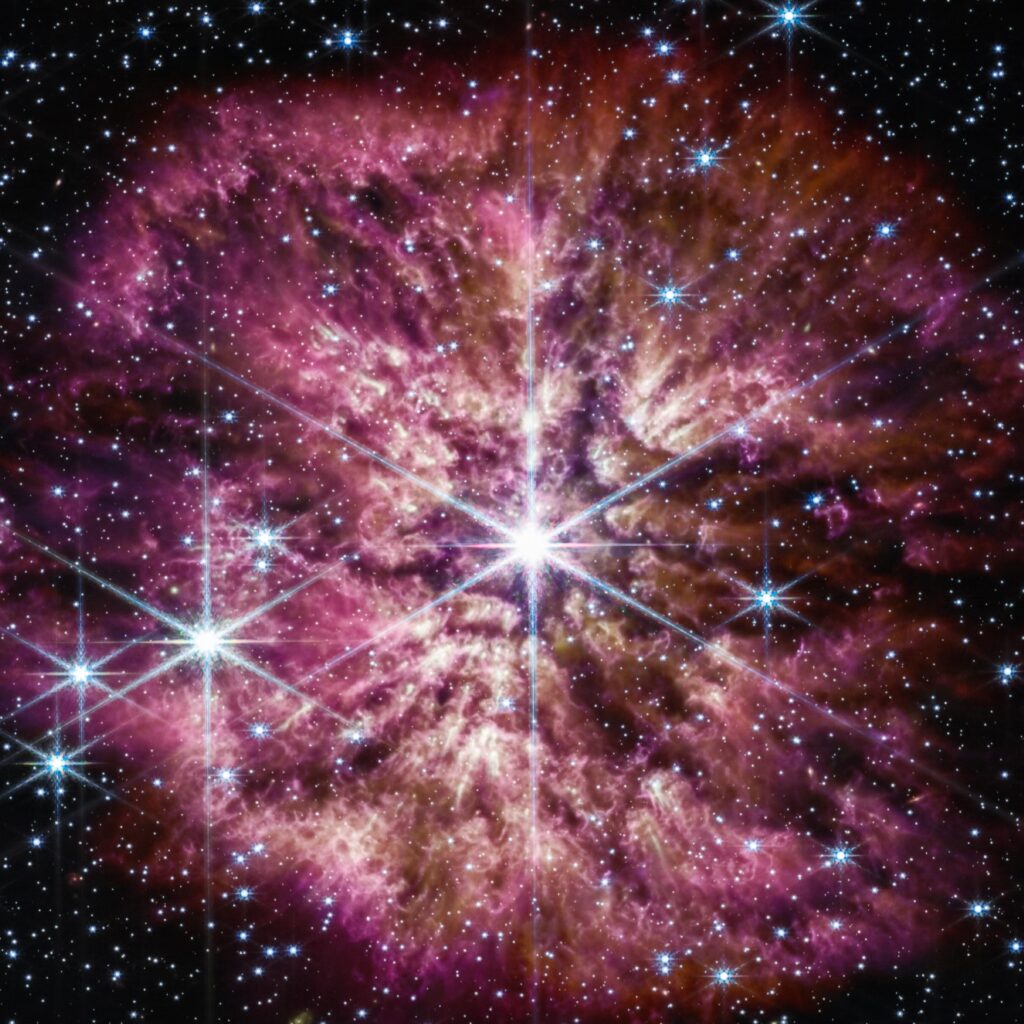
The James Webb Space Telescope (JWST) is uniquely equipped to explore the early universe and potentially identify dark stars. Its advanced infrared capabilities allow it to observe wavelengths beyond the reach of previous telescopes, penetrating cosmic dust and revealing faint, distant objects. Dark stars are predicted to be large, relatively cool, and extremely luminous in the infrared spectrum, yet faint or invisible in visible light. JWST’s sensitivity to mid-infrared light makes it an ideal instrument to detect such characteristics, offering a new window into these elusive cosmic phenomena.
Challenges in Identifying Dark Stars
Distinguishing dark stars from other astrophysical objects presents significant difficulties. Their observational signatures may resemble those of supermassive early galaxies or bright, metal-poor protostars. Accurate identification requires detailed spectral analysis, focusing on unique absorption features or unusual line ratios in the infrared spectrum that could indicate dark matter interactions. However, the complexity of early universe conditions, combined with effects like cosmic dust obscuration and gravitational lensing, complicates the interpretation of JWST data, necessitating cautious and rigorous analysis.
Scientific Significance and Cosmological Implications
Confirming the existence of dark stars would have profound implications for both astrophysics and particle physics. These objects could serve as natural laboratories to investigate the properties of dark matter, including particle mass, annihilation cross-section, and spatial distribution during the universe’s infancy. Understanding dark stars would deepen our knowledge of the fundamental forces shaping cosmic structure and the role of dark matter in star formation, potentially bridging gaps between microscopic particle behavior and large-scale cosmic phenomena.
Common Misconceptions About Dark Stars
Dark stars are simply black holes or dark nebulae.
Dark stars are theorized to be powered by dark matter annihilation, distinct from black holes which are collapsed stellar remnants, and from dark nebulae which are clouds of gas and dust.
Dark stars emit no light at all.
While dark stars may be faint or invisible in visible light, they are expected to be luminous in the infrared spectrum due to their large size and energy source.
Future Prospects and Observational Strategies
The potential discovery of dark stars through JWST data marks an exciting frontier in astronomy. Validating their existence would challenge existing models of star formation and dark matter behavior, prompting new theoretical and observational efforts. Future investigations may involve follow-up observations with next-generation ground-based telescopes equipped with enhanced sensitivity and resolution, aiming to confirm dark star candidates and further explore their properties.
Conclusion: The Quest to Unveil Cosmic Mysteries
The intriguing possibility that JWST has detected dark stars stimulates a reevaluation of both observational techniques and theoretical frameworks in astrophysics. This pursuit exemplifies the dynamic nature of scientific inquiry, where unexpected findings inspire deeper exploration and refinement of knowledge. Whether dark stars transition from theoretical constructs to confirmed cosmic entities remains uncertain, but the endeavor enriches our ongoing mission to decode the universe’s earliest chapters and the hidden forces shaping its evolution.
FAQ
What are dark stars?
Dark stars are theoretical stellar objects that derive their energy from dark matter annihilation rather than nuclear fusion.
How does the James Webb Space Telescope help in detecting dark stars?
The JWST can observe in the infrared spectrum, which is crucial for identifying dark stars that are faint or invisible in visible light.



Leave a Reply