
Short Answer
Understanding Dark Matter
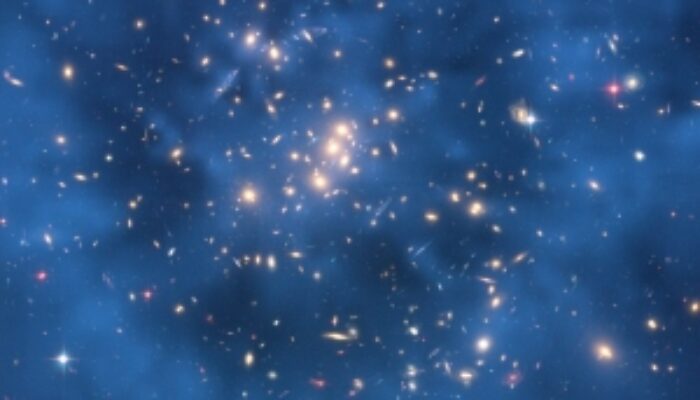
Dark matter is a mysterious component of the universe, accounting for roughly 27% of its total mass-energy content. Unlike ordinary matter, it neither emits nor absorbs light, making it invisible to traditional telescopes and detectors. Its presence is inferred primarily through gravitational effects on visible matter, radiation, and the large-scale structure of the cosmos. Despite decades of research, the fundamental nature of dark matter remains one of the most profound enigmas in modern physics.
Characteristics of Dark Matter
- Non-luminous:
Dark matter does not interact with electromagnetic radiation, rendering it undetectable by conventional optical instruments. - Gravitational influence:
It exerts gravitational forces that affect the motion of stars, galaxies, and galaxy clusters. - Hypothetical particles:
Candidates such as Weakly Interacting Massive Particles (WIMPs) and axions have been proposed but remain unconfirmed.
Exploring Excess Electrons as Clues
Recent scientific investigations have turned attention to the surplus of electrons detected in certain cosmic environments. These excess electrons, often generated during high-energy astrophysical events, may provide a novel window into the interactions between ordinary matter and dark matter. By studying these charged particles, researchers hope to uncover subtle signatures that could reveal the elusive properties of dark matter.
Sources of Excess Electrons
- Cosmic ray collisions:
High-energy cosmic rays interacting with interstellar gas and dust can produce an abundance of energetic electrons. - Supernova remnants:
Explosive stellar events release particles that contribute to electron excesses in their vicinity. - Potential dark matter interactions:
The annihilation or decay of dark matter particles might generate additional electrons, detectable as anomalies in electron flux.
Mechanisms Linking Electrons and Dark Matter
The hypothesis that excess electrons could be byproducts of dark matter processes hinges on the idea that dark matter particles might annihilate or decay, releasing standard particles including electrons. These electrons then propagate through space, potentially observable by advanced detectors. This mechanism challenges traditional astrophysical explanations and suggests a deeper connection between visible and invisible matter.
Empirical Evidence and Observational Techniques
Advanced instruments such as the Fermi Gamma-ray Space Telescope have detected diffuse gamma-ray emissions that may correlate with regions exhibiting electron excesses. These observations, combined with data from particle detectors and cosmic ray studies, provide a multifaceted approach to investigating dark matter signatures.
- Gamma-ray observations:
Gamma rays can result from electron interactions or dark matter annihilation, serving as indirect evidence. - Particle detectors:
Ground-based and spaceborne detectors measure electron fluxes and energy spectra. - Astrophysical modeling:
Simulations help differentiate between electrons from known sources and those potentially linked to dark matter.
Reevaluating Astrophysical Models
Traditional explanations for electron excesses, such as emissions from pulsars or supernovae, often fall short of fully accounting for observed anomalies. This discrepancy invites a reassessment of dark matter distribution and behavior, suggesting it may be more heterogeneous than previously assumed. Integrating electron data with gravitational studies like lensing and galaxy rotation curves could refine our understanding of dark matter’s spatial characteristics.
Implications for Particle Physics and Cosmology
Investigating excess electrons as indicators of dark matter interactions has the potential to revolutionize fundamental physics. Confirming a link could constrain the properties of dark matter candidates and inspire innovative detection strategies. This interdisciplinary endeavor bridges astrophysics, particle physics, and cosmology, fostering new theoretical developments and experimental approaches.
Engaging the Scientific Community and Public
The study of excess electrons not only advances scientific knowledge but also stimulates public interest in cosmic mysteries. By promoting dialogue across disciplines and involving broader audiences, this research enriches our collective understanding of the universe and encourages collaborative exploration of its hidden facets.
Technological Advances Enabling Discovery
Recent progress in particle detection technology, computational simulations, and high-energy astrophysics has made the detailed study of excess electrons feasible. These tools allow researchers to test theoretical models against empirical data with unprecedented precision, accelerating the quest to decode dark matter’s nature.
Conclusion: A New Frontier in Dark Matter Research
The focus on excess electrons as potential dark matter signatures represents a paradigm shift in cosmic research. By challenging established assumptions and embracing innovative methodologies, scientists are poised to unravel the complex interplay between visible and invisible matter. This promising avenue holds the key to deepening our comprehension of the universe’s fundamental structure and the forces shaping it.


Leave a Reply