
Short Answer
Understanding Superfluids
Superfluids represent a fascinating and mysterious state of matter within the realm of quantum mechanics, where conventional physical laws appear to lose their grip. This extraordinary phase occurs when certain fluids, upon cooling below a critical temperature, exhibit the remarkable ability to flow without any viscosity. Far from being a mere scientific curiosity, superfluidity offers profound insights into the quantum nature of matter on a macroscopic scale, challenging and expanding our grasp of physics.
Fundamental Characteristics of Superfluidity
At the heart of superfluid behavior lies two pivotal phenomena: quantum coherence and quantized vortices. Quantum coherence refers to the collective synchronization of particles, which behave as a unified quantum entity described by a single macroscopic wave function. This collective state eliminates the individuality of particles, creating a harmonious system akin to an orchestra producing a symphony greater than the sum of its parts.
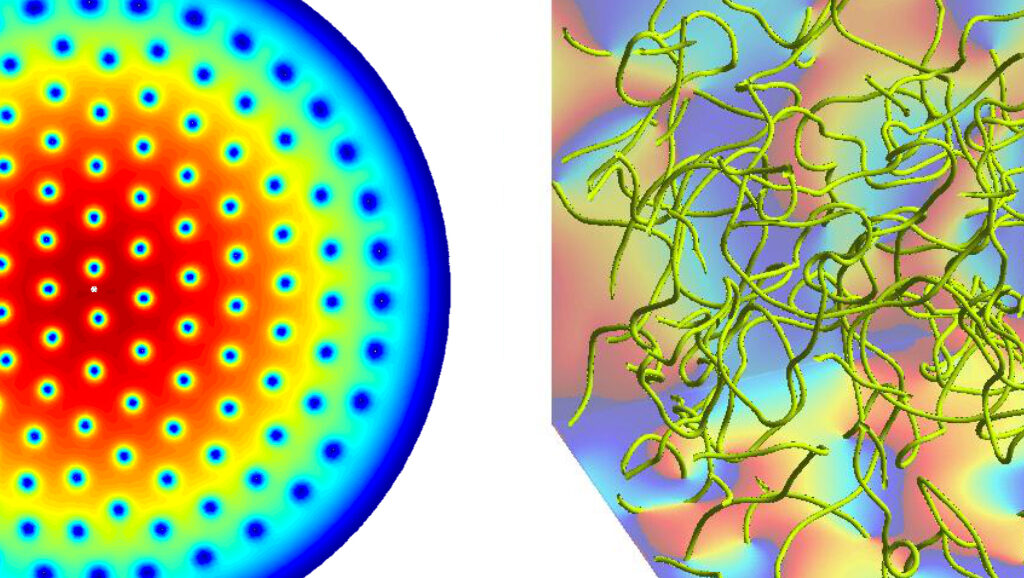
Quantized vortices, on the other hand, are discrete whirlpools that form within the superfluid. Each vortex carries a fixed, quantized amount of angular momentum, embodying an intriguing balance between order and chaos. These vortices flow freely without resistance, illustrating the unique quantum fluid dynamics that distinguish superfluids from classical fluids.
Mechanisms Behind Superfluid Flow
Unlike ordinary fluids, which adhere to the no-slip boundary condition and experience friction when flowing past surfaces, superfluids glide effortlessly, circumventing obstacles with an almost ethereal smoothness. This frictionless flow arises from the absence of viscosity, enabling superfluids to move through microscopic channels and around barriers without energy loss. Such behavior opens up exciting possibilities for technological applications, including ultra-efficient cooling systems and advancements in quantum computing and precision measurement.
Superfluidity in Bose-Einstein Condensates
Experimental breakthroughs in ultra-cold atomic gases, particularly Bose-Einstein Condensates (BECs), have provided a fertile ground for studying superfluidity under controlled conditions. In BECs, atoms are cooled to temperatures near absolute zero, causing them to occupy the same quantum state and act collectively as a single quantum entity. This state serves as a dynamic platform for exploring quantum fluid phenomena and testing theoretical models that were once purely speculative.
Superfluidity in Astrophysics
The intriguing properties of superfluids extend beyond laboratory settings into the cosmos. Neutron stars, the dense remnants of massive stellar explosions, are believed to contain superfluid neutrons and protons within their interiors. This superfluid state influences the star’s rotational dynamics and may play a role in the emission of gravitational waves and the synthesis of heavy elements. The study of superfluidity in such extreme environments bridges the gap between microscopic quantum effects and large-scale astrophysical phenomena.
Varieties of Superfluid Phases
Superfluidity manifests differently depending on the type of fluid and its quantum characteristics. For example, helium-4 exhibits bosonic superfluidity characterized by vortex-like flow patterns, while helium-3 demonstrates fermionic superfluidity, where pairs of fermions form under specific conditions to create a superfluid state. This duality highlights the complex and rich behavior of quantum fluids, inviting ongoing research into how variables such as temperature, density, and external forces influence these phases.
Mathematical Description of Superfluidity
The behavior of superfluids can be described using a macroscopic wave function, often denoted as Ψ(r,t), which encapsulates the quantum state of the fluid. The density of the superfluid is proportional to the square of the wave function’s magnitude, |Ψ|², while the phase of Ψ determines the velocity field of the fluid. The quantization of circulation around vortices is expressed as:
- Quantized circulation formula:
∮ v · dl = (h/m) × n
where v is the velocity of the superfluid, dl is an element along a closed path, h is Planck’s constant, m is the mass of the particle, and n is an integer representing the quantum number of the vortex.
Practical Applications and Technological Implications
The unique frictionless flow of superfluids has inspired a range of innovative applications. In microfluidic devices, superfluid helium can transport fluids without energy loss, enhancing efficiency. Additionally, superfluid cooling systems are employed in advanced scientific instruments requiring ultra-low temperatures. The principles of superfluidity also underpin emerging technologies in quantum computing, where coherent quantum states are essential for qubit stability and error reduction.
Common Misunderstandings About Superfluids
- Misconception: Superfluids are simply very cold liquids.
Correction: While superfluids exist at extremely low temperatures, their defining feature is the ability to flow without viscosity, a quantum mechanical property not found in ordinary cold liquids. - Misconception: Superfluidity violates the laws of physics.
Correction: Superfluidity does not break physical laws but rather reveals quantum mechanical effects that classical physics cannot explain.
Significance of Superfluidity in Science and Beyond
Superfluidity stands as a cornerstone in the study of quantum mechanics, offering a tangible glimpse into the behavior of matter under extreme quantum conditions. Its exploration not only deepens our theoretical understanding but also drives technological innovation and enriches our comprehension of cosmic phenomena. By unraveling the mysteries of superfluids, scientists continue to push the boundaries of knowledge, paving the way for breakthroughs that may redefine our interaction with the quantum world and the universe at large.
FAQ
What is a superfluid?
A superfluid is a phase of matter that flows without viscosity, typically occurring at extremely low temperatures.
How do superfluids differ from ordinary fluids?
Superfluids can flow without friction, unlike ordinary fluids which experience resistance.
What are some applications of superfluidity?
Applications include ultra-efficient cooling systems and advancements in quantum computing.






Leave a Reply