

Short Answer
Definition of Dark Matter and Dark Energy
Dark matter and dark energy are two mysterious components that together make up about 95% of the total mass-energy content of the universe. Despite their dominance, their exact nature remains elusive, making them central subjects in cosmology and fundamental physics.
- Dark Matter:
A form of matter that does not emit, absorb, or reflect light, rendering it invisible to electromagnetic observations. Its presence is inferred from gravitational effects on visible matter, such as the unexpected rotation speeds of galaxies, gravitational lensing phenomena, and fluctuations in the cosmic microwave background radiation. - Dark Energy:
An enigmatic force responsible for the observed accelerated expansion of the universe. Often modeled as a cosmological constant, it represents a repulsive energy density uniformly filling space, counteracting gravitational attraction on cosmic scales.
Theoretical Frameworks Explaining Dark Components
Scientists have developed various theoretical models to describe the properties and behaviors of dark matter and dark energy, each offering unique insights and predictions.
Models of Dark Matter
The Cold Dark Matter (CDM) paradigm is the prevailing model, proposing that dark matter consists of slow-moving particles that cluster gravitationally, enabling the formation of galaxies and large-scale cosmic structures. Particle physics theories suggest candidates such as WIMPs (Weakly Interacting Massive Particles) and axions, which remain undetected but are the focus of extensive experimental searches.
Models of Dark Energy
Dark energy theories are more varied. The simplest approach treats it as a constant energy density permeating space, known as the Cosmological Constant. Alternative hypotheses like Quintessence propose a dynamic scalar field whose energy density changes over time, potentially influencing the universe’s long-term evolution.
Observational Evidence Supporting Dark Matter and Dark Energy
Empirical data underpin the existence of dark matter and dark energy, though their direct detection remains a challenge.
Gravitational Effects of Dark Matter
One of the strongest indicators of dark matter is the observation that stars in galaxies orbit at speeds inconsistent with the visible mass alone. Instead of slowing down at greater distances from the galactic center, stars maintain high velocities, implying the presence of an unseen mass exerting gravitational pull.
Accelerated Expansion and Dark Energy
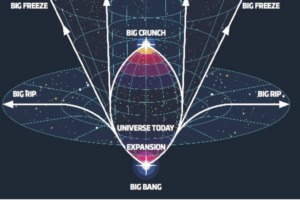
The late 1990s discovery that the universe’s expansion is accelerating revolutionized cosmology. Observations of distant supernovae revealed this unexpected acceleration, necessitating the introduction of dark energy to explain the phenomenon. Further support comes from measurements of the cosmic microwave background by missions like WMAP, which map the universe’s geometry and composition, confirming the significant roles of dark matter and dark energy.
Alternative Hypotheses and Emerging Theories
Beyond mainstream models, several alternative theories attempt to explain cosmic observations without invoking dark matter or dark energy as separate entities.
- Modified Gravity Theories:
Approaches such as Modified Newtonian Dynamics (MOND) suggest that changes to the laws of gravity at galactic scales could account for observed phenomena traditionally attributed to dark matter. While intriguing, these theories often struggle to explain all cosmological data comprehensively. - Quantum Gravity and Emergent Concepts:
Theories like Loop Quantum Gravity and emergent gravity explore the fundamental nature of space-time itself, proposing that dark matter and dark energy might arise from deeper quantum properties of the universe.
Interconnection Between Observations and Theoretical Advances
The synergy between observational astronomy and theoretical physics is vital for progress in understanding dark matter and dark energy. Upcoming missions such as the European Space Agency’s Euclid telescope and NASA’s Wide Field Infrared Survey Telescope (WFIRST) are designed to probe cosmic expansion and structure formation with unprecedented precision. These efforts aim to bridge gaps between data and theory, refining our comprehension of the universe’s dark components.
Challenges and Prospects in Dark Universe Research
Research into dark matter and dark energy faces significant obstacles, including the absence of direct detection and the complexity of competing theoretical models. Progress depends on interdisciplinary collaboration across astrophysics, particle physics, and cosmology, alongside technological advancements in detectors and experimental methods. Future breakthroughs in these areas hold promise for unraveling the fundamental nature of these cosmic mysteries.
Significance of Understanding Dark Matter and Dark Energy
Deciphering the properties of dark matter and dark energy is crucial for a comprehensive understanding of the universe’s origin, structure, and ultimate fate. These components influence galaxy formation, cosmic evolution, and the large-scale geometry of space-time. Insights gained from their study not only deepen our knowledge of fundamental physics but also drive technological innovation and inspire new scientific paradigms.
FAQ
What is dark matter?
Dark matter is a type of matter that does not interact with electromagnetic forces, making it invisible, but its presence is inferred from gravitational effects on visible matter.
Why is dark energy important?
Dark energy is responsible for the accelerated expansion of the universe, making it essential for understanding cosmic evolution.
Leave a Reply