
Short Answer
Definition of Dark Matter and Normal Matter
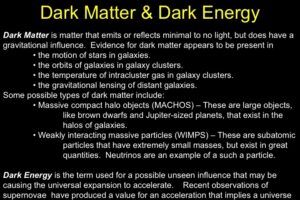
Dark matter is a mysterious form of matter that does not emit, absorb, or reflect light, making it invisible to current electromagnetic detection methods. It constitutes about 27% of the universe’s total mass-energy content and plays a crucial role in shaping cosmic structures. In contrast, normal matter, also known as baryonic matter, consists of atoms forming stars, planets, and living beings. This matter interacts with electromagnetic radiation, which is why it is visible through telescopes and other instruments.
- Normal Matter (Baryonic Matter):
Composed of protons, neutrons, and electrons, it forms all the visible structures in the universe and interacts with light. - Dark Matter:
An invisible substance that exerts gravitational effects but does not interact with electromagnetic forces, making it undetectable by conventional means.
Exploring the Hypothesis: Could Dark Matter Be Hidden Normal Matter?
The idea that dark matter might simply be normal matter concealed from detection has intrigued scientists. This hypothesis suggests that dark matter could be composed of baryonic objects or materials that are difficult to observe, such as faint astrophysical bodies or cold gas clouds. However, extensive research and observations have challenged this notion, indicating that hidden normal matter alone cannot account for all the gravitational effects attributed to dark matter.
Massive Compact Halo Objects (MACHOs)
MACHOs are astrophysical bodies like black holes, neutron stars, brown dwarfs, and rogue planets that reside in the halos of galaxies. These objects emit little or no light, making them difficult to detect directly. Early investigations employed gravitational microlensing, where the gravity of a MACHO bends light from a background star, causing a temporary brightening. Although some MACHOs have been found, their population is insufficient to explain the total dark matter content.
Invisible Gas Clouds and the Interstellar Medium
Another baryonic candidate involves cold, dense clouds of hydrogen or helium gas scattered throughout galactic halos. These clouds might absorb or emit radiation at frequencies that are challenging to detect. Despite advanced surveys across the electromagnetic spectrum, astronomers have not found enough baryonic matter in these forms to explain dark matter’s gravitational influence.
Exotic Baryonic Forms
Speculative forms of baryonic matter, such as quark nuggets or primordial black holes formed in the early universe, have been proposed as potential dark matter candidates. These exotic objects could evade detection due to their small size or weak interactions. While intriguing, confirming their existence remains a significant challenge.
Non-Baryonic Dark Matter Candidates
Beyond baryonic matter, particle physics offers a range of hypothetical particles that could constitute dark matter. These non-baryonic candidates do not interact with electromagnetic forces but influence the universe gravitationally, aligning well with observations.
- Weakly Interacting Massive Particles (WIMPs):
Hypothetical particles that interact via the weak nuclear force and gravity, making them difficult to detect. - Axions:
Extremely light particles proposed to solve certain problems in quantum chromodynamics, potentially contributing to dark matter. - Sterile Neutrinos:
Hypothetical neutrinos that do not interact via the standard weak force, making them elusive dark matter candidates.
Cosmological Constraints on Baryonic Matter
Observations of the cosmic microwave background (CMB), baryon acoustic oscillations, and primordial nucleosynthesis impose strict limits on the amount of baryonic matter in the universe. These measurements indicate that baryons make up only a small fraction of the total matter, insufficient to explain the gravitational effects attributed to dark matter. This evidence strongly supports the existence of non-baryonic dark matter.
Evidence from Galactic Rotation Curves
One of the most compelling indicators of dark matter’s presence is the rotation speed of stars in galaxies. Stars orbiting far from galactic centers move faster than can be accounted for by visible matter alone, implying a significant amount of unseen mass extending beyond the luminous regions. The discrepancy between observed rotation curves and predictions based on visible matter cannot be reconciled by hidden baryonic matter alone, reinforcing the need for non-baryonic dark matter.
Challenges and Limitations in Detecting Hidden Normal Matter
Despite the constraints, the possibility remains that some forms of normal matter could be extremely difficult to detect. Ultra-dense or ultra-cold gas clouds, or large populations of substellar objects, might evade current observational techniques. However, ongoing multi-wavelength surveys continue to narrow these possibilities, making it increasingly unlikely that hidden baryonic matter accounts for the majority of dark matter.
Advances in Simulations and Astrophysical Modeling
Modern computational models simulate how hidden baryonic matter might behave gravitationally and interact with visible matter. These simulations explore phenomena such as subtle gravitational lensing effects and star formation dynamics in dense regions. While these studies confirm that baryonic matter cannot fully explain dark matter, they enhance our understanding of the complex interplay between visible and invisible components in the cosmos.
Why Understanding Dark Matter’s Nature Is Crucial
Determining whether dark matter is hidden normal matter or something fundamentally different is vital for advancing astrophysics and cosmology. This knowledge influences our comprehension of galaxy formation, cosmic evolution, and the fundamental laws governing the universe. The ongoing quest to identify dark matter drives technological innovation, refines theoretical models, and deepens humanity’s grasp of the cosmos.
Common Misconceptions About Dark Matter
Dark matter is just ordinary matter that we cannot see.
Observational evidence and cosmological measurements limit the amount of baryonic matter, indicating that dark matter must include non-baryonic components.
MACHOs can fully explain dark matter.
While MACHOs contribute to some dark matter, their numbers are insufficient to account for all gravitational effects observed.
Conclusion: The Ongoing Mystery of Dark Matter
The question of whether dark matter is hidden normal matter remains a stimulating scientific inquiry. Although current evidence favors non-baryonic particles as the primary constituents, exploring baryonic possibilities has sharpened experimental techniques and theoretical insights. As observational capabilities and theoretical frameworks evolve, the true nature of dark matter may eventually be unveiled, revealing profound secrets about the universe’s composition and history.

Leave a Reply