
Short Answer
Definition of Cosmic Waves and Cosmic Rays
Cosmic waves and cosmic rays are two distinct phenomena originating from the vast expanse of the universe. Although both terms share the prefix “cosmic” and relate to extraterrestrial events, they differ fundamentally in their composition, sources, and effects. Gaining a clear understanding of these phenomena enhances our knowledge of astrophysics and reveals the intricate interactions between celestial bodies and Earth.
Understanding Cosmic Waves
Cosmic waves refer to electromagnetic radiation emitted by various astronomical objects and events. These waves span a wide spectrum, including radio waves, microwaves, infrared, visible light, ultraviolet rays, X-rays, and gamma rays. They consist of oscillating electric and magnetic fields that propagate through the vacuum of space at the speed of light, approximately 299,792 kilometers per second.
- Sources:
Cosmic waves originate from diverse astrophysical processes such as supernova explosions, stellar radiation, and interactions within interstellar dust clouds. - Characteristics:
Their ability to travel immense distances without significant attenuation allows them to carry valuable information about the universe’s structure and events. - Role on Earth:
Solar electromagnetic waves influence life on Earth by driving photosynthesis, affecting weather systems, and enabling technologies like radio communication.
Exploring Cosmic Rays
Unlike cosmic waves, cosmic rays are high-energy particles that travel through space, primarily composed of protons and atomic nuclei, with smaller proportions of electrons and other subatomic particles. These particles are accelerated to near-light speeds by powerful cosmic phenomena such as supernova remnants and black hole jets.
- Composition:
Cosmic rays mainly consist of charged particles, including protons and heavier nuclei, distinguishing them from electromagnetic waves. - Energy Levels:
They exhibit a broad range of energies, with ultra-high-energy cosmic rays (UHECRs) reaching energies beyond one billion trillion electronvolts, challenging current physical theories. - Interaction with Earth:
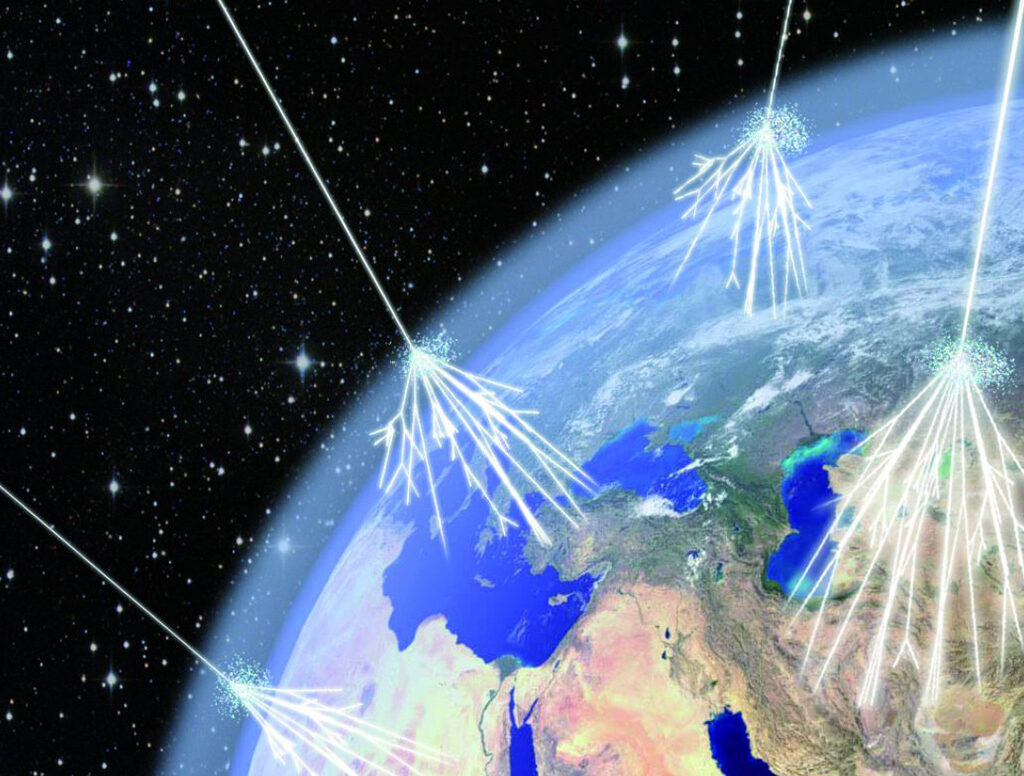
Upon striking Earth’s atmosphere, cosmic rays generate cascades of secondary particles, such as muons and neutrinos, which are crucial for particle physics research.
Mechanisms of Cosmic Waves and Rays
Cosmic waves propagate as electromagnetic oscillations, transmitting energy and information across space without requiring a medium. Their behavior is governed by Maxwell’s equations, which describe how electric and magnetic fields interact and propagate.
Cosmic rays, on the other hand, are particles accelerated by astrophysical processes involving magnetic fields and shock waves. Their trajectories are influenced by magnetic fields in space, and their collisions with atmospheric molecules produce extensive particle showers detectable on Earth.
Mathematical and Physical Principles
The propagation of cosmic waves can be described by the wave equation derived from Maxwell’s equations:
∇²E – (1/c²) ∂²E/∂t² = 0
where E is the electric field vector and c is the speed of light.
For cosmic rays, their kinetic energy E is given by the relativistic energy formula:
E = γmc²
where m is the rest mass of the particle, c is the speed of light, and γ (gamma) is the Lorentz factor accounting for relativistic speeds.
Real-World Examples and Observations
Cosmic waves manifest in everyday phenomena such as sunlight, which is a mixture of electromagnetic waves essential for life. Gamma-ray bursts, among the most energetic cosmic waves, originate from cataclysmic events like neutron star collisions and provide insights into stellar evolution.
Cosmic rays are detected by ground-based observatories like the Pierre Auger Observatory, which studies ultra-high-energy particles. Their interactions with the atmosphere contribute to natural background radiation and may influence cloud formation, thereby affecting climate patterns.
Common Misconceptions
Cosmic rays are a form of electromagnetic radiation.
Cosmic rays are high-energy particles, not waves; they consist of matter such as protons and atomic nuclei.
Cosmic waves only include visible light.
Cosmic waves encompass the entire electromagnetic spectrum, from radio waves to gamma rays.
Cosmic rays are harmful and constantly dangerous to humans.
While cosmic rays carry high energy, Earth’s atmosphere and magnetic field shield most of their harmful effects; they also provide valuable scientific data.
Significance of Cosmic Waves and Rays
Both cosmic waves and cosmic rays are fundamental to advancing our understanding of the universe. Cosmic waves serve as messengers, revealing the composition, structure, and dynamics of celestial bodies. They enable technologies such as satellite communication and remote sensing.
Cosmic rays offer a natural laboratory for studying particle physics at energies unattainable by human-made accelerators. Their study helps unravel the origins of cosmic phenomena and contributes to knowledge about atmospheric processes and climate.
Future Directions in Cosmic Research
Ongoing and upcoming missions, including the James Webb Space Telescope, aim to capture cosmic waves with unprecedented detail, expanding our view of the cosmos. Simultaneously, advanced detectors on Earth and in space continue to probe cosmic rays, seeking to solve mysteries surrounding their sources and extreme energies.
These efforts promise to deepen our grasp of cosmic interactions and the fundamental laws governing the universe, bridging gaps between astrophysics, particle physics, and Earth sciences.
Conclusion: The Cosmic Symphony
Cosmic waves and cosmic rays together compose a dynamic interplay that enriches our cosmic perspective. While cosmic waves flow as continuous electromagnetic melodies, cosmic rays punctuate the universe with bursts of energetic particles. Their coexistence highlights the complexity and beauty of the cosmos, inviting us to explore the profound connections between the microcosm and macrocosm, the known and the mysterious.
FAQ
What are cosmic waves?
Cosmic waves are electromagnetic radiation from astronomical objects, spanning various wavelengths.
What are cosmic rays?
Cosmic rays are high-energy particles, primarily protons and atomic nuclei, that travel through space.
How do cosmic rays affect Earth?
Cosmic rays interact with Earth's atmosphere, generating secondary particles and contributing to natural background radiation.




Leave a Reply