

Short Answer
Understanding Faster-Than-Light Particles
The concept of particles moving beyond the speed of light has traditionally been a topic reserved for theoretical physics and speculative discussions. However, recent studies and claims have sparked renewed interest, suggesting a possible shift in our comprehension of the universe’s fundamental laws. To appreciate the significance of this idea, it is essential to recognize the speed of light as a universal speed limit that has governed physics for over a century.
Definition and Significance of the Speed of Light
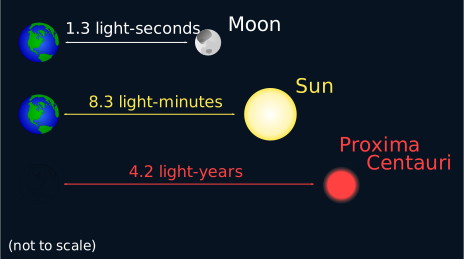
Central to modern physics is Albert Einstein’s special relativity theory, which asserts that no object can surpass the speed of light in a vacuum-approximately 299,792,458 meters per second. This constant is more than a mere figure; it represents a fundamental boundary woven into the fabric of space and time, influencing how matter and information propagate.
- Relativistic Mass Increase:
As an object nears light speed, its relativistic mass approaches infinity, demanding infinite energy for further acceleration. - Cosmic Speed Limit:
This principle effectively prohibits faster-than-light (FTL) travel under conventional physics.
Hypothetical Particles and Quantum Phenomena
Despite the established speed limit, certain theoretical constructs and quantum phenomena challenge this boundary. One such example is the hypothetical tachyon, a particle proposed to always travel faster than light. Although tachyons remain unobserved experimentally, their theoretical existence raises profound questions about causality and the nature of time.
- Tachyons:
Hypothetical particles that would move faster than light, potentially enabling backward time communication and causing causality paradoxes. - Quantum Entanglement:
Entangled particles exhibit instantaneous correlations regardless of distance, a phenomenon Einstein called “spooky action at a distance.” However, this does not allow for faster-than-light communication due to the inherent randomness of quantum state changes.
Experimental Investigations and Neutrino Anomalies
Research into neutrinos-subatomic particles with negligible mass and weak interactions-has occasionally hinted at superluminal behavior. Some experiments reported neutrinos traveling slightly faster than light, though these findings were later attributed to measurement errors or experimental artifacts. Nonetheless, such results have invigorated theoretical discussions about conditions under which the speed limit might be surpassed, especially in extreme astrophysical environments or exotic matter states.
Implications for Physics and Philosophy
Confirming the existence of faster-than-light particles would have far-reaching consequences. It would challenge the absolutes of current physics, necessitate a reevaluation of causality, and potentially lead to revisions of the Standard Model of particle physics. Concepts such as time dilation, simultaneity, and information transfer would require reexamination, possibly unlocking revolutionary technologies like instantaneous communication and advanced propulsion systems for interstellar travel.
Scientific Approach and Skepticism
While the prospect of superluminal particles is captivating, it is crucial to maintain a rigorous scientific perspective. Extraordinary claims require extraordinary evidence, and the scientific community demands reproducible experiments and solid theoretical foundations before revising established laws. This cautious approach ensures that any paradigm shifts are grounded in empirical validation rather than speculation.
The Role of Space-Time and Theoretical Constructs
Beyond particles themselves, the fabric of space-time as described by general relativity offers theoretical pathways to effective faster-than-light travel. Concepts such as wormholes, warp drives, and space-time curvature suggest that manipulating the geometry of space could allow transit between distant points faster than light would in normal space, without violating local speed limits. These ideas intersect with cutting-edge fields like quantum gravity and remain at the frontier of scientific inquiry.
Why Exploring Faster-Than-Light Phenomena Matters
The investigation into particles exceeding light speed embodies the dynamic and evolving nature of science. It challenges our understanding, fuels curiosity, and exemplifies the iterative process of observation, theory, and experimentation. Whether or not superluminal particles are ultimately confirmed, the pursuit enriches our grasp of the universe and highlights the spirit of scientific exploration.
Summary
The dialogue surrounding faster-than-light particles invites us to reconsider the cosmic rules that have long been accepted as immutable. It opens the door to revolutionary ideas that blend theoretical physics with empirical research, encouraging a balance of open-mindedness and skepticism. This ongoing quest not only deepens our knowledge but also inspires wonder at the vast mysteries of the cosmos.
FAQ
What are tachyons?
Tachyons are hypothetical particles that are theorized to travel faster than light, potentially enabling backward time communication.
Can particles exceed the speed of light?
According to current physics, no particle can exceed the speed of light in a vacuum; however, some experimental results have suggested anomalies.


Leave a Reply