
Short Answer
Definition of Elements and Atoms
In the fields of chemistry and physics, the concepts of “elements” and “atoms” are fundamental to understanding the composition of matter. Although these terms are sometimes used interchangeably in everyday language, they represent distinct ideas. Grasping the difference between elements and atoms is essential for a deeper comprehension of atomic theory and the nature of substances.
- Element:
A pure substance that cannot be broken down into simpler substances through chemical reactions. Each element is identified by a unique atomic number, which equals the number of protons in its atoms’ nuclei. The periodic table organizes all known elements-currently about 118-based on their atomic structure and properties. Examples include hydrogen (H), carbon (C), and gold (Au). - Atom:
The smallest unit of an element that retains its chemical identity. An atom consists of a nucleus containing protons and neutrons, surrounded by electrons. This structure determines the element’s chemical behavior and reactivity.
Atomic Structure and Isotopes
Atoms are composed of a dense nucleus made up of protons and neutrons, with electrons orbiting in probabilistic regions called orbitals. While the number of protons defines the element, variations in neutron count create isotopes-different forms of the same element with distinct nuclear properties.
- Isotopes:
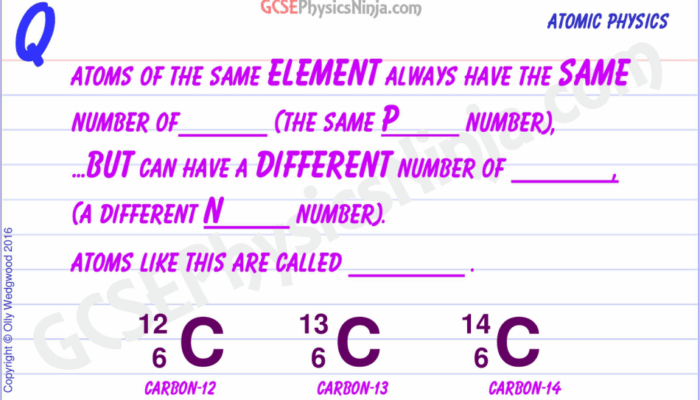
Atoms of the same element that have identical proton numbers but differ in neutron count. For example, carbon-12 has six neutrons, whereas carbon-14 contains eight. These differences influence physical properties and nuclear stability, enabling applications such as radiocarbon dating and medical diagnostics.
Elements in Different Forms and Chemical Bonding
Elements can exist in various molecular or ionic states, demonstrating the versatility of atoms when they combine or change form. For instance, chlorine appears as a diatomic molecule (Cl₂) in its gaseous state and as chloride ions (Cl⁻) in ionic compounds. This adaptability is central to the formation of diverse chemical compounds through covalent, ionic, or metallic bonds.
Intrinsic vs. Extrinsic Properties
Properties of elements and atoms can be categorized as intrinsic or extrinsic:
- Intrinsic Properties:
Characteristics inherent to the element itself, such as atomic mass, melting point, and density. - Extrinsic Properties:
Traits that emerge from the interaction of atoms within compounds or specific environments. For example, sodium (Na) is a soft, reactive metal in its elemental form, but when combined with chlorine to form sodium chloride (NaCl), it becomes a stable, non-reactive ionic compound.
Quantum Mechanical Perspective on Atomic Behavior
Advances in quantum mechanics have revolutionized our understanding of atoms, revealing that electrons occupy orbitals with probabilistic distributions rather than fixed paths. This dynamic model explains how electron configurations influence chemical reactivity and bonding patterns, providing a more nuanced view of atomic interactions at the molecular level.
Applications and Significance
Distinguishing between elements and atoms is not only theoretically important but also critical in practical fields such as material science, molecular biology, and nanotechnology. Understanding atomic composition and behavior enables scientists to design new materials with tailored properties and to explore biological processes at the cellular scale. Manipulating atomic interactions allows for innovations in technology and medicine, underscoring the importance of this fundamental knowledge.
Summary and Conclusion
While elements and atoms are intrinsically linked as the foundational units of matter, they differ in definition and role. Elements are pure substances defined by their atomic number and cannot be chemically decomposed, whereas atoms are the smallest units that embody the properties of these elements. Recognizing this distinction enhances our understanding of the material universe and supports ongoing scientific advancements across multiple disciplines.
FAQ
What is the difference between an element and an atom?
An element is a pure substance defined by its atomic number, while an atom is the smallest unit of an element that retains its chemical properties.
Can elements have different forms?
Yes, elements can exist as isotopes, allotropes, or in ionic and molecular states.
How do isotopes affect element properties?
Isotopes differ in neutron number, which can influence nuclear stability and physical properties.
Why is distinguishing between elements and atoms important?
It clarifies chemical behavior and supports applications in science and technology.





Leave a Reply