
Short Answer
Definition of Fundamental Particles and Electrons
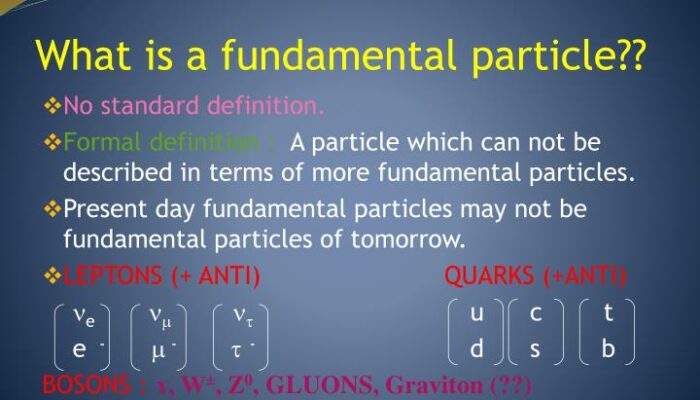
In particle physics, fundamental particles are defined as the most basic constituents of matter, entities that are not composed of smaller parts. These particles serve as the foundational building blocks from which all matter is constructed. Among these, the electron has traditionally been recognized as a fundamental particle, characterized by its negative electric charge and pivotal role in atomic and molecular structures.
- Fundamental Particles:
Particles that lack any internal substructure and cannot be broken down into smaller components. - Electron:
A negatively charged subatomic particle essential for chemical bonding and atomic interactions, historically considered point-like and indivisible.
Historical Perspective on Electron Classification
For decades, electrons were regarded as point-like particles without any internal composition, a view supported by the Standard Model of particle physics. This model has provided a robust framework for understanding the fundamental constituents of matter, placing electrons firmly among the elementary particles. However, as experimental techniques and theoretical models have advanced, this classification has come under scrutiny.
Criteria for Fundamental Status
The designation of a particle as fundamental hinges on the absence of smaller constituent parts. Traditionally, if a particle exhibits no detectable substructure, it is deemed fundamental. Yet, this criterion is evolving as new scientific insights emerge, challenging the simplicity of this definition.
Modern Theoretical Challenges to Electron Fundamentality
Recent progress in high-energy physics, particularly experiments conducted at particle accelerators like the Large Hadron Collider (LHC), has prompted reevaluation of the fundamental nature of particles such as electrons. Although no subcomponents have been observed, some advanced theories propose that what we perceive as fundamental particles might be manifestations of deeper, more complex entities.
String Theory and the Nature of Particles
One prominent theoretical framework, string theory, suggests that the universe’s basic constituents are not zero-dimensional points but one-dimensional strings. These strings vibrate at specific frequencies, and their vibrational modes correspond to different particles, including electrons. In this view, electrons are not truly fundamental but represent the lowest energy vibrational state of these strings.
Quantum Mechanical Properties of Electrons
Electrons exhibit behaviors that defy classical descriptions, such as wave-particle duality, quantum entanglement, and superposition. These quantum phenomena complicate the straightforward classification of electrons as fundamental particles, as their properties extend beyond simple particle-like characteristics.
Emergent Properties and Their Implications
Emergent properties arise when interactions among fundamental components produce new phenomena that cannot be explained solely by the properties of individual parts. While electrons are often treated as fundamental in practical contexts, their collective interactions within atoms and molecules give rise to complex behaviors that transcend their basic definition.
Philosophical and Scientific Implications
The evolving understanding of electrons challenges the static classification of fundamental particles. If electrons possess underlying structures or exhibit emergent behaviors, redefining their fundamental status may be necessary to align scientific models with observed realities. This ongoing inquiry reflects broader themes in scientific discovery, where shifts in perspective have historically revolutionized our comprehension of the universe.
Technological Relevance of Electron Fundamentality
The fundamental nature of electrons has significant consequences for cutting-edge technologies such as quantum computing and nanotechnology. Manipulating electron states is central to these fields, which rely on quantum mechanical principles that simultaneously question and utilize the electron’s fundamental properties. A refined understanding of electrons could drive advancements in both scientific knowledge and technological innovation.
Real-World Examples
- Quantum Computing:
Utilizes the quantum states of electrons to perform computations far beyond classical capabilities, relying on their quantum properties. - Nanotechnology:
Exploits electron behavior at atomic scales to develop new materials and devices with unprecedented precision and functionality.
Common Misconceptions About Electrons
Electrons are indivisible, point-like particles with no internal structure.
While electrons appear point-like at current experimental resolutions, theories like string theory propose they may be manifestations of more fundamental entities.
Quantum mechanics fully explains the nature of electrons.
Quantum mechanics describes electron behavior but does not preclude deeper underlying structures or emergent phenomena.
Why Understanding Electron Fundamentality Matters
Clarifying whether electrons are truly fundamental impacts both theoretical physics and practical applications. It influences our grasp of the universe’s fabric, informs the development of new technologies, and shapes the future direction of scientific research. The quest to understand electrons epitomizes the dynamic nature of science, where each discovery opens new avenues of inquiry and challenges established paradigms.
FAQ
What is an electron?
An electron is a negatively charged subatomic particle that is essential for chemical bonding.
Are electrons truly fundamental particles?
While traditionally classified as fundamental, recent theories suggest they may represent the lowest energy states of more complex structures.





Leave a Reply