
Short Answer
Definition of Atomic Clocks
Atomic clocks are highly precise timekeeping instruments that measure time based on the natural oscillations of atoms. Unlike traditional clocks that depend on mechanical movements or pendulum swings, atomic clocks utilize the consistent frequency of atomic transitions, primarily in elements such as cesium or rubidium, to define the passage of time with extraordinary accuracy.
- Atomic resonance:
The fundamental principle behind atomic clocks, where atoms oscillate at a specific frequency when exposed to electromagnetic radiation. - Standard of time:
One second is internationally defined by the frequency of cesium atom oscillations, specifically 9,192,631,770 cycles of microwave radiation.
Principles and Mechanism of Atomic Clocks
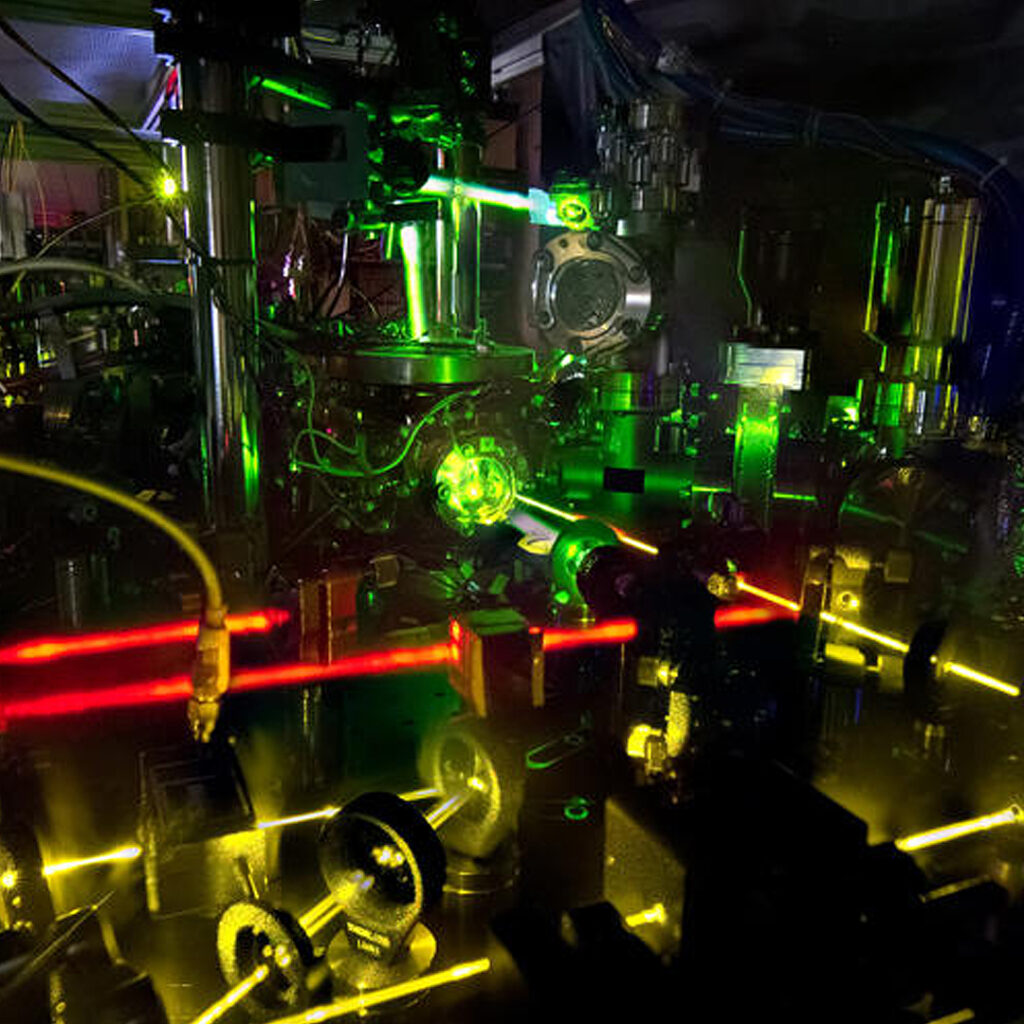
Atomic clocks operate by exploiting the consistent frequency at which atoms resonate when stimulated by microwaves or lasers. When cesium or rubidium atoms are exposed to these electromagnetic waves, they transition between energy states at a fixed frequency. This frequency serves as a highly stable reference, allowing the clock to count oscillations and thereby measure time with unparalleled precision.
Modern atomic clocks often use microwave radiation to induce these transitions, while emerging technologies like optical lattice clocks employ lasers to trap atoms in a lattice structure, further enhancing stability and accuracy.
Mathematical Basis and Time Definition
The definition of a second in atomic timekeeping is mathematically grounded in the frequency of atomic oscillations:
1 second = 9,192,631,770 cycles of microwave radiation corresponding to the transition between two hyperfine levels of the ground state of the cesium-133 atom.
Here, the variables represent:
- Frequency (f): The number of oscillations per second of the cesium atom’s energy state transition.
- Cycles: The count of complete oscillations used to define the duration of one second.
Applications in Modern Technology
Atomic clocks have revolutionized various technological fields by providing an unprecedented level of timing accuracy:
- Global Positioning System (GPS):
GPS satellites rely on atomic clocks to synchronize signals, enabling precise location tracking worldwide. Without this exact timing, positional accuracy would deteriorate significantly. - Telecommunications:
Network synchronization depends on atomic clocks to maintain seamless data transmission across global communication systems. - Quantum Computing:
Precise timing from atomic clocks aids in synchronizing quantum bits (qubits), enhancing coherence times and computational efficiency.
Philosophical and Scientific Implications
The advent of atomic clocks has not only advanced practical timekeeping but also provoked deeper reflections on the nature of time itself. Traditionally viewed as a linear progression from past to future, time is now understood to be more flexible, influenced by factors such as velocity and gravity, as described by Einstein’s theory of relativity. Atomic clocks, with their extreme precision, have made it possible to observe these relativistic effects in real-world scenarios.
Moreover, the intersection of atomic timekeeping and philosophy raises questions about the fundamental structure of reality. Are temporal measurements merely human constructs, or do they reveal an intrinsic order of the universe? This dialogue challenges our perception of existence and our role within the cosmic framework.
Emerging Technologies: Optical Lattice Clocks
Optical lattice clocks represent the next frontier in atomic timekeeping. These devices use lasers to trap atoms in a grid-like lattice, allowing for even more precise measurement of atomic oscillations at optical frequencies, which are much higher than microwave frequencies used in traditional atomic clocks. This advancement promises timekeeping accuracy that could measure intervals spanning millions of years with negligible error, opening new possibilities for both theoretical research and practical applications.
Scientific Research and Fundamental Physics
Atomic clocks contribute significantly to fundamental physics by enabling precise experiments that probe the nature of spacetime and the constants of physics. Researchers use these clocks to test whether fundamental constants vary over time, which could have profound implications for quantum mechanics, cosmology, and our understanding of the universe’s expansion. By refining temporal measurements, atomic clocks help uncover the underlying mechanisms governing particle behavior and the fabric of the cosmos.
Challenges in Atomic Clock Development
Despite remarkable progress, atomic clock technology faces ongoing challenges. Environmental factors such as temperature changes and electromagnetic interference can affect the stability and accuracy of these devices. Scientists continue to develop methods to shield atomic clocks from such disturbances and improve their robustness, pushing the boundaries of precision timekeeping closer to theoretical limits.
Significance and Future Outlook
The invention and continuous improvement of atomic clocks have transformed time measurement from a practical tool into a gateway for exploring fundamental scientific questions. Their impact spans navigation, communication, quantum computing, and physics research, underscoring their critical role in modern technology and science. As atomic clocks evolve, they not only enhance our ability to measure time but also deepen our understanding of the universe, inviting humanity to explore the profound mysteries of temporal existence and the nature of reality itself.
FAQ
What is an atomic clock?
An atomic clock is a highly precise timekeeping instrument that measures time based on the natural oscillations of atoms, particularly cesium or rubidium.
How do atomic clocks work?
Atomic clocks work by exploiting the consistent frequency at which atoms resonate when exposed to microwaves or lasers, counting oscillations to measure time.
What are the applications of atomic clocks?
Atomic clocks are used in GPS satellites for location tracking, telecommunications for network synchronization, and in quantum computing to enhance coherence times.
What are optical lattice clocks?
Optical lattice clocks are an advanced type of atomic clock that use lasers to trap atoms in a grid, allowing for even more precise measurements of time.



Leave a Reply