
Short Answer
Overview of Optical Engineering
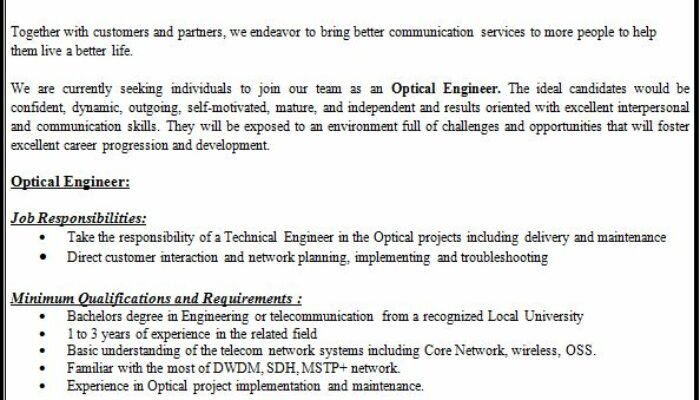
Optical engineering is a specialized field that merges principles from physics, engineering, and advanced technology. It focuses on the design, analysis, and application of systems that manipulate light. Professionals in this domain, known as optical engineers, engage in a diverse range of activities that span from conceptual theoretical work to hands-on experimental implementation.
Core Responsibilities of an Optical Engineer
The daily routine of an optical engineer typically begins with a detailed evaluation of current projects. This stage demands precision and a deep understanding of fundamental optical phenomena such as diffraction, refraction, and laser behavior. Engineers often rely on sophisticated simulation tools to model how light interacts within systems, enabling them to predict performance before physical prototypes are constructed.
Collaboration is another vital aspect of their workday. Optical engineers frequently participate in interdisciplinary meetings, exchanging ideas with experts in materials science, electrical engineering, and related fields. These discussions help identify potential challenges and inspire innovative approaches by integrating diverse perspectives on material characteristics and photonic responses.
Experimental Work and Troubleshooting
Hands-on laboratory work forms a significant portion of an optical engineer’s responsibilities. In controlled environments, they assemble and test components such as lenses, mirrors, diffraction gratings, and sensors. This practical phase transforms theoretical designs into tangible devices, requiring strict adherence to safety protocols, especially when working with high-intensity lasers and sensitive photonic equipment.
Problem-solving is intrinsic to experimental activities. Optical systems often face issues like aberrations or misalignments, which engineers must diagnose and correct. This process involves systematic investigation, drawing on extensive knowledge to isolate errors caused by factors such as component defects or improper setup. Such troubleshooting not only resolves immediate problems but also enhances the engineer’s expertise.
Analytical and Documentation Tasks
Following experimental procedures, optical engineers dedicate time to analyzing data collected from tests. This involves interpreting complex light behaviors using mathematical frameworks like Fourier optics and wavefront analysis. The insights gained from this analysis are crucial for refining designs and advancing project goals.
Equally important is the documentation process. Engineers prepare detailed technical reports that describe methodologies, results, and design rationales. Clear and thorough documentation ensures that research can be validated, reproduced, and extended by other professionals, fostering continuity and progress within the field.
Project Management and Professional Growth
Later in the day, optical engineers often shift focus to managing project logistics. This includes coordinating schedules, allocating resources, and communicating with stakeholders to keep developments on track. The dynamic nature of projects requires adaptability and multitasking skills, balancing innovation with practical constraints.
Continuous learning is a hallmark of the profession. Optical engineers actively pursue professional development through seminars, workshops, and networking opportunities. Staying informed about emerging technologies and trends, such as quantum optics and photonic integrated circuits, is essential for maintaining expertise and inspiring future innovations.
Significance of Optical Engineering
The work of optical engineers is pivotal in advancing technologies that impact numerous industries. By exploring and manipulating the properties of light, they contribute to breakthroughs in telecommunications, medical imaging, entertainment, and beyond. The blend of creativity and analytical rigor inherent in optical engineering not only drives technological progress but also enriches our understanding of the physical world.
Key Concepts in Optical Engineering
- Diffraction:
The bending and spreading of light waves when they encounter obstacles or apertures, influencing the resolution and behavior of optical systems. - Refraction:
The change in direction of light as it passes between different media, fundamental to lens design and image formation. - Laser Optics:
The study and application of coherent light sources, essential for precision measurements, communications, and material processing.
Mathematical Foundations
Optical engineering relies heavily on mathematical models to describe light behavior. For example, Fourier optics uses Fourier transforms to analyze wavefronts and image formation:
U(f_x, f_y) = ∫∫ u(x, y) e^{-j2π(f_x x + f_y y)} dx dy
Where:
- U(f_x, f_y): Fourier transform of the optical field
- u(x, y): Spatial distribution of the optical field
- f_x, f_y: Spatial frequency variables
This mathematical framework enables engineers to predict how optical systems will perform under various conditions.
Practical Applications
Optical engineering principles are applied in numerous real-world scenarios, including:
- Telecommunications:
Designing fiber optic networks that transmit data at high speeds over long distances. - Medical Devices:
Developing imaging systems such as endoscopes and optical coherence tomography for diagnostics. - Consumer Electronics:
Creating camera lenses and display technologies for smartphones and virtual reality devices.
Common Misunderstandings About Optical Engineering
- Misconception: Optical engineering is solely about building lenses.
Correction: While lens design is important, the field encompasses a broad range of activities including system simulation, laser technology, and photonics integration. - Misconception: Optical engineers only work in laboratories.
Correction: Their roles also involve computational modeling, project management, and interdisciplinary collaboration beyond the lab environment.
FAQ
What does an optical engineer do?
An optical engineer designs and analyzes systems that manipulate light, often working on projects in telecommunications, medical imaging, and consumer electronics.
What skills are required for optical engineering?
Skills include problem-solving, knowledge of optics and light behavior, project management, and proficiency in experimental techniques.





Leave a Reply