
Short Answer
Definition of Acoustics and Its Relation to Brass Instruments
Acoustics is a specialized field within physics that studies the creation, transmission, and perception of sound waves. When applied to musical acoustics, particularly in the context of brass instruments, it reveals a fascinating blend of scientific principles, skilled craftsmanship, and artistic expression. This intersection prompts intriguing questions about how the resonant qualities of brass instruments influence emotional responses and how a deeper understanding of acoustics can refine musical performance.
Overview of Brass Instruments in Orchestras
The brass section in orchestras typically includes instruments such as trumpets, trombones, tubas, and French horns. Each of these instruments exhibits unique acoustic characteristics shaped by their individual design and construction. Grasping these acoustic properties is essential not only for instrument makers but also for musicians aiming to master their craft. This article explores the physics underlying brass instruments, focusing on wave behavior, resonance, and harmonic overtones that define their distinctive sound.
Sound Production Mechanism in Brass Instruments
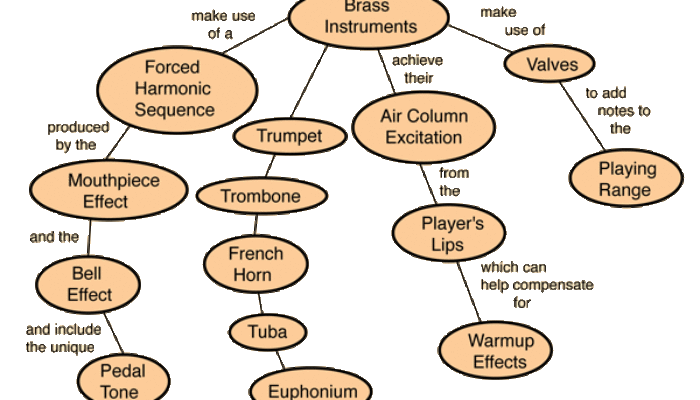
Brass instruments fall under the category of wind instruments, producing sound through the vibration of air inside a tubular body. The player’s lips create a buzzing effect, generating pressure waves that travel through the air column within the instrument. The pitch of the note is primarily determined by the fundamental frequency-the lowest frequency of vibration. However, the instrument’s timbre, often confused with mere tone quality, results from a complex layering of overtones and harmonics that enrich the sound.
Resonance and Harmonics in Brass Instruments
Understanding resonance is crucial to appreciating the acoustics of brass instruments. When a musician buzzes their lips, the air column vibrates at multiple frequencies simultaneously, corresponding to different harmonics. These harmonics form the overtone series, which mathematically explains how certain frequencies are naturally amplified. The sound’s quality and intensity depend not only on the instrument’s design but also on the player’s technique and breath control.
Harmonic Series Explained
The harmonic series in brass instruments begins with the fundamental frequency, which is the primary pitch heard by the listener. Following this, a sequence of overtones emerges at integer multiples of the fundamental frequency. For example, if a tuba’s fundamental frequency is 65 Hz, its harmonics will resonate at 130 Hz, 195 Hz, and so on. Skilled brass players must adeptly navigate these harmonic layers to convey emotional depth and narrative through their music.
Design Factors Influencing Brass Instrument Acoustics
The construction of brass instruments involves numerous design considerations that significantly impact their acoustic performance. Key elements include the shape of the bell, the materials used, and the length of the tubing.
- Bell Shape:
The flare of the bell affects how sound waves disperse into the surrounding environment. A wider bell enhances sound projection, facilitating better blending with other orchestral sections. - Material Composition:
Brass alloys, primarily copper and zinc, possess different damping properties. Damping refers to the rate at which sound energy is absorbed by the material, influencing the brightness or warmth of the instrument’s tone. - Tubing Length:
The length of the air column determines the fundamental pitch and harmonic possibilities of the instrument.
Role of Valve Systems in Pitch Control
Valves, found in instruments like trumpets and tubas, add complexity to pitch manipulation. They act as mechanical shortcuts that extend the length of the air column without changing the instrument’s physical size. This mechanism allows musicians to alter the fundamental pitch dynamically, expanding the range of harmonic options while preserving the instrument’s acoustic integrity.
Challenges of Acoustics in Performance Environments
While theoretical knowledge of brass acoustics is invaluable, applying it in live performance settings presents challenges. External factors such as the acoustics of the venue and audience presence can significantly affect sound production. Musicians must often adjust their intonation and technique in response to these variables, requiring keen auditory skills and adaptability.
Ensemble Dynamics and Acoustic Interaction
Within orchestral performances, the brass section functions as a unified group. However, the interaction between individual instruments creates a complex soundscape that can either harmonize or clash depending on the players’ coordination. Each instrument’s timbre influences how sound waves combine and project, making collaboration and shared acoustic awareness essential for achieving a balanced ensemble sound.
Integrating Acoustical Science with Musical Artistry
The convergence of acoustics, physics, and music raises important questions about how musicians can harness scientific insights to enhance their artistic expression. This integration encourages pedagogical approaches that blend scientific understanding with musical training, potentially cultivating musicians who possess both technical expertise and a profound appreciation of the science behind their art.
Conclusion: The Symbiosis of Physics and Musical Expression in Brass Instruments
Exploring the acoustics of brass instruments uncovers a sophisticated relationship between physical principles and artistic creativity. By comprehending resonance, harmonic structures, and material effects, brass players can elevate their performance mastery. Moreover, addressing the acoustic challenges encountered during live performances fosters a richer dialogue that celebrates both technical skill and emotional resonance, affirming music as a universal language deeply rooted in scientific phenomena.
FAQ
What factors influence the sound of brass instruments?
Key factors include the shape of the bell, material properties, and tubing length, all of which affect resonance and harmonic production.
How do valves in brass instruments affect pitch?
Valves act as mechanical shortcuts that change the length of the air column, allowing musicians to alter pitch without changing the instrument’s physical size.



Leave a Reply