
Short Answer
Definition of a Light Year
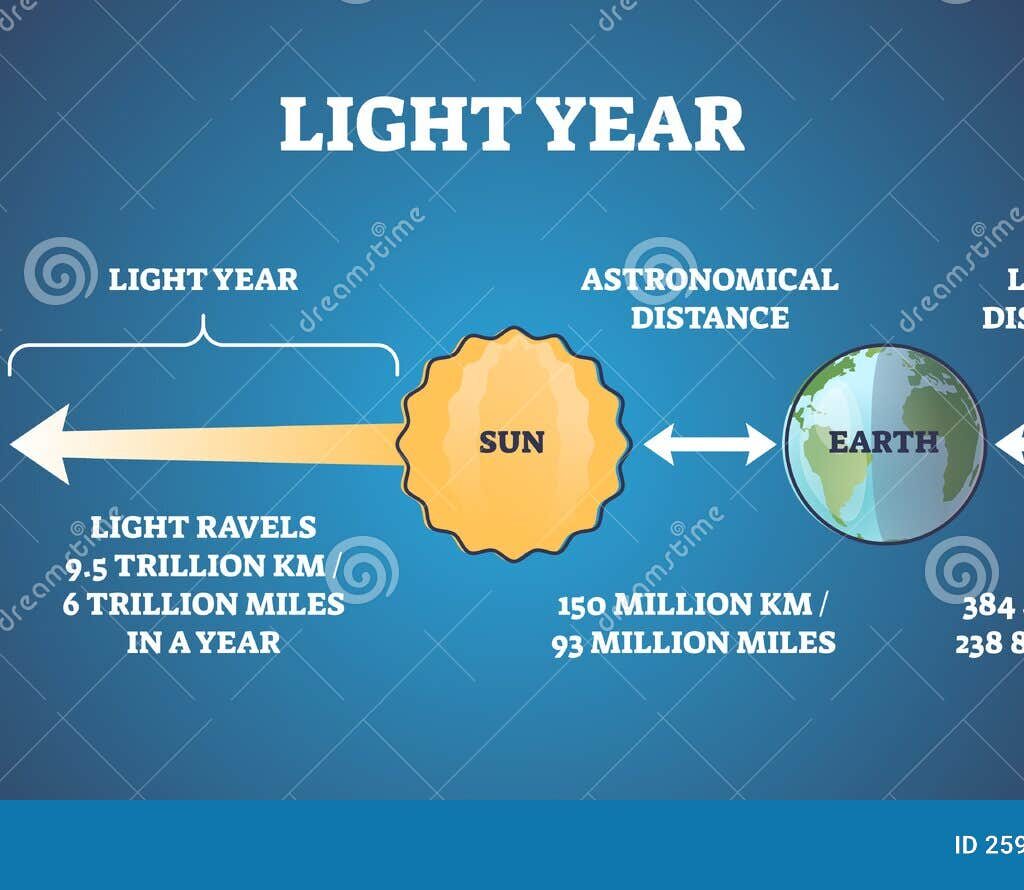
A light year is a unique astronomical unit used to express vast distances in space. Unlike conventional units such as miles or kilometers, a light year measures the distance that light travels through the vacuum of space over the course of one Earth year. This unit elegantly combines the concepts of distance and time, reflecting the fundamental properties of the universe.
- Speed of Light:
Light moves at an extraordinary speed of approximately 299,792 kilometers per second (about 186,282 miles per second), making it the fastest known entity in the cosmos. - Distance Covered:
Over one year, light travels roughly 9.46 trillion kilometers (about 5.88 trillion miles), defining the length of a single light year.
Historical and Practical Context
The term “light year” might initially seem paradoxical, as it combines a measure of time (“year”) with a measure of distance (“light”). However, this unit was developed to provide a more intuitive way to describe the immense separations between celestial objects. Expressing distances in miles or kilometers quickly becomes unwieldy and abstract when dealing with the vastness of space. Saying a star is “four trillion miles away” lacks the clarity and impact of “four light years away,” which also implicitly conveys the time it takes for light to travel that distance.
How Light Years Function as a Measurement
Light years serve as a cosmic ruler that inherently incorporates the finite speed of light, linking spatial distance with temporal duration. When astronomers observe an object located several light years away, they are effectively looking back in time, seeing the object as it existed when the light first began its journey toward Earth. For example, observing a star four light years away means viewing it as it was four years ago.
Mathematical Explanation of a Light Year
The calculation of a light year involves multiplying the speed of light by the number of seconds in one year:
Distance (light year) = Speed of Light × Time
- Speed of Light (c): Approximately 299,792 km/s
- Time (t): Number of seconds in one year (~31,536,000 seconds)
Thus, one light year ≈ 299,792 km/s × 31,536,000 s ≈ 9.46 × 10¹² kilometers.
Implications of Using Light Years in Astronomy
Employing light years as a unit of measurement transcends terrestrial limitations and aligns with the fundamental physics of the universe. The speed of light is not just a constant; it represents the ultimate speed limit in the cosmos, shaping the structure of spacetime itself. This dual nature of light years-encompassing both distance and time-provides a more comprehensive understanding of cosmic scales.
Observing the Universe Through Light Years
When we observe distant galaxies or stars, we are essentially engaging in a form of cosmic time travel. For instance, a galaxy located ten million light years away is seen as it existed ten million years ago. The photons reaching our telescopes today began their journey long before modern humans existed, offering a glimpse into the ancient universe. This perspective highlights the dynamic and evolving nature of celestial bodies, from star formation to black hole activity, all unfolding over immense timescales.
Challenges and Limitations of Light Year Measurements
While the light year is an invaluable tool, it also presents certain challenges, especially at cosmological distances. The expansion of the universe causes space itself to stretch, complicating the notion of a fixed distance. At scales of millions or billions of light years, astronomers must incorporate concepts like redshift and cosmological models to accurately describe distances.
Additionally, light’s interaction with matter can affect observations. It can be absorbed, scattered, or gravitationally bent by massive objects, which may distort or obscure the true position and nature of distant sources. Moreover, phenomena such as dark matter and dark energy, which do not emit light, require indirect detection methods, underscoring the limitations of relying solely on light-based measurements.
Common Misconceptions About Light Years
A light year is a measure of time.
Despite the word “year,” a light year is a unit of distance, specifically how far light travels in one year.
Observing distant objects shows them as they are now.
Because light takes time to travel, we see distant objects as they were in the past, not their current state.
Significance of the Light Year in Science and Daily Understanding
The light year is more than a mere unit; it is a conceptual bridge linking the vastness of space with the flow of time. It challenges everyday perceptions of distance and encourages a deeper appreciation of the universe’s complexity. By framing cosmic distances in terms of light travel time, it enriches our understanding of the universe’s history and evolution, fostering a sense of wonder and humility about our place within the cosmos.
Conclusion: The Poetic and Practical Role of the Light Year
In a universe governed by the speed of light, the light year stands as both a practical measurement and a poetic symbol. It encapsulates the interplay between velocity, space, and time, inviting us to contemplate the mysteries of the cosmos. Through this lens, the universe reveals itself as a vast tapestry woven from threads of light, distance, and epochs long past, inspiring ongoing exploration and discovery.
FAQ
What is a light year?
A light year is a unit of distance that measures how far light travels in one year, approximately 9.46 trillion kilometers or 5.88 trillion miles.
Why do we use light years instead of kilometers or miles?
Light years provide a more intuitive understanding of vast cosmic distances, linking distance and time in a meaningful way.


Leave a Reply