
Short Answer
Definition of Dark Matter
Dark matter is a mysterious and invisible form of matter that does not emit, absorb, or reflect light, making it undetectable by conventional telescopes. Despite its invisibility, it exerts a significant gravitational influence on visible matter and the overall structure of the Universe. It constitutes a major component of the cosmos, shaping the formation and evolution of galaxies and large-scale cosmic structures.
- Invisible Nature:
Dark matter cannot be observed directly through electromagnetic radiation, which includes visible light, X-rays, and radio waves. - Gravitational Effects:
Its presence is inferred from the gravitational pull it exerts on stars, galaxies, and galaxy clusters. - Cosmic Abundance:
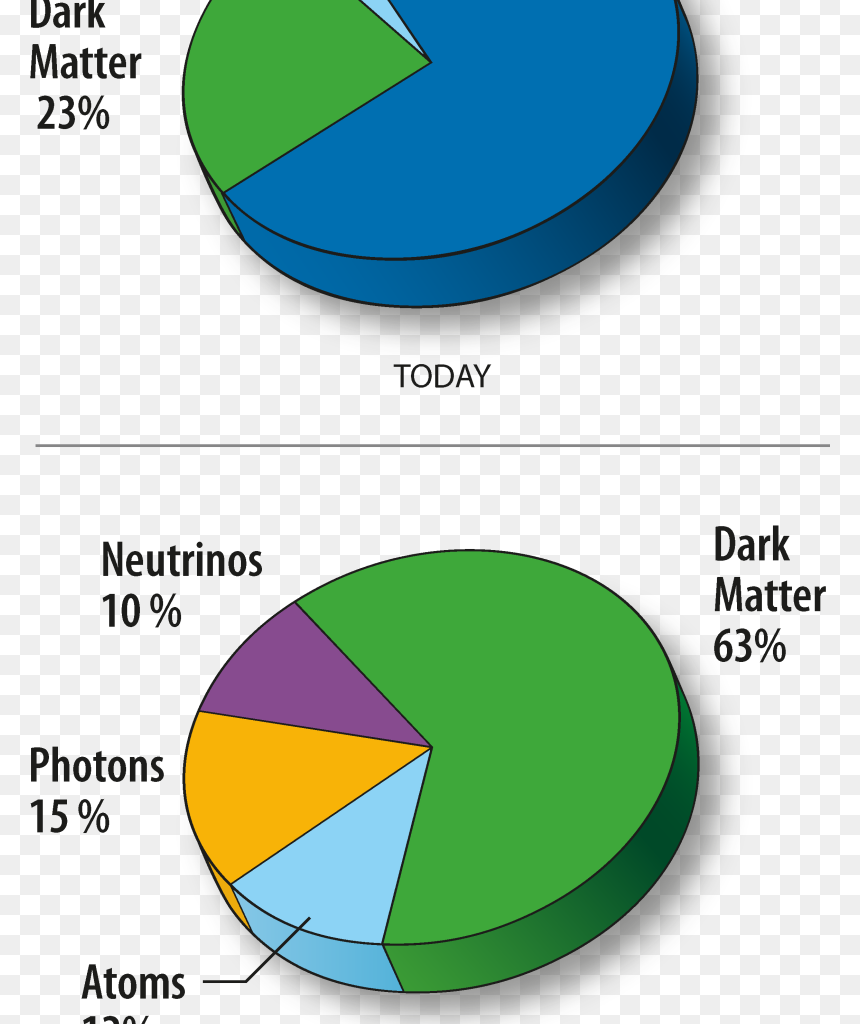
It makes up approximately 27% of the Universe’s total mass-energy content, vastly outweighing ordinary matter.
Composition of the Universe
The Universe is composed of several fundamental components, each playing a distinct role in its makeup and evolution:
- Baryonic Matter:
This is the ordinary matter consisting of atoms, including stars, planets, gas, and dust, accounting for about 5% of the Universe. - Dark Matter:
Constituting roughly 27%, dark matter dominates the mass budget but remains unseen. - Dark Energy:
Making up about 68%, dark energy is responsible for the accelerated expansion of the Universe.
Methods for Determining Dark Matter’s Proportion
Scientists estimate the fraction of dark matter in the Universe through various observational and theoretical approaches:
- Galaxy Rotation Curves:
Measurements of how stars orbit within galaxies reveal that visible matter alone cannot account for the observed rotational speeds. The constant velocity at large radii implies the presence of a massive, unseen halo of dark matter. - Large-Scale Structure Mapping:
The distribution of galaxies and galaxy clusters across the cosmos reflects the gravitational scaffolding provided by dark matter, which guides the aggregation of ordinary matter. - Cosmic Microwave Background (CMB) Analysis:
Fluctuations in the CMB radiation, the relic light from the Big Bang, carry imprints of early density variations seeded by dark matter, allowing precise cosmological measurements.
How Dark Matter Influences Cosmic Evolution
Dark matter plays a pivotal role in the Universe’s development by acting as the gravitational framework around which visible matter coalesces:
- Galaxy Formation:
Dark matter clumps create gravitational wells that attract gas and dust, leading to star formation and the assembly of galaxies. - Structure Stability:
Without dark matter, galaxies would lack the gravitational cohesion to maintain their structure, potentially dispersing over time. - Cosmic Web:
On the largest scales, dark matter forms a vast network of filaments and voids, shaping the cosmic web that defines the Universe’s architecture.
Scientific Theories and Candidates for Dark Matter
Despite extensive research, the exact nature of dark matter remains unknown. Several theoretical particles have been proposed as candidates:
- Weakly Interacting Massive Particles (WIMPs):
Hypothetical particles that interact via gravity and the weak nuclear force but not electromagnetically. - Axions:
Ultra-light particles predicted by extensions of quantum chromodynamics, potentially abundant in the Universe. - Sterile Neutrinos:
Hypothetical neutrinos that do not interact via the weak force, making them difficult to detect.
Experimental efforts to detect these particles include underground detectors, particle accelerators, and space-based observatories, though direct detection remains elusive.
Common Misconceptions About Dark Matter
Dark matter is the same as dark energy.
Dark matter and dark energy are distinct; dark matter exerts gravitational attraction, while dark energy drives the Universe’s accelerated expansion.
Dark matter can be seen with powerful telescopes.
Dark matter does not emit or reflect light, so it cannot be observed directly with any telescope.
Dark matter is made of ordinary matter like black holes or planets.
Dark matter is non-baryonic and fundamentally different from ordinary matter, as it does not interact electromagnetically.
Significance of Dark Matter in Science and Cosmology
Understanding dark matter is crucial for multiple reasons:
- Explaining Cosmic Structure:
It provides the gravitational framework necessary for the formation and stability of galaxies and clusters. - Advancing Physics:
Studying dark matter challenges and extends the Standard Model of particle physics, potentially revealing new fundamental particles. - Cosmological Models:
Accurate knowledge of dark matter’s proportion is essential for models that describe the Universe’s origin, evolution, and fate.
Real-World Implications and Future Prospects
While dark matter does not affect daily life directly, its study has profound implications for our understanding of the Universe:
- Technological Innovation:
The search for dark matter drives advancements in detector technology, data analysis, and experimental physics. - Philosophical Impact:
It challenges human perceptions of reality, highlighting that most of the Universe is composed of unseen components. - Ongoing Research:
Future telescopes and experiments aim to uncover the nature of dark matter, potentially revolutionizing cosmology and particle physics.
Summary
Dark matter constitutes about 27% of the Universe’s total mass-energy, vastly exceeding the amount of visible matter. Its gravitational influence is essential for the formation and maintenance of cosmic structures, yet it remains invisible and enigmatic. Through indirect observations such as galaxy rotation curves, large-scale structure mapping, and cosmic microwave background studies, scientists have pieced together its significant role in the cosmos. The quest to identify dark matter’s true nature continues to be a central challenge in modern astrophysics, promising to deepen our understanding of the Universe’s fundamental composition and evolution.
FAQ
What is dark matter?
Dark matter is an invisible form of matter that constitutes about 27% of the Universe’s mass-energy, influencing the structure and evolution of galaxies.
How do scientists estimate the amount of dark matter in the Universe?
Scientists estimate dark matter’s proportion through methods like galaxy rotation curves, large-scale structure mapping, and cosmic microwave background analysis.
Why is dark matter important in cosmology?
Dark matter is crucial for explaining cosmic structure formation, advancing physics, and refining cosmological models of the Universe’s evolution.





Leave a Reply