
Short Answer
Understanding Dark Matter
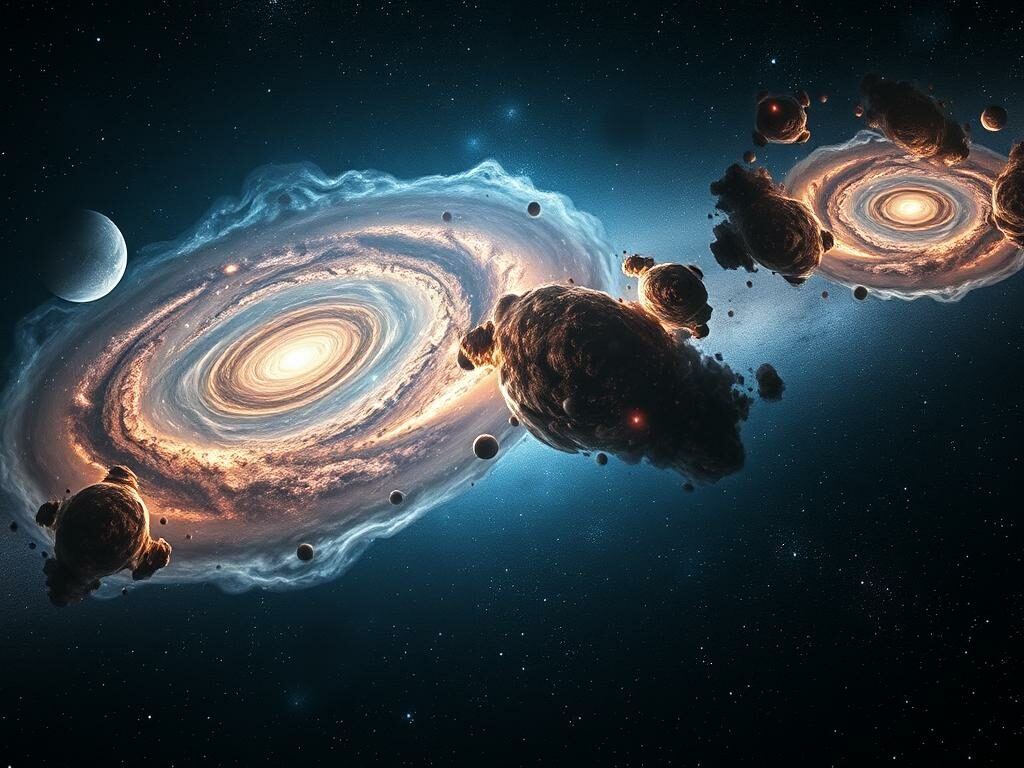
Dark matter is a mysterious and invisible component of the universe, making up approximately 27% of its total mass-energy content. Unlike ordinary matter, it neither emits nor reflects light, rendering it undetectable by conventional telescopes. Its presence is inferred primarily through gravitational effects on visible matter, radiation, and the large-scale structure of the cosmos.
Defining Dark Matter and Its Relationship to Light
Traditionally, light is defined as electromagnetic radiation detectable by the human eye or instruments sensitive to a broad range of wavelengths, from radio waves to gamma rays. Dark matter, however, does not interact with electromagnetic radiation in any observable way, which raises the question: could dark matter be a form of light that exists outside the range of our current detection capabilities?
- Electromagnetic Spectrum:
Visible light is only a small segment of the electromagnetic spectrum, which includes many frequencies and wavelengths beyond human perception and technological reach. - Invisible Radiation:
There may be forms of electromagnetic radiation or particles that do not interact with ordinary matter or light in conventional ways, potentially constituting dark matter.
Hypotheses on Dark Matter as Hidden Light
Several theoretical models propose that dark matter could be linked to exotic forms of electromagnetic phenomena, such as dark photons or hidden photons, which are analogs to regular photons but interact very weakly with normal matter.
- Dark Photons:
Hypothetical particles similar to photons but with minimal interaction with baryonic matter, possibly mediating forces in unseen sectors of the universe. - Paraphotons or Hidden Photons:
Predicted by extensions of the Standard Model, these particles might coexist with regular photons but remain undetectable by standard observational methods due to their extremely low interaction cross-section.
Advanced Theoretical Perspectives
Quantum field theory and higher-dimensional models offer additional frameworks to understand dark matter as a form of hidden light. For example, in brane-world scenarios, our observable universe is a four-dimensional slice of a higher-dimensional space, where fields extending into extra dimensions could manifest as dark matter effects.
Observational Evidence and Gravitational Effects
While dark matter does not emit or absorb light, its gravitational influence on visible matter and light is measurable. Phenomena such as gravitational lensing-where light from distant objects is bent and magnified by massive unseen structures-provide indirect evidence of dark matter’s presence and distribution.
Scientific and Philosophical Implications
The concept of dark matter as hidden light challenges traditional notions of reality and perception. It raises profound questions about the limits of human observation and the nature of existence beyond what can be directly measured.
- Perception vs. Reality:
The existence of entities detectable only through indirect means suggests that reality encompasses more than what is immediately observable. - Unity of Light and Darkness:
This duality reflects the broader epistemological challenge of understanding the universe through both seen and unseen phenomena.
Technological Approaches to Detecting Hidden Light
Efforts to uncover dark matter involve a multidisciplinary array of tools and methods, extending beyond traditional electromagnetic detection:
- Particle Accelerators:
High-energy collisions may produce or reveal dark sector particles. - Deep Underground Detectors:
Shielded environments designed to detect rare interactions with dark matter particles. - Space-Based Observatories:
Instruments observing cosmic microwave background radiation and gravitational lensing effects. - Gravitational Wave and Neutrino Observatories:
Novel sensors that might detect indirect signatures of dark matter.
Why Exploring Dark Matter as Hidden Light Is Crucial
Understanding whether dark matter is a form of undetected light has significant implications for physics, cosmology, and our comprehension of the universe. It pushes the boundaries of current scientific paradigms, inspiring new theories and technologies that could unlock deeper cosmic truths.
Summary and Future Outlook
Although direct proof of dark matter as a hidden form of light remains elusive, this hypothesis enriches scientific discourse by highlighting the interplay between observation and inference. The ongoing quest to identify dark matter embodies humanity’s enduring pursuit of knowledge, illuminating the profound mysteries that lie beyond the visible universe.
FAQ
What is dark matter?
Dark matter is an invisible component of the universe that makes up about 27% of its mass-energy content and does not interact with electromagnetic radiation.
How is dark matter detected?
Dark matter is detected indirectly through its gravitational effects on visible matter and light, such as in gravitational lensing.
Could dark matter be a form of light?
Some theories suggest dark matter could be linked to exotic forms of light, like dark photons, which interact very weakly with normal matter.

Leave a Reply