
Short Answer
Understanding Falsifiability
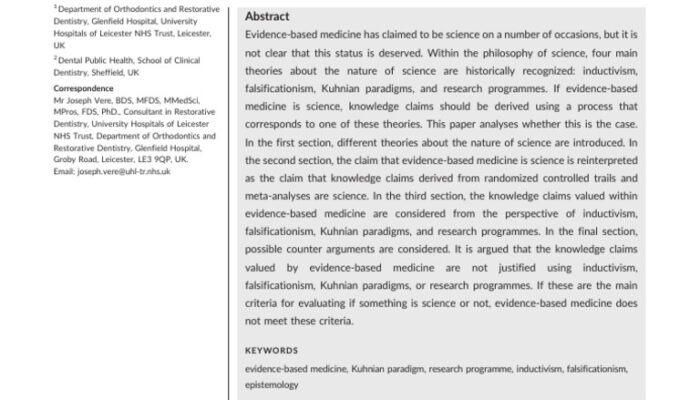
Falsifiability is a foundational concept in the philosophy of science, serving as a critical criterion for distinguishing scientific theories from non-scientific ones. It requires that any hypothesis or theory must be structured in a way that allows it to be potentially disproven through empirical evidence. This principle ensures that scientific claims remain testable and open to refutation, fostering a rigorous process of validation and rejection that underpins the scientific method.
- Definition:
The capacity of a statement or theory to be proven false by observation or experiment. - Significance:
Acts as a demarcation line between scientific and non-scientific propositions. - Origin:
Popularized by philosopher Karl Popper as a response to the limitations of verificationism.
Challenges Beyond Falsifiability
Despite its central role in empirical inquiry, falsifiability does not encompass all forms of knowledge or belief. Certain domains, such as metaphysics, theology, and some areas of theoretical physics, present claims that resist straightforward empirical testing. These ideas often dwell in a space where they cannot be conclusively proven or disproven, raising questions about their epistemic status and the limits of scientific investigation.
- Metaphysical Claims:
Assertions about universals, consciousness, or cosmic purpose that evade empirical scrutiny. - Theological Assertions:
Beliefs grounded in faith rather than testable evidence. - Theoretical Physics:
Concepts like string theory or multiverse hypotheses that currently lack direct empirical support.
Epistemological Implications of Unfalsifiable Claims
The existence of unfalsifiable propositions invites a reconsideration of traditional epistemic frameworks. Instead of a strict binary between true and false, or provable and unprovable, a more nuanced spectrum of knowledge emerges. This includes provisional acceptance based on coherence, pragmatic usefulness, or experiential resonance, which broadens the scope of inquiry beyond rigid falsification criteria.

- Provisional Acceptance:
Temporarily endorsing ideas based on their explanatory power or internal consistency. - Pragmatic Utility:
Valuing theories for their practical applications despite lack of definitive proof. - Experiential Resonance:
Recognizing subjective or phenomenological insights as meaningful despite empirical elusiveness.
Falsifiability in Different Domains
The applicability and desirability of falsifiability vary across disciplines. While natural sciences rely heavily on falsifiability as a benchmark for scientific rigor, fields such as ethics, aesthetics, and certain social sciences operate under different epistemic standards. This diversity calls for a pluralistic approach to knowledge validation, respecting the unique methodologies and goals of each domain.
- Natural Sciences:
Emphasize empirical testing and falsifiability as core principles. - Ethics and Aesthetics:
Often involve subjective judgments and values that resist empirical falsification. - Social Sciences:
Deal with complex, context-dependent phenomena where strict falsifiability may be impractical.
Complex Systems and the Limits of Falsifiability
Modern scientific challenges, such as climate modeling, economic forecasting, and behavioral psychology, illustrate the limitations of applying strict falsifiability. These fields involve intricate systems with numerous interacting variables, making absolute proof or disproof elusive. Instead, models serve as heuristic tools that provide probabilistic insights and guide understanding through degrees of confidence rather than binary outcomes.
Case Study: Theoretical Entities in Physics
Entities like dark matter and dark energy exemplify how falsifiability can evolve with advancements in technology and methodology. Although these phenomena are not directly observable, their existence is inferred from gravitational effects and cosmological observations. As experimental techniques improve, what was once speculative may become empirically testable, demonstrating the fluid boundary between falsifiable and unfalsifiable claims.
Falsifiability and Human Understanding
The tension between falsifiable and unfalsifiable claims reflects a deeper existential challenge: navigating a world where absolute certainty is often unattainable. This dynamic encourages a balanced approach that combines skepticism with openness, empirical rigor with philosophical reflection, and acknowledges multiple layers of evidence-from direct observation to logical coherence.
Why Falsifiability Matters
Falsifiability is crucial because it underpins the reliability and progress of scientific knowledge. By demanding that theories be testable and refutable, it prevents dogmatism and promotes continuous refinement of understanding. Moreover, recognizing the limits of falsifiability fosters intellectual humility and encourages interdisciplinary dialogue, enriching both scientific and philosophical pursuits.
Common Misconceptions About Falsifiability
All meaningful claims must be falsifiable.
Some valuable insights, especially in ethics or metaphysics, may not be falsifiable but still contribute to human understanding.
Falsifiability guarantees truth.
While falsifiability allows for testing, it does not ensure that a theory is true, only that it can be challenged and potentially disproven.
Unfalsifiable claims are inherently unscientific.
Certain scientific hypotheses may currently be unfalsifiable due to technological limits but remain within the scientific domain pending future evidence.
Conclusion: Embracing Complexity in Knowledge
The exploration of falsifiability versus unfalsifiability reveals the intricate architecture of human knowledge. It challenges us to refine our methods, expand our epistemic horizons, and accept that inquiry is an evolving dialogue rather than a quest for absolute answers. This perspective nurtures curiosity, fosters intellectual resilience, and ultimately enriches our collective pursuit of truth.




Leave a Reply