
Short Answer
Definition
The telescopes that preceded the Hubble Space Telescope represent a continuum of astronomical instruments, both terrestrial and space-based, that significantly advanced our understanding of the universe. These predecessors laid the technological and scientific groundwork that enabled Hubble’s revolutionary observations, spanning from early optical devices on Earth to pioneering orbital observatories exploring wavelengths inaccessible from the ground.
Historical Evolution of Telescopes Before Hubble
Early Ground-Based Optical Telescopes
The foundation of modern astronomy was established with the invention of the optical telescope in the early 17th century. Galileo Galilei’s rudimentary refracting telescope marked a turning point by revealing celestial bodies in unprecedented detail. Over subsequent centuries, the development of reflecting telescopes, which utilized mirrors instead of lenses, addressed issues like chromatic aberration and allowed for larger apertures, enhancing light-gathering power and image clarity.
Notable Terrestrial Giants: The Hale Telescope
Among the most significant ground-based instruments before Hubble was the Hale Telescope at Palomar Observatory, completed in 1949. Featuring a 200-inch (5.08-meter) primary mirror, it was the largest optical telescope of its time and remained so for decades. This telescope enabled astronomers to observe faint and distant cosmic phenomena such as galaxies, nebulae, and quasars, contributing profoundly to deep-space research despite the limitations imposed by Earth’s turbulent atmosphere.
Challenges of Earth-Based Astronomy
While terrestrial telescopes achieved remarkable feats, they were inherently constrained by atmospheric interference. The Earth’s atmosphere distorts and dims incoming light, reducing the sharpness and sensitivity of observations. This atmospheric turbulence, along with light pollution, motivated astronomers to seek alternatives beyond the planet’s surface to obtain clearer and more comprehensive views of the cosmos.
Emergence of Space-Based Telescopes
Early Orbital Observatories
The dawn of the Space Age in the mid-20th century ushered in the possibility of placing telescopes above the atmosphere. Initial space telescopes were relatively small but groundbreaking in their ability to observe ultraviolet and X-ray wavelengths blocked by Earth’s atmosphere. NASA’s Orbiting Astronomical Observatory (OAO) program, initiated in the 1960s, was a pioneering effort in this direction. OAO-2, launched in 1968, became the first successful space telescope to provide ultraviolet data free from atmospheric absorption, opening new frontiers in stellar and galactic studies.
Advancements Through Successive Missions
Following OAO, other space observatories expanded the scope of astronomical research. The Copernicus satellite, launched in 1972, furthered ultraviolet astronomy by delivering detailed observations of stars and interstellar matter. The 1970s and early 1980s also saw the deployment of specialized satellites such as the Uhuru X-ray observatory and the Infrared Astronomical Satellite (IRAS) in 1983, which conducted the first all-sky infrared survey from space. These missions underscored the importance of multi-wavelength astronomy, enabling scientists to study the universe across a broad spectrum beyond visible light.
The International Ultraviolet Explorer (IUE)
Directly preceding Hubble, the International Ultraviolet Explorer (IUE), launched in 1978, was a landmark collaboration between NASA, the European Space Agency, and the United Kingdom. IUE provided continuous ultraviolet observations over many years, demonstrating the feasibility and scientific value of long-duration space-based astronomy. Its success helped validate the technological approaches and scientific goals that would shape the Hubble Space Telescope.
Technological Innovations Leading to Hubble
The development of space telescopes before Hubble involved overcoming significant engineering challenges. Creating lightweight, high-precision optics capable of operating in the harsh environment of space was critical. Additionally, engineers had to design reliable remote control systems and data transmission methods to manage instruments from Earth. The experience gained from earlier missions like OAO and IUE directly influenced Hubble’s sophisticated design.
Scientific Priorities and Capabilities
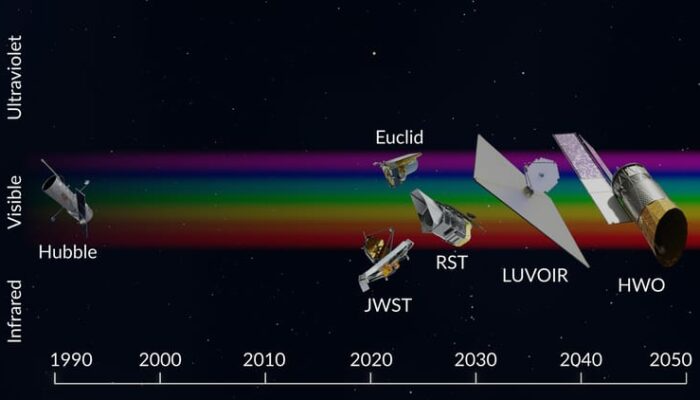
While initial space telescopes focused on ultraviolet and X-ray wavelengths, Hubble was designed as a versatile observatory primarily optimized for visible light, with extended capabilities in ultraviolet and near-infrared bands. This broad spectral range allowed Hubble to build upon the discoveries of its predecessors and provide unprecedented clarity and depth in astronomical imaging.
Adaptive Optics and Ground-Based Enhancements
Before Hubble’s launch in 1990, astronomers also improved ground-based observations through adaptive optics technology. This method uses deformable mirrors to correct atmospheric distortions in near real-time, significantly enhancing image resolution. Despite these advances, adaptive optics could not fully replicate the clarity achievable by a telescope operating above the atmosphere, highlighting the leap forward represented by Hubble’s orbital vantage point.
Legacy and Impact of Pre-Hubble Telescopes
The telescopes that came before Hubble collectively represent a rich heritage of scientific inquiry and technological innovation. Ground-based giants like the Hale Telescope provided foundational data and experience, while early space observatories circumvented atmospheric limitations and opened new spectral windows. These incremental advancements in optics, instrumentation, and spacecraft engineering culminated in the creation of Hubble, a telescope capable of exploring the cosmos with unmatched precision.
Why Understanding Pre-Hubble Telescopes Matters
Recognizing the lineage of telescopes before Hubble is essential for appreciating the evolution of astronomical observation. Each instrument contributed unique insights and technological breakthroughs that shaped modern astrophysics. This historical perspective underscores the importance of continuous innovation and collaboration in expanding humanity’s cosmic knowledge and inspires future generations of space exploration and telescope design.
Summary
- Early Optical Telescopes:
Initiated by Galileo’s refractor and advanced by reflecting telescopes, these instruments laid the groundwork for modern astronomy. - Hale Telescope:
The largest ground-based optical telescope before Hubble, pivotal in deep-space observations despite atmospheric challenges. - Space-Based Pioneers:
Programs like OAO and satellites such as Copernicus, Uhuru, and IRAS expanded astronomy into ultraviolet, X-ray, and infrared wavelengths. - International Ultraviolet Explorer (IUE):
A direct predecessor to Hubble, demonstrating the value of long-term space-based ultraviolet observations. - Technological Progress:
Innovations in optics, remote control, and data transmission from earlier missions enabled Hubble’s advanced capabilities. - Adaptive Optics:
Ground-based technology that improved image quality but could not match the clarity of space telescopes.
Looking Forward
The pioneering telescopes before Hubble continue to influence the design and objectives of current and future observatories. Their legacy fuels ongoing efforts to explore the universe with ever greater precision, ensuring that humanity’s quest to understand the cosmos remains vibrant and progressive.
FAQ
What was the largest telescope before the Hubble Space Telescope?
The Hale Telescope at Palomar Observatory, completed in 1949, was the largest optical telescope before Hubble.
What was the role of the International Ultraviolet Explorer?
The IUE, launched in 1978, provided continuous ultraviolet observations and demonstrated the feasibility of long-term space-based astronomy.

Leave a Reply