
Short Answer
Definition of Dark Matter
Dark matter is a mysterious and invisible form of matter that constitutes a significant portion of the universe’s total mass. Unlike ordinary matter, it neither emits nor absorbs electromagnetic radiation, making it undetectable by conventional telescopes. Despite its invisibility, dark matter exerts a powerful gravitational influence that shapes the structure and evolution of the cosmos.
- Invisible Substance:
Dark matter does not interact with light or other electromagnetic forces, rendering it completely unseen by direct observation. - Gravitational Influence:
Its presence is inferred from the gravitational effects it has on visible matter, radiation, and the large-scale structure of the universe.
Evidence Supporting the Existence of Dark Matter
Galactic Rotation Curves
One of the earliest indications of dark matter came from studying how galaxies rotate. According to classical Newtonian physics, stars located farther from the galactic center should orbit more slowly due to the decreasing gravitational pull from visible matter. However, observations reveal that stars at the outskirts of galaxies maintain unexpectedly high speeds, suggesting the presence of additional unseen mass that provides the necessary gravitational force to keep them bound.
Gravitational Lensing
Gravitational lensing occurs when the gravity of a massive object bends and magnifies the light from objects behind it, as predicted by Einstein’s general relativity. When astronomers observe clusters of galaxies, the amount of lensing detected is far greater than what visible matter alone can explain. This discrepancy points to a substantial amount of invisible mass-dark matter-contributing to the gravitational field.
Cosmic Microwave Background (CMB) Fluctuations
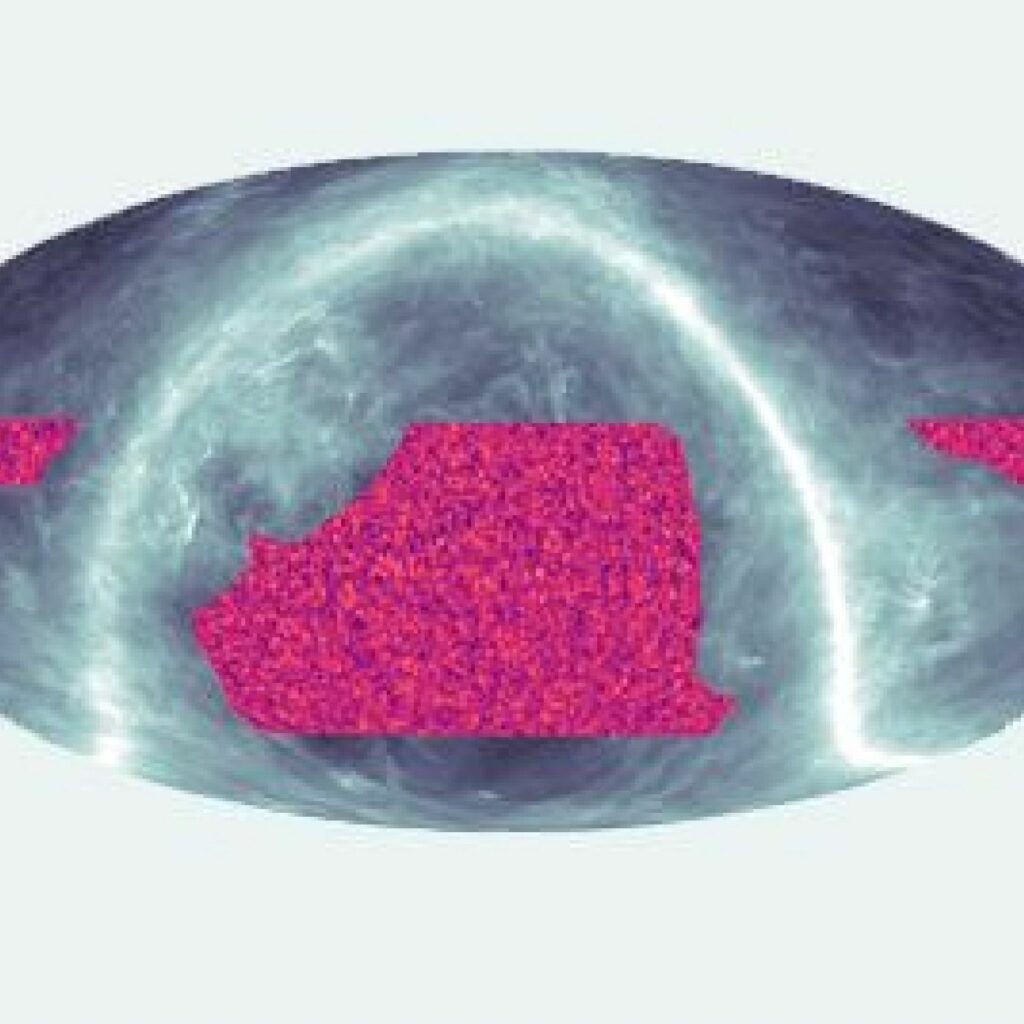
The cosmic microwave background is the residual radiation from the Big Bang, exhibiting minute temperature and density variations. Detailed measurements of these fluctuations reveal that ordinary matter accounts for only about 5% of the universe’s total energy content, while dark matter comprises roughly 27%. This data provides a crucial cosmological fingerprint confirming dark matter’s fundamental role in the universe.
Large-Scale Structure Formation
The distribution of galaxies across the universe is not random but forms a vast cosmic web of filaments and voids. Simulations of cosmic evolution show that such structures could not have formed within the universe’s 13.8 billion-year history without the gravitational scaffolding provided by dark matter. It acts as the framework around which ordinary matter clusters to form galaxies and galaxy clusters.
Characteristics and Nature of Dark Matter
Dark matter’s defining trait is its lack of interaction with electromagnetic forces, distinguishing it from the particles that make up stars, planets, and living beings. It neither emits nor reflects light, making it completely transparent to electromagnetic detection methods. Its existence is inferred solely through its gravitational effects on visible matter and radiation.
Hypothesized Constituents
Scientists have proposed several candidates for dark matter particles, though none have been directly detected yet:
- Weakly Interacting Massive Particles (WIMPs):
Hypothetical particles that interact via gravity and the weak nuclear force but not electromagnetically. - Axions:
Extremely light particles proposed to solve certain problems in particle physics and potentially constitute dark matter. - Sterile Neutrinos:
Hypothetical neutrinos that do not interact via the standard weak force, making them difficult to detect.
Scientific and Philosophical Significance
Dark matter challenges our understanding of the universe by revealing that the visible matter we observe is only a small fraction of the total cosmic content. Its elusive nature pushes the boundaries of astrophysics, particle physics, and cosmology, driving the development of new theories and experimental techniques. Philosophically, it invites reflection on the limits of human perception and the vast unknowns that lie beyond our sensory and technological reach.
Methods of Investigation
Efforts to detect dark matter directly involve a variety of sophisticated approaches:
- Underground Detectors:
Shielded from cosmic radiation, these experiments aim to capture rare interactions between dark matter particles and ordinary matter. - Particle Colliders:
Facilities like the Large Hadron Collider recreate conditions similar to the early universe to potentially produce dark matter particles. - Astronomical Observations:
Continued study of gravitational lensing, galaxy rotation, and cosmic background radiation refines our understanding of dark matter’s distribution and properties.
Common Misconceptions About Dark Matter
Dark matter is the same as dark energy.
Dark matter and dark energy are distinct; dark matter exerts gravitational attraction, while dark energy drives the accelerated expansion of the universe.
Dark matter can be seen with powerful telescopes.
Dark matter does not emit or reflect light, making it invisible to all electromagnetic-based detection methods.
Why Understanding Dark Matter Is Crucial
Comprehending dark matter is essential for a complete picture of the universe’s composition, structure, and evolution. It influences galaxy formation, cosmic dynamics, and the ultimate fate of the cosmos. Unlocking its secrets could revolutionize physics, revealing new fundamental particles and forces, and deepen our grasp of the universe’s hidden dimensions.
Conclusion: The Ongoing Quest
The existence of dark matter is inferred through a combination of indirect evidence, including galactic rotation anomalies, gravitational lensing, cosmic microwave background patterns, and large-scale cosmic structures. Although invisible to direct observation, its gravitational imprint is undeniable. The pursuit to identify and understand dark matter remains one of the most profound scientific challenges, promising to expand our knowledge of the universe far beyond the visible horizon.
FAQ
What is dark matter?
Dark matter is a hypothetical form of matter that does not emit or interact with electromagnetic radiation, making it invisible and detectable only through its gravitational effects.
How do we know dark matter exists?
Evidence for dark matter comes from observations like galactic rotation curves, gravitational lensing, and cosmic microwave background fluctuations.
What are the main candidates for dark matter particles?
The primary candidates for dark matter particles include Weakly Interacting Massive Particles (WIMPs), axions, and sterile neutrinos.


Leave a Reply