
Short Answer
Definition of Black Holes
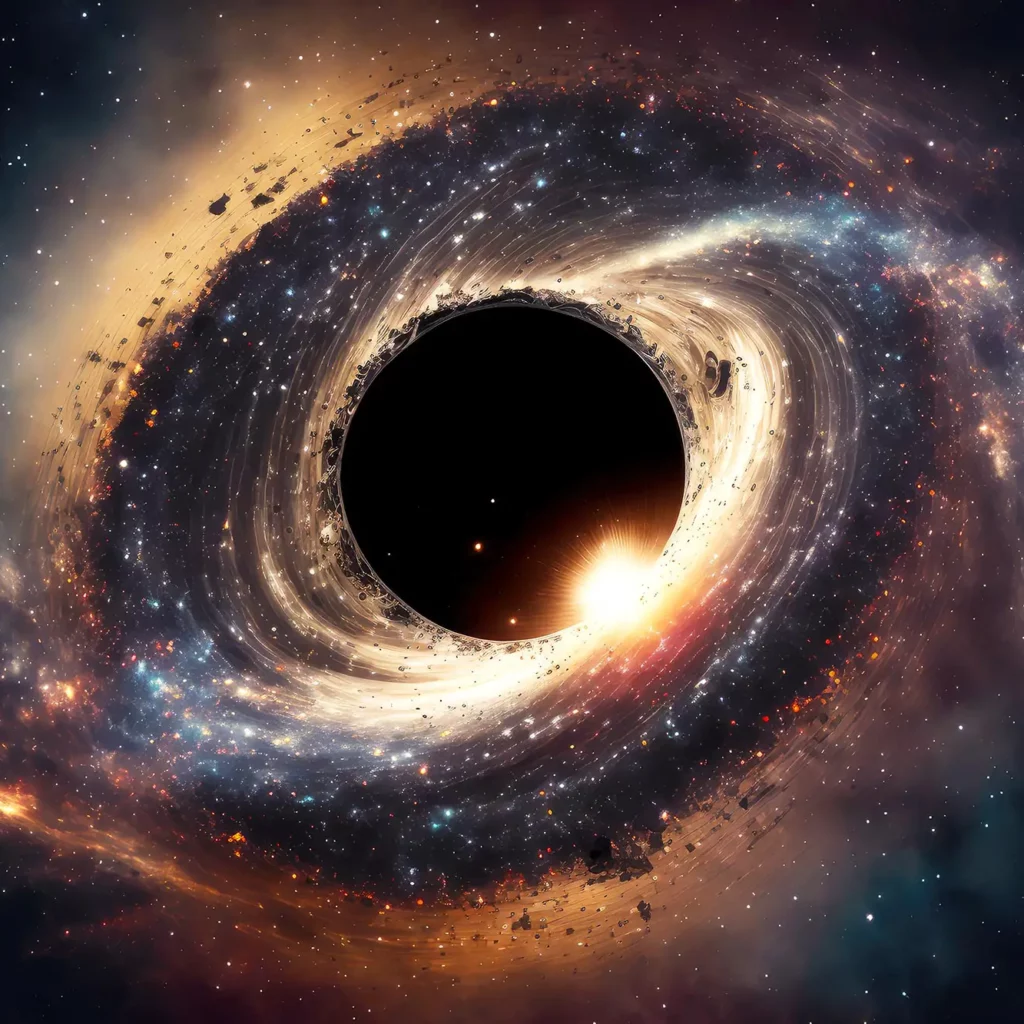
Black holes are extraordinary cosmic entities characterized by gravitational fields so intense that nothing, not even light, can escape their grasp. These regions in space represent some of the most mysterious and captivating phenomena in astrophysics, often described as cosmic voids or singularities where conventional laws of physics break down.
- Event Horizon:
The boundary surrounding a black hole beyond which escape is impossible. - Singularity:
A point at the center of a black hole where density becomes infinite and spacetime curvature is extreme.
Historical Context and Discovery
The concept of black holes emerged from theoretical predictions in the early 20th century, but it was not until the mid-1900s that observational evidence began to support their existence. Scientists inferred black holes indirectly by studying the behavior of nearby matter and detecting high-energy emissions such as X-rays, which indicated the presence of massive, compact objects exerting powerful gravitational forces.
Initially, black holes were thought to be rare and located far from Earth, but recent findings suggest they may be more common and closer than previously believed, prompting a reevaluation of their role within our galactic environment.
Technological Advances in Black Hole Observation
Breakthroughs in observational technology have revolutionized black hole research. Instruments like the Event Horizon Telescope (EHT) have enabled astronomers to capture the first direct images of a black hole’s shadow, transforming theoretical concepts into observable phenomena. Enhanced interferometry and sensitive detectors across various wavelengths have expanded our ability to study black holes with unprecedented precision.
Fundamental Physics and Black Holes
Black holes serve as natural laboratories where the fundamental forces of nature intersect, particularly gravity, quantum mechanics, and thermodynamics. The singularity challenges classical physics, necessitating new theories such as quantum gravity to explain conditions at these extreme scales.
The event horizon introduces profound scientific and philosophical questions, especially with the prediction of Hawking radiation-a quantum effect that suggests black holes can emit particles and gradually evaporate. This phenomenon raises important issues regarding information loss, entropy, and the reconciliation of quantum theory with general relativity.
Role of Black Holes in Galactic Evolution
Far from being mere cosmic vacuum cleaners, black holes, especially supermassive ones at galactic centers, play a crucial role in shaping galaxies. Their gravitational influence affects star formation, galactic structure, and the distribution of interstellar matter. Understanding these feedback processes is essential for comprehending the lifecycle and dynamics of galaxies over billions of years.
Interdisciplinary Approaches to Black Hole Research
The complexity of black holes demands collaboration across multiple scientific disciplines. Theoretical physicists develop models to describe their properties, astrophysicists gather and interpret observational data, and computational scientists employ simulations and machine learning to analyze vast datasets. This integrated approach accelerates progress in unraveling the mysteries of black holes.
Common Misconceptions About Black Holes
Black holes are cosmic vacuum cleaners that indiscriminately suck in everything.
Black holes exert gravitational pull like any other massive object; objects must be within a certain proximity to be captured.
Black holes are eternal and unchanging.
Due to Hawking radiation, black holes can lose mass and eventually evaporate over extremely long timescales.
Why Understanding Black Holes Is Important
Studying black holes is vital for advancing our knowledge of the universe’s fundamental laws and the nature of spacetime. They challenge existing theories and inspire new physics, bridging gaps between quantum mechanics and general relativity. Additionally, black holes influence cosmic evolution and structure, making them key to understanding the universe’s past, present, and future.
Real-World Implications and Future Directions
The discovery that black holes may be more prevalent and closer to Earth than once thought opens new avenues for research and technological development. Improved detection methods and observational tools will deepen our insight into their properties and effects on the cosmic environment. As we continue to explore these enigmatic objects, black holes remain a profound symbol of the limits and possibilities of human knowledge.
FAQ
What is a black hole?
A black hole is a region in space where the gravitational pull is so strong that nothing, not even light, can escape from it.
How are black holes formed?
Black holes can form from the remnants of massive stars that collapse under their own gravity.
What role do black holes play in galaxies?
They influence star formation, galactic structure, and the distribution of interstellar matter.
Can black holes evaporate?
Yes, black holes can lose mass and evaporate over extremely long timescales due to Hawking radiation.




Leave a Reply