

Short Answer
Definition of Dark Matter
Dark matter is a mysterious and invisible substance that permeates the universe, eluding direct detection by conventional telescopes and electromagnetic radiation. Despite its invisibility, it exerts a profound gravitational influence, shaping the formation and cohesion of galaxies and large-scale cosmic structures. Accounting for approximately 27% of the universe’s total mass-energy composition, dark matter remains one of the most perplexing enigmas in contemporary astrophysics.
Role and Significance in the Universe
While ordinary, luminous matter-such as stars, planets, and nebulae-constitutes less than 5% of the cosmos, dark matter forms an unseen framework that holds visible matter together across vast distances. It acts as the gravitational glue that maintains the structural integrity of galaxies and clusters, orchestrating the cosmic dance of celestial bodies. This invisible scaffold is essential for understanding the universe’s evolution and large-scale architecture.
Mechanisms Behind Dark Matter’s Influence
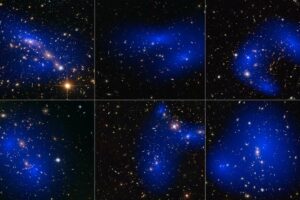
Dark matter reveals its presence primarily through gravitational effects rather than electromagnetic interactions. Its gravitational pull affects the rotation speeds of galaxies, the motion of galaxy clusters, and the bending of light from distant objects-a phenomenon known as gravitational lensing. These observations suggest that dark matter interacts weakly, if at all, with ordinary matter and light, making it detectable only through its gravitational footprint.
Theoretical Perspectives and Hypotheses
Scientists have proposed various theories to explain the nature of dark matter. The leading candidates include exotic particles such as Weakly Interacting Massive Particles (WIMPs), which are hypothesized to interact via gravity and possibly the weak nuclear force but evade electromagnetic detection. Alternative frameworks, like Modified Newtonian Dynamics (MOND), suggest that the laws of gravity themselves might differ at galactic scales, potentially eliminating the need for dark matter. Other speculative ideas explore dark matter as a manifestation of quantum fluctuations, hidden dimensions, or even as a phenomenon emerging from the fabric of spacetime itself.
Experimental Efforts to Detect Dark Matter
In pursuit of direct evidence, researchers have developed highly sensitive detectors placed deep underground or in space to capture rare interactions between dark matter particles and ordinary matter. Despite decades of experimentation, these elusive particles have yet to be observed directly, prompting questions about the validity of current models and the possibility that dark matter may exist in forms not yet conceived by science.
Mathematical Framework and Formulas
The gravitational effects of dark matter are often incorporated into cosmological models through modifications of Newtonian gravity and Einstein’s General Relativity. For example, the rotation velocity ( v(r) ) of stars in a galaxy at radius ( r ) can be expressed as:
- Rotation velocity formula:
( v(r) = sqrt{frac{G M(r)}{r}} ) - Variables:
( G ) is the gravitational constant, ( M(r) ) is the mass enclosed within radius ( r ), including both visible and dark matter components.
Discrepancies between observed rotation curves and those predicted by visible matter alone imply the presence of additional unseen mass, attributed to dark matter.
Real-World Examples and Observations
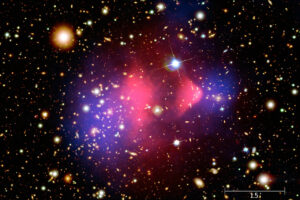
One of the most compelling pieces of evidence for dark matter comes from the study of galactic rotation curves, where stars orbit at unexpectedly high speeds far from galactic centers. Another example is the Bullet Cluster, a collision of galaxy clusters where the separation of visible matter and gravitational mass distribution strongly supports the existence of dark matter. Gravitational lensing observations also reveal mass concentrations that cannot be accounted for by luminous matter alone.
Implications Beyond Astrophysics
The mystery of dark matter extends its influence beyond the realm of astrophysics into philosophy, speculative fiction, and even cognitive sciences. It challenges our understanding of existence and invisibility, suggesting that unseen forces may govern not only cosmic structures but potentially aspects of consciousness and societal dynamics. The quest to comprehend dark matter invites a broader reflection on the nature of reality and the limits of human perception.
Emerging Theoretical Models
Advanced theories in particle physics, such as supersymmetry and string theory, propose new candidates for dark matter particles residing in hidden dimensions or interacting through unknown forces. These models, while mathematically rigorous, push the boundaries of empirical science and open avenues for exploring realms beyond current observational capabilities. Each theoretical development enriches the dialogue between experimental data and conceptual innovation.
Why Understanding Dark Matter Is Crucial
Deciphering the true nature of dark matter is pivotal for advancing our comprehension of the universe’s composition, evolution, and fundamental laws. It holds the potential to revolutionize physics, akin to the transformative impacts of the Copernican heliocentric model or Darwinian evolution. Beyond scientific progress, unraveling this cosmic mystery fuels human curiosity and expands the horizons of knowledge, reminding us of the vast, intricate, and often hidden complexity of existence.
FAQ
What is dark matter?
Dark matter is a form of matter that does not emit or interact with electromagnetic radiation, making it invisible. It is detected through its gravitational effects on visible matter.
How do we know dark matter exists?
Dark matter is inferred from phenomena such as the unexpectedly fast rotation speeds of galaxies, gravitational lensing, and the mass distribution seen in galaxy cluster collisions.
What experiments are being done to detect dark matter?
Experiments use underground detectors and space-based observatories to search for rare interactions between dark matter particles and ordinary matter, though none have yet been confirmed.
Could dark matter be explained without new particles?
Some theories propose modifications to gravity laws at galactic scales (e.g., MOND) that might explain observations without invoking dark matter particles.

Leave a Reply