
Short Answer
Definition of a Light-Year
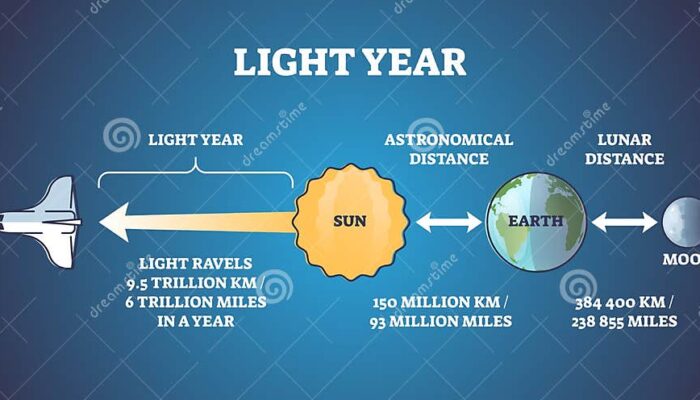
A light-year is a unit used to express astronomical distances, defined as the length that light travels in a vacuum over the course of one Earth year. Despite the inclusion of the word “year,” it is important to recognize that a light-year measures distance, not time. Light moves at an extraordinary velocity of roughly 299,792 kilometers per second (approximately 186,282 miles per second), enabling it to cover nearly 9.46 trillion kilometers (about 5.88 trillion miles) within a single year. This immense scale makes the light-year an essential metric for describing the vast separations between celestial objects, which would otherwise be cumbersome to convey using conventional units like kilometers or miles.
Relationship Between Distance and Time in a Light-Year
Although a light-year is fundamentally a distance measurement, it inherently incorporates a temporal element. When astronomers state that a star is, for example, 10 light-years away, they mean that the light reaching Earth from that star began its journey a decade ago. Consequently, observing distant stars and galaxies is akin to looking back in time, as the light we detect today carries information from the past. This dual nature of the light-year-linking spatial distance with the passage of time-provides profound insights into the universe’s structure and history.
Comparison with Other Astronomical Distance Units
In addition to the light-year, astronomers use other units to measure cosmic distances, such as the parsec. One parsec equals approximately 3.26 light-years and is derived from the method of parallax, which involves measuring the apparent shift of a star against distant background stars as Earth orbits the Sun. Unlike the light-year, which is based on the constant speed of light and a fixed time interval, the parsec is grounded in geometric triangulation. This distinction highlights the variety of approaches used in astronomy to quantify distances, each tailored to specific observational techniques and scientific needs.
Scientific Significance and Physical Principles
The concept of a light-year is deeply connected to fundamental physics, particularly the constant speed of light, which is a cornerstone of Einstein’s theory of relativity. Since no object or information can travel faster than light, the light-year establishes a natural boundary on how quickly signals and matter can move through space. This limitation has important implications for understanding causality, the structure of space-time, and the observable universe. Thus, the light-year is not merely a practical unit but also a gateway to exploring foundational concepts in modern physics.
Applications in Astronomy and Astrophysics
Light-years serve as a critical tool for astronomers and astrophysicists to map and analyze the universe. They enable the measurement and classification of distances to stars, galaxies, and other celestial phenomena such as supernovae and quasars. By correlating the light observed with the time it was emitted, scientists can construct a timeline of cosmic events, facilitating a deeper understanding of the universe’s evolution. This framework allows researchers to interpret the vast cosmic landscape and its dynamic processes with greater clarity.
Light-Years in Popular Culture and Education
Beyond scientific contexts, the term light-year has permeated popular culture, often symbolizing futuristic travel, immense distances, and the grandeur of the cosmos. It frequently appears in science fiction narratives, where interstellar voyages are described in terms of light-years, helping audiences visualize the scale of space exploration. Educational institutions and museums also utilize the concept to communicate the enormity of the universe to the public. Visual tools such as diagrams and animations illustrate how light-years translate into the time it takes for light to reach Earth, making abstract cosmic distances more accessible. For example, Proxima Centauri, the closest star to the Sun, lies about 4.24 light-years away, meaning the light we see today left that star over four years ago, providing a tangible sense of cosmic time.
Clarifying Common Confusions About Light-Years
It is crucial to avoid misunderstanding a light-year as a measure of travel time for objects other than light. The “year” in light-year refers solely to the time interval used to define the distance light covers in that period. For instance, a spacecraft traveling at 10% of the speed of light would require ten years to traverse one light-year. Therefore, the light-year remains a distance metric, even though it inherently references a temporal duration.
Why Understanding Light-Years Is Important
The light-year embodies a unique fusion of spatial and temporal dimensions, quantifying how far light travels over a standardized time frame. This duality enriches our comprehension of the universe by revealing not only the vast distances between celestial bodies but also the historical context of the light we observe. Grasping this concept enhances scientific literacy and deepens the appreciation of the cosmos’ immense scale and the fundamental speed limit set by light. Ultimately, the light-year stands as a testament to the intertwined nature of space and time, shaping humanity’s understanding of its place in the universe.
FAQ
Is a light-year a measure of time?
No, despite the name, a light-year measures distance, specifically how far light travels in one year.
How far does light travel in a light-year?
Light travels about 9.46 trillion kilometers or 5.88 trillion miles in one light-year.
What is the difference between a light-year and a parsec?
A parsec is a distance unit based on stellar parallax and equals about 3.26 light-years.
Why is a light-year important in astronomy?
It helps measure vast cosmic distances and allows astronomers to look back in time by observing light emitted years ago.

Leave a Reply