
Short Answer
Definition of Exoplanets and Their Significance
Exoplanets are celestial bodies that orbit stars beyond our own solar system. They represent a captivating area of study in modern astrophysics, offering insights into the formation and evolution of planetary systems throughout the galaxy. The direct observation of an exoplanet orbiting its host star marks a pivotal milestone in this field, providing invaluable data that enhances our understanding of planetary dynamics and the conditions that foster planet formation.
The Beta Pictoris System: A Natural Laboratory
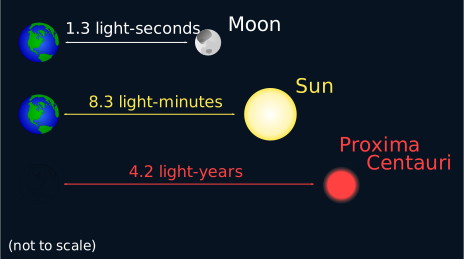
Situated roughly 63 light-years away in the constellation Pictor, the Beta Pictoris system features a young, luminous A-type star encircled by a dense circumstellar disk composed of gas and dust. This disk contains the fundamental materials necessary for planet formation. With an estimated age of about 12 million years, Beta Pictoris offers a rare glimpse into the early stages of planetary development, making it an exceptional subject for astrophysical research.
- Host Star:
A young A-type star, bright and massive, providing the energy that influences the surrounding disk. - Circumstellar Disk:
A rich mixture of gas and dust, serving as the birthplace of planets within the system. - System Age:
Approximately 12 million years, indicating a relatively nascent planetary environment.
Direct Imaging of Exoplanets: Techniques and Challenges
While many exoplanets have been discovered through indirect methods such as the transit technique-which detects dips in stellar brightness as planets pass in front of their stars-direct imaging offers a more immediate view. This approach captures actual images of exoplanets by isolating their faint light from the overwhelming glare of their host stars.
Direct imaging requires advanced technologies like adaptive optics, which correct for atmospheric distortions caused by Earth’s turbulent air. These systems enable astronomers to discern the subtle light emitted or reflected by exoplanets, allowing for real-time tracking of their orbital motion.
Beta Pictoris b: Characteristics and Observational Insights
Beta Pictoris b is a giant exoplanet residing within the circumstellar disk of its host star. It is approximately 12 times the size of Jupiter and orbits at a significant distance, making it an ideal candidate for detailed atmospheric study.
- Size and Mass:
A gas giant with a mass and radius substantially larger than Jupiter. - Orbital Distance:
Positioned far enough from its star to allow direct observation and atmospheric analysis. - Atmospheric Composition:
Spectroscopic studies reveal molecules such as methane, indicating complex chemical processes similar to those found in gas giants of our solar system.
Planetary Formation and Evolution: Insights from Beta Pictoris b
The direct observation of Beta Pictoris b’s orbit provides critical evidence to refine existing models of how planets form and evolve. Two primary theories dominate this field:
- Core Accretion:
Planets form gradually as dust and gas coalesce around a solid core. - Gravitational Instability:
Rapid formation occurs through the collapse of dense regions within the protoplanetary disk.
Data from Beta Pictoris b supports the notion that planetary systems can exhibit a wide range of orbital configurations, from tight, close-in orbits to expansive, distant paths. This diversity underscores the complexity of planetary system architectures.
Dynamic Interactions and Orbital Migration
Planets like Beta Pictoris b do not exist in isolation; their orbits are influenced by interactions with residual gas and dust in their natal disks. These interactions can cause orbital migration, altering the planet’s trajectory over time. Such dynamical processes may lead to resonances-gravitational relationships between planets-that shape the overall stability and structure of the planetary system.
Implications for Habitability and Astrobiology
Studying the environment around Beta Pictoris b offers valuable clues about the conditions that might foster habitable worlds. The gravitational forces and material exchanges within the system can influence the potential for life-supporting planets to develop. Understanding these mechanisms enhances our broader search for life beyond Earth by identifying the factors that contribute to habitability in diverse planetary systems.
Interdisciplinary Collaboration in Exoplanet Research
The exploration of exoplanets like Beta Pictoris b exemplifies the synergy between multiple scientific disciplines, including astronomy, planetary science, and astrobiology. This collaborative approach enriches theoretical models and observational techniques, driving forward our comprehensive understanding of planetary systems and their evolution.
Conclusion: Advancing Our Cosmic Perspective
The real-time observation of an exoplanet in motion, as demonstrated by Beta Pictoris b, highlights the remarkable progress in astronomical instrumentation and methodology. These findings not only deepen our knowledge of planetary formation and dynamics but also pave the way for future discoveries that will further unravel the complexities of distant worlds. Continued research promises to bridge the gap between theoretical predictions and empirical evidence, expanding our grasp of the universe’s vast and varied planetary landscapes.
FAQ
What is an exoplanet?
An exoplanet is a celestial body that orbits a star outside our solar system.
Why is Beta Pictoris b significant?
Its direct observation helps refine models of planetary formation and evolution.




Leave a Reply