
Short Answer
Definition of Shor’s Algorithm
Shor’s algorithm is a revolutionary quantum computing method designed to efficiently factorize large integers. Unlike classical algorithms, which face exponential time complexity as numbers grow, Shor’s algorithm leverages quantum mechanics to perform this task in polynomial time. This capability poses significant challenges to traditional cryptographic systems that rely on the difficulty of integer factorization for security.
Foundations in Number Theory
At the heart of Shor’s algorithm lies the fundamental concept of prime numbers, the indivisible building blocks of arithmetic. Multiplying two primes produces a composite number, but decomposing that composite back into its prime factors is a notoriously difficult problem for classical computers. This difficulty forms the basis of many encryption schemes, as factoring large composite numbers is computationally intensive and time-consuming using conventional methods.
Limitations of Classical Factoring Algorithms
Classical approaches, such as the number field sieve, can factor integers but their efficiency deteriorates rapidly with increasing number size. The time required grows exponentially, making them impractical for very large numbers commonly used in cryptography. This exponential growth in complexity underpins the security assumptions of many encryption protocols.
Quantum Computing and Shor’s Algorithm
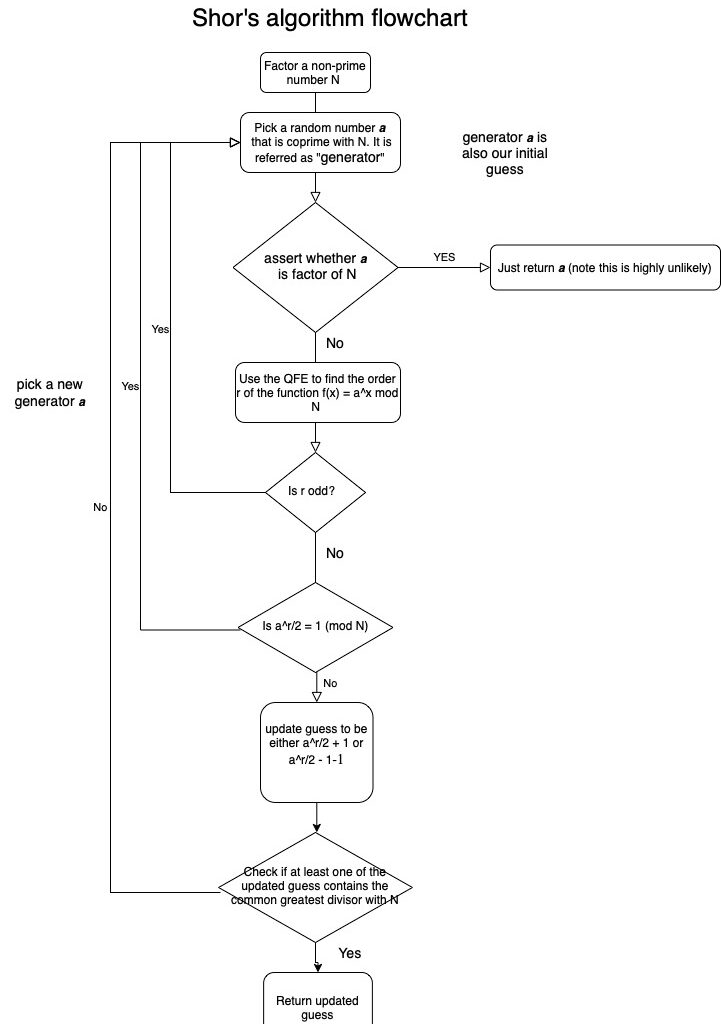
Shor’s algorithm exploits unique quantum phenomena like superposition and entanglement to accelerate the factoring process. It operates in two main stages: a quantum phase and a classical phase. The quantum phase utilizes the quantum Fourier transform (QFT), a critical mathematical operation that uncovers periodicity in the problem’s structure by manipulating quantum states. This phase effectively harnesses the interference patterns of probability amplitudes to extract hidden information.
Quantum Phase
- Quantum Fourier Transform (QFT):
A quantum analogue of the classical Fourier transform, QFT is essential for detecting periodicity in quantum states, enabling the algorithm to identify factors efficiently. - Superposition and Entanglement:
These quantum properties allow the algorithm to process multiple possibilities simultaneously, vastly speeding up the search for factors.
Classical Phase
Following the quantum computations, the classical phase uses traditional algorithms to interpret the quantum output and extract the prime factors. This hybrid approach combines the strengths of quantum and classical computing to achieve a dramatic reduction in computational time.
Mathematical Explanation and Complexity
Shor’s algorithm reduces the integer factorization problem from exponential time complexity, typical of classical methods, to polynomial time. The key mathematical insight involves finding the period r of the function f(x) = a^x mod N, where N is the composite number to be factored and a is a randomly chosen integer coprime to N. Once the period r is determined, the factors of N can be derived using the greatest common divisor (GCD) function.
Key formula:
If r is even and a^{r/2} notequiv -1 pmod{N}, then factors of N are given by:
- ( gcd(a^{r/2} – 1, N) )
- ( gcd(a^{r/2} + 1, N) )
Impact on Cryptography
Many encryption systems, including RSA, rely on the assumption that factoring large composite numbers is computationally infeasible. Shor’s algorithm undermines this assumption by providing a method to factor these numbers efficiently on a sufficiently powerful quantum computer. This revelation has sparked a surge in research focused on developing quantum-resistant cryptographic algorithms, collectively known as post-quantum cryptography.
Post-Quantum Cryptography
In response to the threat posed by quantum algorithms like Shor’s, the field of post-quantum cryptography aims to create encryption methods that remain secure even against quantum attacks. These new protocols often rely on mathematical problems believed to be hard for both classical and quantum computers, such as lattice-based, hash-based, and code-based cryptography.
Broader Applications of Shor’s Algorithm
Beyond cryptography, Shor’s algorithm exemplifies the transformative potential of quantum computing across various scientific disciplines. Its ability to solve complex problems efficiently could accelerate advancements in fields such as materials science, molecular biology, and optimization problems, where classical computation faces significant limitations.
Common Misconceptions About Shor’s Algorithm
Shor’s algorithm can be run on any current computer.
It requires a sufficiently large and error-corrected quantum computer, which is still under development.
Shor’s algorithm instantly breaks all encryption.
While it threatens certain cryptographic schemes, practical quantum computers capable of running Shor’s algorithm at scale do not yet exist, and alternative cryptographic methods are being developed.
Significance in the Quantum Era
Shor’s algorithm represents a pivotal milestone in the evolution of computing, highlighting the profound interplay between quantum mechanics and computational theory. It challenges existing paradigms, urging a reevaluation of security protocols and inspiring innovation in algorithm design. As quantum technology progresses, understanding and adapting to the implications of Shor’s algorithm will be crucial for safeguarding digital infrastructure and harnessing the full potential of quantum computation.
FAQ
What is Shor's algorithm?
Shor’s algorithm is a quantum computing method for efficiently factorizing large integers, which poses a threat to classical cryptographic systems.
How does Shor's algorithm impact cryptography?
It undermines the security of encryption systems like RSA by allowing efficient factorization of large numbers.





Leave a Reply