
Short Answer
Definition of Elementary Particles
Elementary particles are the most fundamental constituents of matter and energy in the universe. Unlike composite particles, they are not known to be made up of smaller components. These particles form the basis of all physical substances and forces, serving as the essential building blocks in the fabric of reality.
- Fermions:
Particles that make up matter, including quarks and leptons. - Bosons:
Particles responsible for mediating fundamental forces between matter particles.
Classification and Characteristics
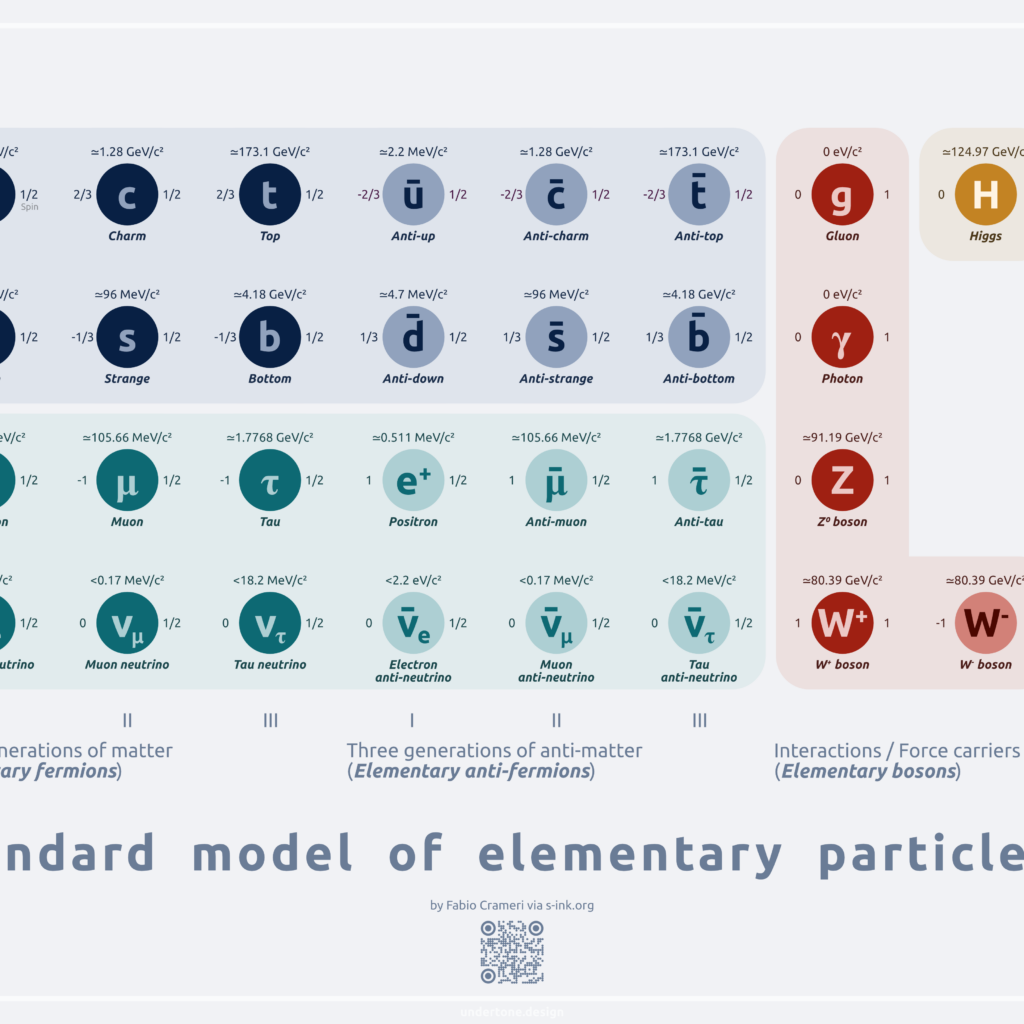
Elementary particles are primarily divided into two categories: fermions and bosons, each with distinct roles and properties.
Fermions: The Matter Constituents
Fermions are the particles that constitute matter. They obey the Pauli exclusion principle, which prevents identical fermions from occupying the same quantum state simultaneously. Fermions are further split into two groups:
- Quarks: These particles combine to form protons and neutrons, the core components of atomic nuclei. Quarks interact via the strong nuclear force, which is mediated by gluons.
- Leptons: This group includes electrons, muons, and neutrinos. Leptons participate in various fundamental interactions and are crucial for the structure of atoms and subatomic processes.
Bosons: The Force Carriers
Bosons are particles that facilitate the fundamental forces of nature. Unlike fermions, bosons can occupy the same quantum state, allowing them to mediate interactions between matter particles. Key bosons include:
- Photons: Mediators of the electromagnetic force.
- W and Z Bosons: Responsible for the weak nuclear force, which governs certain types of particle decay.
- Gluons: Carriers of the strong nuclear force binding quarks together.
- Higgs Boson: Associated with the Higgs field, it explains how particles acquire mass.
The Standard Model Framework
The Standard Model of particle physics is the prevailing theory that organizes and explains the behavior and interactions of elementary particles. It integrates the classification of fermions and bosons and describes how these particles interact through fundamental forces.
A central feature of the Standard Model is the explanation of mass via the Higgs mechanism. The Higgs field permeates all space, and particles gain mass through their interaction with this field. The discovery of the Higgs boson in 2012 provided experimental confirmation of this mechanism, deepening our understanding of particle properties.
Quantum Nature and Philosophical Implications
Elementary particles challenge classical notions of substance and identity. According to quantum mechanics, particles do not possess definite properties until measured; instead, they exist as probability distributions governed by wavefunctions. The Heisenberg Uncertainty Principle highlights the intrinsic limitations in simultaneously knowing certain pairs of properties, such as position and momentum.
From a philosophical perspective, elementary particles can be viewed as excitations of underlying quantum fields rather than discrete, tangible objects. This viewpoint suggests that reality is fundamentally relational, shaped by interactions and symmetries rather than by material substance alone.
Interactions and Particle Transformations
Fundamental forces arise from the exchange of bosons between particles, creating a dynamic network of interactions that define the structure and behavior of matter. For example, electromagnetic interactions occur through photon exchange between charged particles, maintaining atomic and molecular stability.
Particle decay processes illustrate that elementary particles can transform into other particles, conserving fundamental quantities such as energy and charge. These transformations underscore the principle that particles are not destroyed but reconfigured within the quantum framework.
Beyond the Standard Model: Dark Matter and Dark Energy
While the Standard Model successfully describes known particles and forces, it does not account for dark matter and dark energy, which together constitute about 95% of the universe’s total mass-energy content. These mysterious components remain undetected directly and suggest the existence of unknown elementary particles or new physics beyond the current model.
Ongoing research aims to identify these elusive particles, which could revolutionize our understanding of the universe and expand the particle physics paradigm.
Why Understanding Elementary Particles Is Crucial
Studying elementary particles is fundamental to comprehending the universe at its most basic level. These particles not only form the matter around us but also govern the forces and interactions that shape cosmic evolution. Insights into their nature have profound implications for technology, cosmology, and our philosophical grasp of existence.
Advancements in particle physics continue to push the boundaries of knowledge, potentially unlocking new technologies and deepening our appreciation of the universe’s intricate design.
Summary
Exploring what elementary particles are made of leads us to a profound understanding that these particles are not composed of smaller parts but are manifestations of fundamental fields and interactions. They embody the principles of quantum mechanics and the symmetries of nature, forming the cornerstone of matter and forces. As scientific inquiry progresses, our grasp of these particles may illuminate the very architecture of the cosmos and our place within it.
FAQ
What are elementary particles?
Elementary particles are the most fundamental building blocks of matter and forces, not made of smaller components.
What is the difference between fermions and bosons?
Fermions make up matter particles like quarks and leptons, while bosons mediate forces such as photons and gluons.
How do elementary particles get their mass?
Elementary particles gain mass through their interaction with the Higgs field, mediated by the Higgs boson.
Are elementary particles made of anything smaller?
Current physics considers elementary particles as fundamental, meaning they are not made of anything smaller.
What role does quantum mechanics play in understanding elementary particles?
Quantum mechanics describes the probabilistic behavior and interactions of elementary particles, challenging classical notions of definite properties.






Leave a Reply