
Short Answer
Definition of Fiber Optics Technology
Fiber optics technology refers to the transmission of information as pulses of light through strands of glass or plastic fibers. This method leverages the properties of light to carry data over long distances with minimal loss, enabling high-speed communication and a variety of applications across multiple industries.
- Core Concept:
Using light signals to transmit data through flexible, transparent fibers. - Material Basis:
Typically involves ultra-pure glass or plastic fibers designed to guide light efficiently. - Primary Use:
Telecommunications, medical imaging, data networks, and more.
Historical Development of Fiber Optics
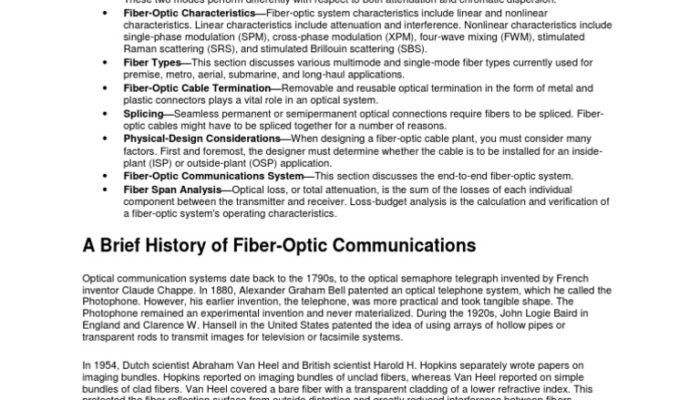
The evolution of fiber optics spans nearly two centuries, beginning with early scientific inquiries into light transmission through transparent media. In the early 1800s, foundational theories on wave propagation were established, setting the stage for future innovations. Notably, Hans Christian Oersted’s work in 1820 introduced key principles of electromagnetic waves, while John Tyndall’s experiments in 1854 demonstrated that light could be directed along curved paths through water, illustrating the potential for guided light transmission.
Mid-19th century experiments by Daniel Colladon and Jacques Babinet further advanced the field by showing that light could travel through glass tubes, laying the groundwork for modern fiber optics. The 20th century brought significant breakthroughs, especially during the 1960s when Charles K. Kao and George Hockham identified the causes of signal loss in glass fibers and proposed methods to reduce attenuation. Their research catalyzed the development of ultra-pure glass fibers capable of transmitting light over long distances with minimal degradation.
Mechanism of Fiber Optic Communication
Fiber optic communication operates by transmitting light signals through thin strands of glass or plastic fibers. These fibers are designed to confine light within their core by means of total internal reflection, allowing the light to travel long distances with very little loss. The process involves converting electrical signals into light pulses, sending them through the fiber, and then converting them back into electrical signals at the receiving end.
- Total Internal Reflection:
Light is trapped inside the fiber core by reflecting off the boundary between the core and the cladding, ensuring minimal signal loss. - Signal Conversion:
Electrical data is transformed into light pulses using lasers or LEDs, then reconverted at the destination. - Low Attenuation:
Advances in material purity reduce signal weakening, enabling long-distance transmission.
Mathematical Explanation and Key Formulas
The performance of fiber optics can be quantified using several key parameters and formulas:
- Attenuation (α):
Represents the loss of signal strength per unit length, typically measured in decibels per kilometer (dB/km).
Formula: α = (10 / L) × log₁₀(P_in / P_out)
Where L is fiber length, P_in is input power, and P_out is output power. - Numerical Aperture (NA):
Defines the light acceptance angle of the fiber.
Formula: NA = √(n_core² – n_cladding²)
Where n_core and n_cladding are refractive indices of the core and cladding respectively. - Bandwidth-Distance Product:
Indicates the data-carrying capacity over a given distance, crucial for communication efficiency.
Applications and Real-World Examples
Fiber optics have become indispensable in numerous fields due to their high-speed and reliable data transmission capabilities:
- Telecommunications:
Fiber optic cables form the backbone of global internet infrastructure, enabling rapid data exchange and long-distance communication. - Medical Field:
Used in endoscopy and minimally invasive surgeries, fiber optics allow doctors to view internal organs with precision and minimal patient trauma. - Data Centers and Networks:
Fiber optic networks support the massive data flow required by cloud computing, streaming services, and large-scale data processing. - Military and Aerospace:
Provide secure, high-bandwidth communication channels resistant to electromagnetic interference.
Common Misconceptions About Fiber Optics
Fiber optic cables are fragile and easily broken.
Modern fiber optic cables are engineered with protective coatings and robust materials, making them durable and suitable for various environments.
Fiber optics are only useful for internet and phone services.
Beyond telecommunications, fiber optics play critical roles in medicine, military, industrial sensing, and more.
Fiber optic installation is prohibitively expensive.
While initial infrastructure costs can be high, the long-term benefits of speed, capacity, and reliability often outweigh the investment.
Significance and Future Prospects
Fiber optics technology is a cornerstone of modern communication, enabling the rapid exchange of vast amounts of data essential for the digital age. Its impact extends beyond connectivity, influencing healthcare, scientific research, and national security. As technology advances, integrating artificial intelligence with fiber optic systems promises enhanced network management and efficiency. Furthermore, emerging quantum communication techniques may leverage fiber optics to achieve unprecedented levels of data security and transmission speed.
Despite challenges such as infrastructure costs and equitable access, fiber optics continue to drive innovation and societal progress. Their role as a critical enabler of global connectivity underscores their enduring importance in shaping the future of communication and technology.
FAQ
What is fiber optics technology?
Fiber optics technology involves transmitting data as light pulses through thin glass or plastic fibers, enabling fast and efficient communication.
Who contributed to the invention of fiber optics?
Contributions came from Hans Christian Oersted, John Tyndall, Daniel Colladon, Jacques Babinet, Charles K. Kao, and George Hockham.
When did fiber optics become viable for telecommunications?
Fiber optics became viable in the 1970s with the invention of low-loss optical fibers and the launch of the first long-distance fiber optic system by AT&T in 1977.
What are some modern applications of fiber optics?
They include telecommunications, medical endoscopy, internet infrastructure, and emerging fields like AI-enhanced communication and quantum networking.
What challenges affect fiber optics deployment?
Challenges include high infrastructure costs, regulatory issues, and ensuring equitable access to fiber networks.




Leave a Reply