
Short Answer
Definition of Elementary Particles
Elementary particles are the most basic units of matter and energy in the universe, often described as the fundamental “letters” composing the cosmic language. Unlike composite particles, these entities are indivisible and lack any smaller internal structure. They form the essential foundation upon which all physical matter and forces are built, making them central to the study of particle physics.
Classification of Elementary Particles
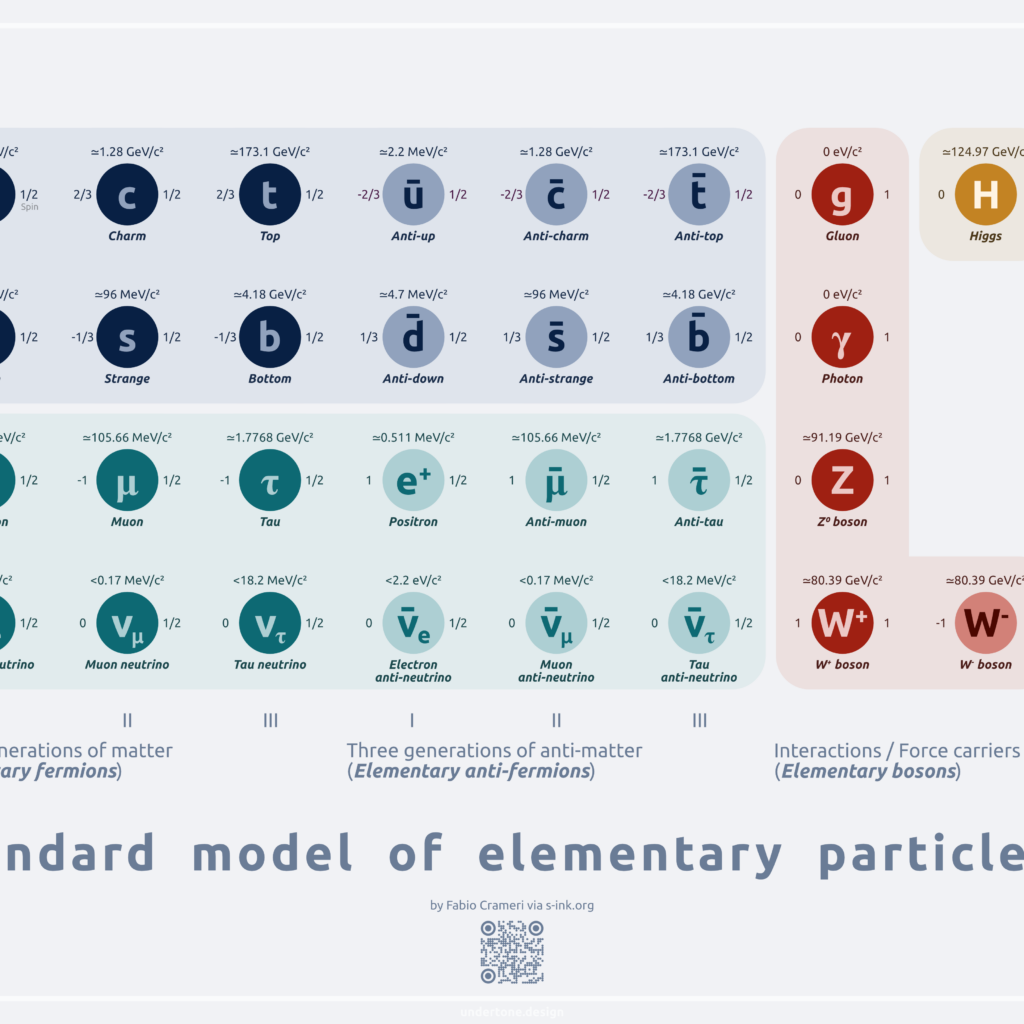
The Standard Model of particle physics provides the primary framework for categorizing elementary particles. According to this model, all matter arises from a finite set of fundamental particles, which are divided into two main groups: fermions and bosons. Each group plays a unique role in the universe’s structure and dynamics.
Fermions: The Building Blocks of Matter
Fermions constitute the matter content of the universe. They include quarks and leptons, which possess intrinsic properties such as electric charge, mass, and spin. Quarks combine to form protons and neutrons, the constituents of atomic nuclei, while leptons include the electron and its heavier counterparts, the muon and tau. These particles interact to create the tangible material world, analogous to individual notes composing a complex symphony.
Bosons: Force Carriers
Bosons act as the mediators of fundamental forces between particles. For example, photons are massless bosons responsible for transmitting the electromagnetic force, while gluons bind quarks together within protons and neutrons through the strong nuclear force. The Higgs boson plays a pivotal role by imparting mass to other particles via the Higgs mechanism. In this way, bosons orchestrate the interactions that govern the behavior of fermions, much like a conductor leading an orchestra.
How Elementary Particles Function
Elementary particles interact through fundamental forces, each mediated by specific bosons. Fermions serve as the constituents of matter, while bosons facilitate the forces that enable particles to attract, repel, or transform. These interactions occur within the framework of quantum field theory, where particles are excitations of underlying fields permeating spacetime.
Mathematical Framework and Formulas
The behavior and properties of elementary particles are described mathematically by the Standard Model Lagrangian, which encapsulates the dynamics of fermions and bosons. Key variables include:
- ψ (Psi):
Represents fermion fields such as quarks and leptons. - Aμ (A-mu):
Denotes gauge boson fields like photons and gluons. - g:
Coupling constants that determine interaction strengths. - m:
Mass terms, often generated through the Higgs mechanism.
These components combine in complex equations that predict particle interactions, decay rates, and scattering processes, forming the backbone of theoretical particle physics.
Real-World Applications and Discoveries
Research into elementary particles has yielded groundbreaking insights and technologies. The detection of the Higgs boson at the Large Hadron Collider (LHC) confirmed the mechanism by which particles acquire mass, validating decades of theoretical work. Beyond pure science, particle physics has contributed to advancements in medical imaging, such as PET scans, and the development of particle accelerators used in cancer treatment and materials science.
Unresolved Questions in Particle Physics
Despite significant progress, many mysteries remain:
- Matter-Antimatter Asymmetry:
Why does the universe contain more matter than antimatter? - Dark Matter:
What is the nature of dark matter, which exerts gravitational effects but remains undetectable by conventional means? - Force Unification:
How can the four fundamental forces be unified into a single theoretical framework?
These questions drive ongoing research, inspiring theories such as supersymmetry and string theory that aim to extend and unify our understanding of fundamental physics.
Common Misconceptions About Elementary Particles
Elementary particles are tiny balls.
They are better described as quantum excitations of fields rather than classical particles with definite size or shape.
All particles have mass.
Some elementary particles, like photons and gluons, are massless.
Elementary particles are static.
They constantly interact, transform, and exist in probabilistic states governed by quantum mechanics.
Significance of Elementary Particles
Understanding elementary particles is crucial for comprehending the universe at its most fundamental level. They form the basis of all matter and mediate the forces that shape the cosmos. Advances in this field not only deepen our grasp of nature’s laws but also fuel technological innovations that impact everyday life. The study of these particles embodies humanity’s quest to decode the universe’s origins, structure, and ultimate fate.
FAQ
What are elementary particles?
Elementary particles are the most basic building blocks of matter and energy, indivisible and without smaller components.
Why are they called elementary particles?
Because they cannot be broken down into smaller parts and serve as the fundamental constituents of the universe.
What are the two main types of elementary particles?
Fermions, which make up matter, and bosons, which mediate fundamental forces.
How do elementary particles interact?
They interact through fundamental forces, each mediated by specific bosons like photons and gluons.
What are some major unresolved questions about elementary particles?
The nature of dark matter, matter-antimatter asymmetry, and the unification of fundamental forces.






Leave a Reply