
Short Answer
Definition of Special Relativity
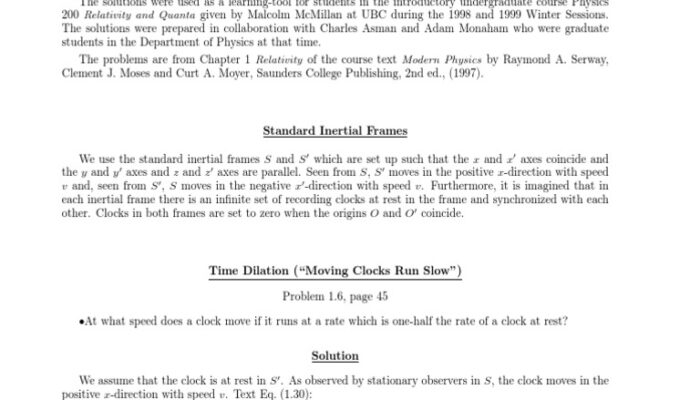
Special relativity is a fundamental theory in physics that revolutionizes our understanding of time, space, and the nature of reality. Formulated by Albert Einstein in 1905, it addresses the behavior of objects moving at speeds close to that of light, challenging the classical mechanics established by Newton. This theory provides a new framework for interpreting physical phenomena when velocities approach the speed of light, fundamentally altering concepts of simultaneity, motion, and energy.
Historical Background: The Emergence of Special Relativity
At the dawn of the 20th century, physics faced a critical conflict between classical mechanics and electromagnetic theory. The constancy of the speed of light, regardless of the observer’s motion, posed a significant challenge to existing scientific models. James Clerk Maxwell’s equations had already described electromagnetic fields, but reconciling these with Newtonian mechanics proved difficult. Einstein’s special relativity emerged as a groundbreaking solution, unifying these disparate ideas and overturning long-held assumptions about space and time.
Fundamental Principles of Special Relativity
Einstein’s theory rests on two essential postulates:
- Invariance of Physical Laws:
The laws governing physics are identical in all inertial frames of reference, meaning they do not change for observers moving at constant velocities relative to one another. - Constancy of the Speed of Light:
The speed of light in a vacuum is a universal constant, approximately 299,792,458 meters per second, and remains the same regardless of the motion of the light source or the observer.
These principles lead to profound consequences that redefine our understanding of time, space, and energy.
Mechanisms and Phenomena in Special Relativity
Time Dilation Explained
One of the most striking effects predicted by special relativity is time dilation. When an object moves at speeds approaching that of light, time appears to slow down for it relative to a stationary observer. This means that a moving clock ticks more slowly compared to one at rest. This phenomenon has been experimentally verified, such as through comparisons of atomic clocks on fast-moving aircraft versus those on the ground, confirming that time is not absolute but relative to the observer’s frame of reference.
Understanding Length Contraction
Alongside time dilation, special relativity predicts length contraction. Objects traveling near the speed of light contract in length along the direction of motion as seen by a stationary observer. This contraction becomes significant only at relativistic speeds and challenges classical intuitions about fixed spatial dimensions, revealing that measurements of length depend on the relative motion between observer and object.
Mass-Energy Equivalence: The Iconic Equation
Special relativity also introduces the profound equivalence between mass and energy, encapsulated in the equation E=mc². This formula expresses that mass can be converted into energy and vice versa, a principle that underpins nuclear reactions such as fission and fusion. This equivalence has far-reaching implications, influencing both theoretical physics and practical technologies, including energy generation and particle physics.
Mathematical Framework of Special Relativity
The mathematical foundation of special relativity involves transformations that relate space and time coordinates between different inertial frames, known as Lorentz transformations. These equations replace the classical Galilean transformations and ensure the invariance of the speed of light.
- Lorentz Transformation Equations:
For an object moving at velocity v relative to an observer, the coordinates transform as:
x’ = γ(x – vt)
t’ = γ(t – vx/c²)
where γ (the Lorentz factor) = 1 / √(1 – v²/c²), and c is the speed of light. - Variables:
x, t: position and time in the stationary frame
x’, t’: position and time in the moving frame
v: relative velocity between frames
c: speed of light
Applications and Real-World Examples
Special relativity is not merely theoretical; it has practical applications that impact modern technology and scientific research:
- Global Positioning System (GPS):
GPS satellites experience time dilation due to their high speeds and weaker gravitational fields compared to Earth’s surface. Corrections based on special relativity are essential to maintain the system’s accuracy. - Particle Accelerators:
Facilities like CERN accelerate particles to velocities near the speed of light, where relativistic effects become significant. Understanding these effects is crucial for predicting particle behavior and outcomes in experiments.
Common Misunderstandings About Special Relativity
- Misconception: Time dilation means time literally stops for fast-moving objects.
Correction: Time dilation means time passes more slowly relative to an observer, but it never stops completely. - Misconception: Length contraction is an illusion rather than a real effect.
Correction: Length contraction is a real physical phenomenon observed from a particular frame of reference, not merely a perceptual trick.
Significance of Special Relativity
Special relativity has transformed both scientific thought and practical technology. It challenges classical notions of absolute time and space, providing a more accurate description of the universe at high velocities. Its principles are foundational in modern physics, influencing fields from cosmology to quantum mechanics, and enabling technologies that rely on precise time and space measurements.
Philosophical and Cultural Impact
Beyond its scientific importance, special relativity captivates the imagination by reshaping our understanding of reality, time, and existence. It invites philosophical reflection on the nature of the universe and our place within it, inspiring curiosity and exploration beyond the boundaries of traditional science.
Future Directions in Relativity Research
Ongoing research seeks to integrate special relativity with quantum mechanics and general relativity, aiming for a unified theory that explains all fundamental forces. Advances in this area promise to deepen our comprehension of the cosmos and may reveal new phenomena that extend beyond current theoretical frameworks.
Summary
Special relativity stands as a cornerstone of modern physics, redefining our concepts of time, space, and energy. Its principles have been rigorously tested and applied, influencing both theoretical understanding and practical technologies. As science progresses, the insights from special relativity continue to guide exploration into the fundamental workings of the universe.
FAQ
What is special relativity?
Special relativity is a theory formulated by Albert Einstein that explains how the laws of physics are the same for all inertial observers and that the speed of light is constant regardless of the motion of the source or observer.
What are the two main postulates of special relativity?
The two main postulates are: 1) The laws of physics are invariant in all inertial frames of reference, and 2) The speed of light in a vacuum is constant for all observers.
What is time dilation?
Time dilation is the phenomenon where time passes slower for an object moving at speeds close to the speed of light relative to a stationary observer.
What is length contraction?
Length contraction is the effect where objects moving near the speed of light appear shorter along the direction of motion to a stationary observer.
How is special relativity applied in real life?
Special relativity is applied in technologies such as GPS satellite systems and particle accelerators, where relativistic effects influence timing and particle behavior.




Leave a Reply