
Short Answer
Definition of Triatomic Molecules and Their Linear Geometry
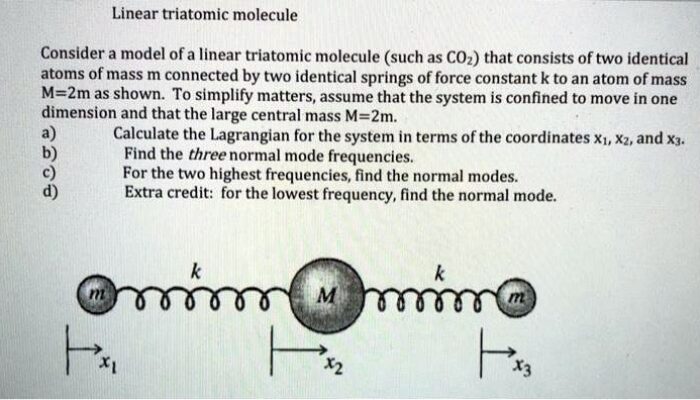
Triatomic molecules are chemical species composed of exactly three atoms, which can be either identical or different elements. When these three atoms align in a straight line, the molecule is described as having a linear geometry. This linear arrangement is characterized by bond angles of 180 degrees, resulting in a symmetrical molecular shape. Such linear triatomic molecules possess distinctive features, including specific vibrational patterns, uniform bond lengths, and symmetry that differentiate them from bent or angular triatomic molecules.
Fundamental Principles Governing Molecular Shape
The spatial configuration of molecules, including triatomic species, is largely explained by the Valence Shell Electron Pair Repulsion (VSEPR) theory. According to this model, electron pairs around a central atom repel each other and arrange themselves to minimize this repulsion, thereby determining the molecule’s geometry. In linear triatomic molecules, the central atom is bonded to two other atoms positioned directly opposite each other, creating a straight-line structure. This arrangement optimizes electron density distribution and stabilizes the molecule’s shape.
Electron Pair Arrangement and Molecular Stability
- Electron Repulsion:
Electron pairs, both bonding and non-bonding, repel each other and seek maximal separation. - Linear Geometry:
Achieved when two bonding pairs are positioned 180 degrees apart, often with no lone pairs on the central atom. - Stabilization:
The linear form minimizes electron pair repulsion, contributing to molecular stability.
Bonding Types in Linear Triatomic Molecules
Linear triatomic molecules can exhibit various bonding interactions, predominantly covalent but sometimes ionic or metallic depending on the species involved.
Covalent Bonding and Hybridization
Covalent bonds arise from the sharing of electron pairs between atoms. A classic example is carbon dioxide (CO2), where a central carbon atom forms two double covalent bonds with oxygen atoms. The carbon atom undergoes sp hybridization, creating two equivalent sp hybrid orbitals arranged linearly. These orbitals overlap with oxygen’s orbitals, resulting in a symmetrical, linear molecule.
Ionic Bonding in Triatomic Ions
In contrast, some triatomic ions such as the carbonate ion (CO32-) exhibit bonding that includes ionic character. Here, the molecule carries a net charge, and the bonding involves electrostatic attractions between charged species rather than pure electron sharing, influencing the overall geometry and electronic structure.
Symmetry and Its Influence on Physical Properties
The linear shape of triatomic molecules imparts a high degree of symmetry, which significantly affects their physical and spectroscopic properties.
Impact on Vibrational Spectra
Due to their linearity, these molecules exhibit simpler vibrational modes compared to non-linear triatomic molecules. The restricted movement along a straight axis results in fewer vibrational degrees of freedom, which simplifies their infrared and Raman spectra. This property is crucial for molecular identification and analysis in spectroscopy.
Thermodynamic and Physical Behavior
The symmetrical charge distribution in linear triatomic molecules often leads to lower polarizability, influencing melting and boiling points. For example, the linear geometry can result in weaker intermolecular forces compared to bent molecules, affecting phase transitions and stability under varying temperature conditions.
Practical Applications and Scientific Significance
Understanding the linear configuration of triatomic molecules is vital across multiple scientific fields.
Environmental Science and Atmospheric Chemistry
Carbon dioxide (CO2), a linear triatomic molecule, plays a critical role as a greenhouse gas. Its linear structure enables efficient absorption of infrared radiation, contributing to the greenhouse effect and influencing global climate patterns. This makes the study of its molecular geometry essential for climate modeling and environmental monitoring.
Materials Science and Nanotechnology
Linear triatomic molecules serve as building blocks in the development of advanced materials. Their inherent linearity can impart mechanical properties such as tensile strength and flexibility, which are valuable in designing polymers, nanomaterials, and biomedical devices. Exploiting these molecular characteristics allows for innovation in material performance and functionality.
Common Misunderstandings About Linear Triatomic Molecules
- Misconception: All triatomic molecules are linear.
Correction: Triatomic molecules can adopt various shapes, including bent and angular geometries, depending on electron pair arrangements and bonding. - Misconception: Linear molecules always have identical atoms.
Correction: Linear triatomic molecules can consist of different atoms, as seen in CO2 and other heteronuclear species. - Misconception: Ionic bonding cannot produce linear triatomic molecules.
Correction: Some ionic triatomic ions, like carbonate, exhibit linear or near-linear geometries influenced by ionic interactions.
Significance of Linear Triatomic Molecules in Science and Technology
The study of linear triatomic molecules is fundamental to advancing knowledge in chemistry, environmental science, and materials engineering. Their unique geometric and electronic properties influence molecular behavior, reactivity, and interactions with electromagnetic radiation. This understanding aids in the design of new materials, the interpretation of spectroscopic data, and the assessment of environmental impacts, underscoring the broad relevance of these molecules in both theoretical and applied sciences.
FAQ
What are triatomic molecules?
Triatomic molecules are chemical species composed of exactly three atoms, which can be identical or different elements.
What determines the shape of triatomic molecules?
The shape of triatomic molecules is largely determined by the Valence Shell Electron Pair Repulsion (VSEPR) theory.
Can triatomic molecules be linear if they have different atoms?
Yes, linear triatomic molecules can consist of different atoms, such as in carbon dioxide (CO2).





Leave a Reply