
Short Answer
Definition of Atomic Duality
The question of whether atoms behave as particles or waves has intrigued scientists and philosophers for centuries. This inquiry lies at the heart of modern physics, probing the fundamental nature of matter and the universe. Atoms exhibit a dual character, oscillating between particle-like and wave-like behaviors, a paradox that reveals the intricate complexity of reality.
Classical Perspectives on Particles and Waves
To understand atomic duality, it is essential to first consider the classical definitions of particles and waves. In classical physics, particles are regarded as distinct, localized objects with specific positions and momenta-imagine tiny billiard balls occupying fixed points in space. Waves, in contrast, are continuous disturbances that travel through space and time without a definite boundary, similar to ripples spreading across a pond’s surface after a stone is thrown. Traditionally, these two concepts were seen as mutually exclusive categories.
Emergence of Wave-Particle Duality in Quantum Mechanics
The advent of quantum mechanics revolutionized this binary view. Pioneering physicists such as Albert Einstein and Louis de Broglie introduced the concept of wave-particle duality, which asserts that all matter exhibits both particle and wave properties depending on the context of observation. This duality is dramatically illustrated by the double-slit experiment, where electrons or atoms passing through two narrow slits produce an interference pattern characteristic of waves, challenging the classical notion of particles as discrete entities.
Mathematical Framework: Wave Functions and Quantum States
Quantum mechanics describes atomic states using wave functions, mathematical expressions that encode the probability distribution of a particle’s position. The Schrödinger equation governs the evolution of these wave functions, providing a probabilistic description of atomic behavior. This framework reveals that atoms do not have definite positions or momenta simultaneously, as articulated by the Heisenberg Uncertainty Principle, which sets fundamental limits on the precision of such measurements.
Electrons as Exemplars of Duality
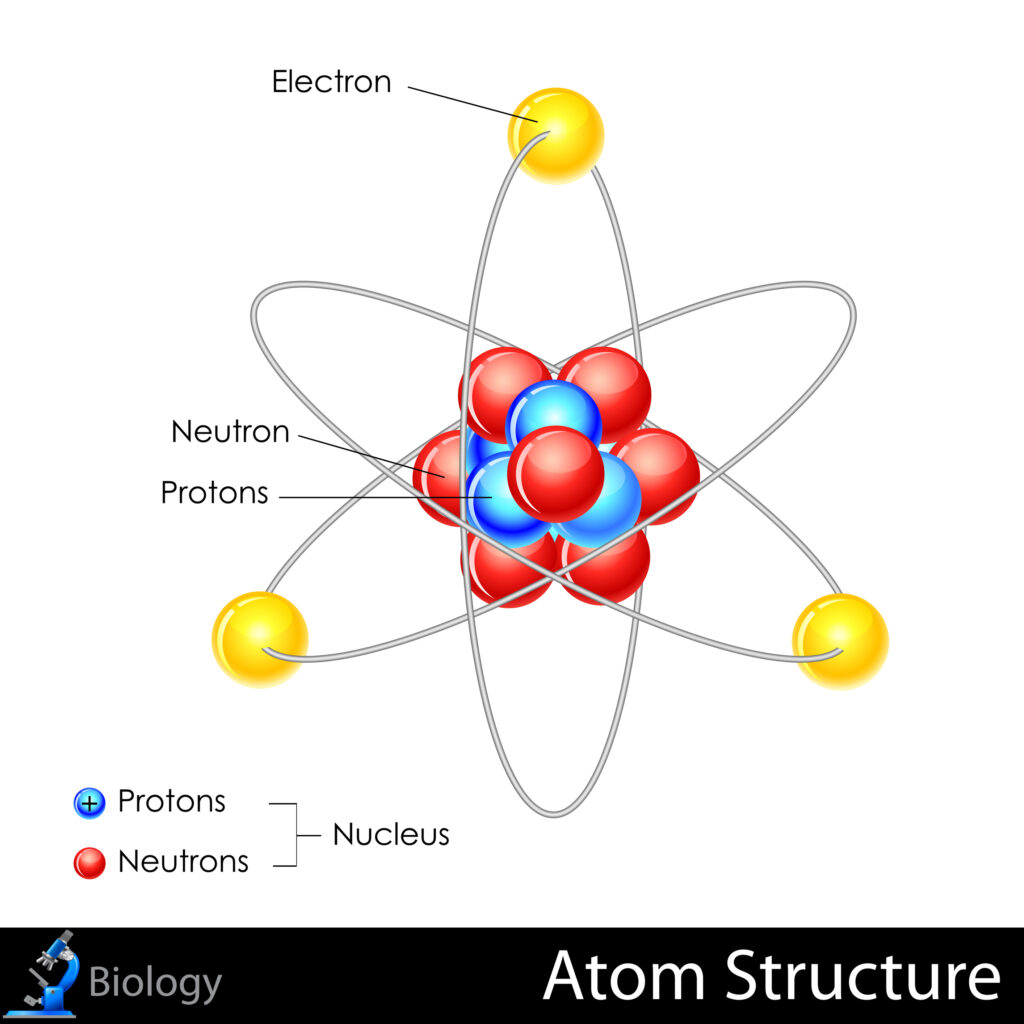
Electrons exemplify the wave-particle duality vividly. While they possess particle-like attributes, electrons also display wave-like characteristics, allowing atoms to be conceptualized as vibrating entities rather than mere collections of particles. This perspective aligns with quantum field theory, which posits that particles arise as excitations of underlying fields permeating the universe, suggesting that atoms are manifestations of deeper, fundamental structures.
Quantum Entanglement and Its Implications
Adding further complexity, quantum entanglement links particles in such a way that the state of one instantly influences the state of another, regardless of the distance separating them. This phenomenon defies classical ideas of locality and causality, highlighting a profound interconnectedness within the atomic realm. The act of measurement itself affects the state of an atom, underscoring the inseparable relationship between observer and observed, a concept resonant with philosophical notions of interconnected existence.
Interpretations and Debates in Quantum Theory
Despite the elegance of wave-particle duality, theoretical debates continue. The Copenhagen interpretation, advocated by Niels Bohr, suggests that atoms exhibit particle properties only upon measurement. Alternative interpretations propose a more objective reality independent of observation. Quantum decoherence theory offers insights into how classical behavior emerges from quantum systems through environmental interactions, enriching our understanding of the quantum-to-classical transition.
Philosophical Reflections on Atomic Nature
The dual nature of atoms invites reflection on broader philosophical questions about reality. If particles can behave as waves and observation influences their state, this challenges traditional notions of an objective, observer-independent universe. Atoms thus serve as metaphors for consciousness itself-dynamic, fluid, and embodying both individuality and universality.
Significance of Understanding Atomic Duality
Exploring whether atoms are particles or waves reveals a complex and nuanced picture of the universe, where rigid distinctions dissolve and new possibilities emerge. This understanding is crucial not only for advancing physics but also for deepening our appreciation of the natural world. The study of atomic duality pushes the boundaries of human knowledge, inspiring ongoing inquiry into the fundamental fabric of existence.
Summary
In essence, atoms embody a duality that mirrors the multifaceted nature of reality. They simultaneously exhibit particle and wave characteristics, challenging classical categories and enriching our comprehension of matter. As quantum mechanics continues to evolve, so does our insight into the interplay between observation, measurement, and the fundamental properties of the universe, fostering both intellectual challenge and profound wonder.
FAQ
What does wave-particle duality mean for atoms?
It means atoms exhibit properties of both particles and waves, depending on how they are observed or measured.
Can atoms be considered only particles or only waves?
No, atoms cannot be fully described as only particles or only waves; quantum mechanics shows they behave as both.
How does observation affect atomic behavior?
Observation influences atomic states by collapsing the wave function, causing atoms to exhibit particle-like properties.






Leave a Reply