
Short Answer
Introduction to John Dalton
John Dalton stands as a towering figure in the history of science, renowned primarily for his pioneering atomic theory that revolutionized the comprehension of matter. His work provided a systematic explanation of atoms, which became the foundation for modern atomic physics. Beyond his scientific achievements, Dalton was also an educator, meteorologist, and philosopher, whose dedication to understanding the natural world inspired countless scientists who followed.
Early Life and Educational Background
Born on September 6, 1766, in Eaglesfield, England, Dalton grew up in a humble Quaker household as the youngest of six siblings. From an early age, he exhibited a keen interest in mathematics and natural sciences, driven by an insatiable curiosity. His academic pursuits were deeply influenced by the Enlightenment era, which emphasized reason, observation, and scientific inquiry. Dalton’s approach was marked by meticulous empirical observation and rigorous experimentation, setting the stage for his future contributions.
Definition and Core Principles of Dalton’s Atomic Theory
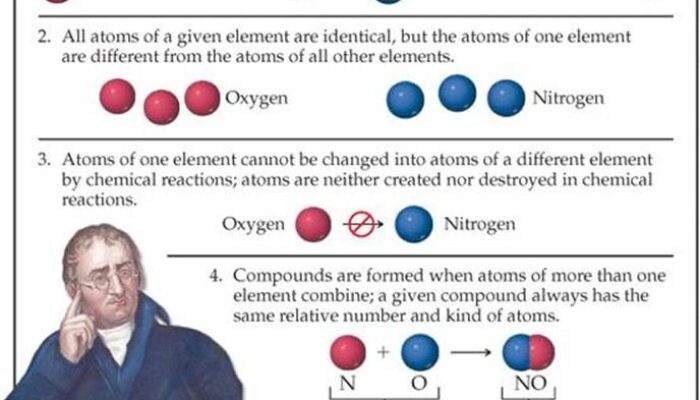
Dalton’s atomic theory, formulated in the early 19th century, offered a coherent explanation for the composition and behavior of matter. It consists of several fundamental postulates that reshaped scientific understanding:
- Atoms as Indivisible Units:
Dalton proposed that all matter consists of tiny, indivisible particles called atoms. These atoms cannot be broken down into smaller parts by chemical means. - Uniformity of Atoms within Elements:
Atoms of a single element are identical in mass and properties, which explains their consistent behavior in chemical reactions. Each element is characterized by the unique mass of its atoms. - Formation of Compounds:
Compounds arise from the combination of atoms of different elements in fixed ratios, highlighting that chemical reactions involve rearranging atoms rather than creating or destroying them. - Conservation of Atoms in Reactions:
During chemical reactions, atoms are merely reorganized to form new substances, maintaining their identity and supporting the law of conservation of mass.
Mechanism and Impact of Dalton’s Atomic Theory
Dalton’s theory simplified the complex diversity of matter by attributing it to various combinations and arrangements of a limited set of atoms. This conceptual breakthrough not only unified existing chemical knowledge but also encouraged precise measurement and reproducibility in chemical experiments. His insistence on quantifiable atomic properties aligned perfectly with the emerging scientific methodologies of his time.
Historical Context and Scientific Evolution
Dalton’s atomic model emerged during a period when the scientific community grappled with competing ideas about matter’s nature. His theory provided clarity and a structured framework that endured despite later refinements. Discoveries such as J.J. Thomson’s electron in 1897 and Ernest Rutherford’s nuclear atom model in 1911 revealed subatomic complexities beyond Dalton’s original concept. Nonetheless, Dalton’s foundational ideas remain central to atomic theory today.
Contributions to Chemistry and Stoichiometry
Dalton’s work laid the groundwork for key chemical concepts, including the mole and the law of multiple proportions. His precise observations and calculations fostered a more systematic and quantitative approach to chemistry, influencing generations of chemists to adopt rigorous scientific methods.
Legacy and Continuing Relevance
While Dalton could not have anticipated the quantum mechanical intricacies that define modern atomic science, his commitment to empirical evidence and logical reasoning established a scientific discipline that continues to thrive. His atomic theory remains a cornerstone in chemistry and physics, underscoring the enduring value of his contributions.
Why Dalton’s Atomic Theory Remains Important
Dalton’s atomic theory is crucial because it provides a fundamental understanding of matter’s composition, which is essential for advancements in science and technology. It offers a framework that explains chemical reactions, material properties, and the behavior of substances at the microscopic level, impacting fields ranging from medicine to materials science.
Common Misconceptions About Dalton’s Atomic Theory
Atoms are indivisible.
While Dalton proposed atoms as indivisible, modern science has shown that atoms consist of smaller subatomic particles like protons, neutrons, and electrons.
All atoms of an element are exactly identical.
Isotopes demonstrate that atoms of the same element can have different masses due to varying numbers of neutrons.
Real-World Applications of Atomic Theory
Dalton’s atomic theory underpins many practical applications today. It guides chemical synthesis in pharmaceuticals, informs material engineering, and supports analytical techniques such as spectroscopy. Understanding atomic interactions enables innovations in energy production, environmental science, and nanotechnology.
Conclusion
John Dalton’s atomic theory revolutionized the scientific perspective on matter, providing a clear and accessible explanation that has stood the test of time. His insights not only advanced chemistry but also deepened humanity’s understanding of the natural world. As science continues to evolve, Dalton’s legacy endures as a testament to the power of observation, experimentation, and rational thought in unraveling the mysteries of the universe.
FAQ
Who was John Dalton?
John Dalton was an English chemist and physicist known for developing the atomic theory that explains the nature of matter.
What did Dalton propose in his atomic theory?
He proposed that matter is made of indivisible atoms, atoms of the same element are identical, compounds form from atoms in fixed ratios, and atoms are conserved during reactions.
How did Dalton’s atomic theory impact science?
It provided a systematic framework for understanding chemical reactions and matter, influencing modern chemistry and physics.
Are atoms indivisible as Dalton suggested?
No, modern science shows atoms consist of smaller particles like protons, neutrons, and electrons.





Leave a Reply