
Short Answer
Definition of Elementary Particles
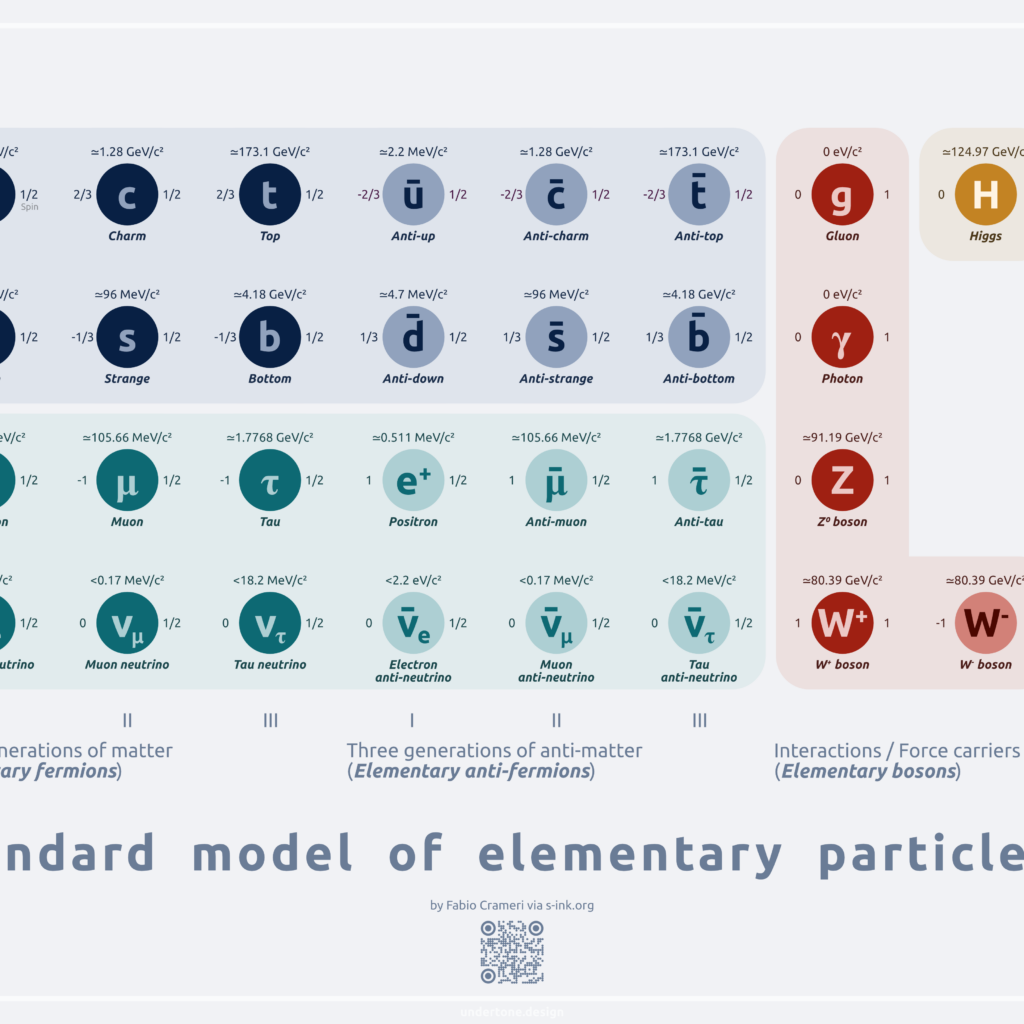
Elementary particles are the most fundamental constituents of matter, indivisible and not composed of smaller components. In particle physics, these particles are broadly classified into two categories: fermions and bosons. Fermions constitute matter itself, while bosons act as force carriers, facilitating interactions between particles. The Standard Model of particle physics identifies 17 such elementary particles, each fulfilling a distinct function within the universe’s complex framework.
- Fermions:
These particles make up all matter, including quarks and leptons. - Bosons:
These particles mediate fundamental forces, such as photons for electromagnetic force and gluons for the strong nuclear force.
Origins of Elementary Particles: The Big Bang and Early Universe
The genesis of elementary particles is intimately tied to the Big Bang, an event approximately 13.8 billion years ago that marked the inception of space, time, and matter. Rather than a conventional explosion, the Big Bang represents a singularity from which the universe rapidly expanded and cooled. Within the first microseconds, quantum fluctuations in this hot, dense environment generated a diverse array of elementary particles, including quarks, leptons, and gauge bosons.
Following their creation, quarks combined to form protons and neutrons, the building blocks of atomic nuclei, through a process called nucleosynthesis. This occurred within minutes after the Big Bang and resulted in the formation of the universe’s lightest elements: hydrogen, helium, and trace lithium. These primordial elements laid the groundwork for the formation of more complex matter.
Evolution of Forces and Matter Formation
As the universe expanded and cooled further, the fundamental forces-electromagnetic, weak nuclear, and strong nuclear-became distinct and began to govern particle interactions. Electrons joined with protons to form neutral atoms, which eventually aggregated into stars, galaxies, and larger cosmic structures. This transformation from elementary particles to macroscopic entities illustrates the remarkable progression of cosmic evolution.
Philosophical and Scientific Implications
The study of elementary particle origins extends beyond physics into philosophical realms. The precise values of physical constants that allow for the existence of life have led to the formulation of the Anthropic Principle, which suggests that the universe’s parameters are finely tuned to support complex life forms. This principle highlights the profound connection between fundamental physics and our very existence.
Dark Matter, Dark Energy, and Unknown Particles
Approximately 95% of the universe’s mass-energy content is composed of dark matter and dark energy, mysterious substances that do not interact with electromagnetic radiation and remain undetectable by conventional means. The nature of these components is one of the greatest enigmas in modern physics. Theories such as supersymmetry propose the existence of new elementary particles that could account for dark matter, while other hypotheses suggest unknown gauge bosons might be involved in these dark phenomena.
Particle Accelerators and Experimental Insights
Modern particle accelerators, like the Large Hadron Collider (LHC), recreate conditions similar to those moments after the Big Bang by colliding particles at near-light speeds. These experiments allow physicists to probe the fundamental forces and particles that compose the universe. A landmark discovery was the Higgs boson in 2012, confirming the existence of the Higgs field, which imparts mass to elementary particles and is essential to the Standard Model.
Quantum Mechanics and Particle-Antiparticle Dynamics
Quantum field theory reveals that particles can spontaneously emerge from vacuum fluctuations as particle-antiparticle pairs, existing transiently before annihilating each other. This phenomenon underscores the inherent uncertainty and duality within the quantum realm, illustrating the dynamic and ephemeral nature of the universe at its most fundamental level.
Quantum Cosmology and Theoretical Perspectives
Quantum cosmology merges quantum mechanics with general relativity to explore the universe’s earliest moments and conditions preceding the Big Bang. Concepts such as the multiverse hypothesis propose that our universe may be one among countless others, challenging traditional notions of causality, time, and existence. These theories push the boundaries of our understanding and invite new questions about the origins of reality itself.
Significance of Understanding Elementary Particle Origins
Investigating the beginnings of elementary particles offers profound insights into the nature of the cosmos and our place within it. This inquiry not only elucidates the formation of matter and the evolution of fundamental forces but also bridges scientific knowledge with philosophical reflection. Each elementary particle embodies a chapter in the universe’s grand narrative, revealing the intricate and elegant structure underlying all existence.
FAQ
What are elementary particles?
Elementary particles are the fundamental constituents of matter, indivisible and classified as fermions or bosons.
How did elementary particles originate?
They originated from quantum fluctuations in the hot, dense environment of the Big Bang, approximately 13.8 billion years ago.
What role do particle accelerators play in physics?
Particle accelerators recreate conditions of the early universe to study fundamental particles and forces.





Leave a Reply