
Short Answer
Definition of Topological Quantum Computing
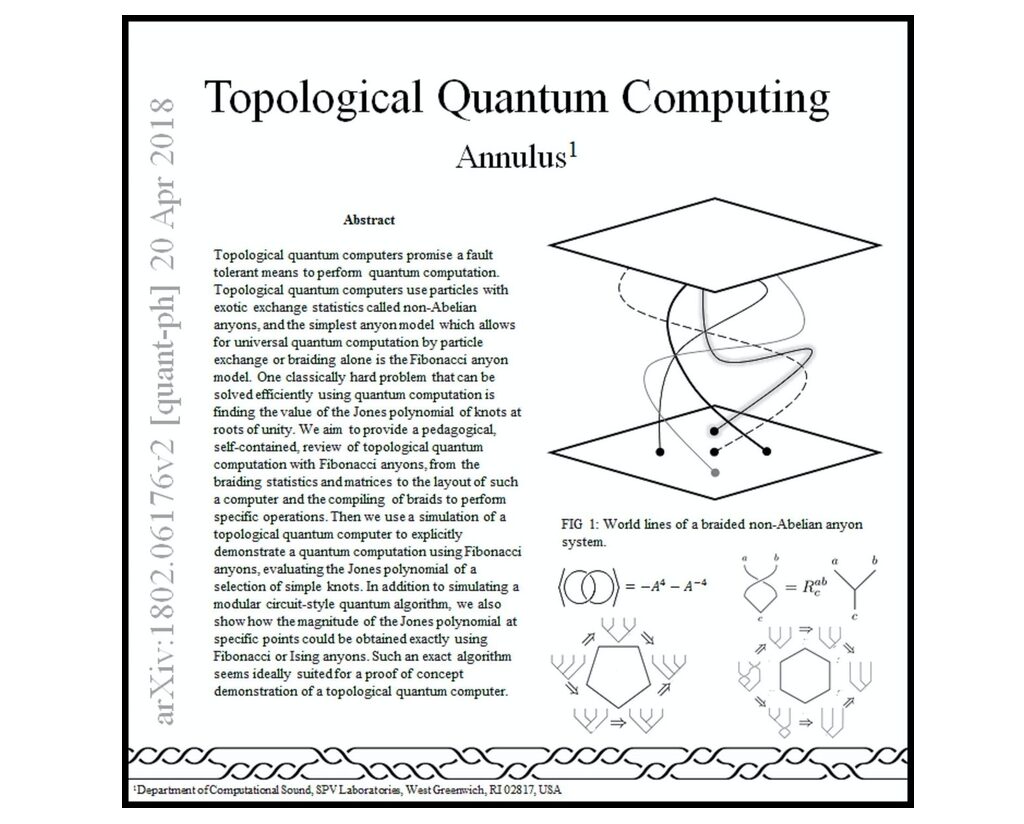
Topological quantum computing is an interdisciplinary field that merges principles from topology, quantum mechanics, and computer science to develop a novel approach to quantum computation. It leverages the mathematical study of spatial properties that remain invariant under continuous deformations to encode and manipulate quantum information in a way that is inherently resistant to errors.
Fundamental Concepts
Qubits: The Basic Unit of Quantum Information
A qubit, or quantum bit, is the essential building block of quantum information. Unlike classical bits, which exist strictly as 0 or 1, qubits can exist in a superposition of both states simultaneously. This unique characteristic enables quantum computers to process complex computations exponentially faster than classical machines.
Topology: The Mathematical Backbone
Topology is the branch of mathematics concerned with properties of space that are preserved under continuous transformations such as stretching or bending, without tearing or gluing. This abstract framework is crucial for understanding how quantum information can be encoded in global features of a system, rather than local details, which is fundamental to topological quantum computing.
Anyons and Their Braiding
Anyons are exotic quasiparticles that exist in two-dimensional systems, distinct from the familiar fermions and bosons found in three-dimensional space. Their defining feature is their unique statistical behavior under exchange, known as braiding. When anyons are moved around one another, their quantum state changes in a way that depends on the path taken, enabling the implementation of quantum gates that are robust against local disturbances.
Key Principles and Mechanisms
Topological Order
Topological order describes a phase of matter characterized by long-range quantum entanglement and non-local correlations. Unlike conventional phases defined by symmetry breaking, topologically ordered states cannot be described by local order parameters. This property allows quantum information to be stored in a manner that is inherently protected from local noise, making it vital for fault-tolerant quantum computation.
Non-Abelian Statistics
Non-Abelian anyons exhibit complex exchange statistics that differ fundamentally from Abelian particles like bosons and fermions. The order in which these particles are exchanged affects the system’s quantum state, enabling a richer set of operations for quantum information processing. This non-commutative behavior is essential for implementing fault-tolerant quantum gates in topological quantum computing.
Quantum Gates via Braiding
Quantum gates are the fundamental operations that manipulate qubits during computation. In topological quantum computing, these gates are realized through the braiding of anyons, where the physical movement of particles around each other enacts logical operations. This method provides intrinsic error protection, as the information is encoded in the global topology of the system rather than local states.
Quantum Coherence and Decoherence
Quantum coherence refers to the maintenance of quantum superposition states over time, which is critical for the successful execution of quantum algorithms. Topological qubits benefit from enhanced coherence due to their protection by topological properties, reducing susceptibility to environmental noise and decoherence, which typically degrade quantum information.
Mathematical Framework
Topological Quantum Field Theory (TQFT)
TQFT provides a rigorous mathematical structure that connects topology with quantum physics. It models the behavior of anyonic excitations and their braiding statistics, offering a theoretical foundation for understanding and designing topological quantum computers. Through TQFT, one can describe how global topological features govern the quantum states and their transformations.
Challenges and Solutions
Fault Tolerance in Quantum Computation
One of the major obstacles in quantum computing is error correction. Topological quantum computing addresses this by encoding information in the global topological properties of the system, which are immune to local perturbations. This fault tolerance is crucial for building scalable and reliable quantum computers capable of practical applications.
Philosophical and Practical Implications
The Quantum Measurement Problem
The measurement problem in quantum mechanics concerns the transition from a quantum superposition to a definite outcome upon observation. Topological quantum computing, with its unique encoding and manipulation of quantum states, offers new perspectives on this foundational issue, potentially deepening our understanding of quantum reality.
Real-World Applications and Importance
Topological quantum computing holds promise for revolutionizing fields such as cryptography, materials science, and complex system simulations by enabling computations that are currently infeasible. Its inherent robustness against errors makes it a leading candidate for realizing practical quantum computers, which could transform technology and scientific research.
Common Misconceptions
Qubits are just like classical bits but faster.
Qubits can exist in superpositions of states, enabling fundamentally different computational capabilities than classical bits.
Anyons are ordinary particles.
Anyons are quasiparticles with unique two-dimensional statistics that differ from standard fermions and bosons.
Topological quantum computing eliminates all errors.
While it significantly reduces certain types of errors through topological protection, it does not make quantum systems completely error-free.
FAQ
What is topological quantum computing?
Topological quantum computing is a quantum computation approach that uses topological states of matter and anyons to perform operations that are inherently resistant to errors.
How do anyons contribute to topological quantum computing?
Anyons are quasiparticles with unique braiding statistics in two-dimensional systems; their movement around each other implements quantum gates that are robust against local disturbances.
What makes topological quantum computing fault tolerant?
It encodes quantum information in global topological properties, which are immune to local noise and perturbations, significantly reducing errors.
Does topological quantum computing eliminate all quantum errors?
No, it reduces certain types of errors through topological protection but does not make quantum systems completely error-free.





Leave a Reply