
Short Answer
Definition of Quantum Computing
Quantum computing represents a groundbreaking paradigm in information processing, leveraging the principles of quantum mechanics to perform computations far beyond the reach of classical computers. Unlike traditional computing, which relies on bits as the smallest unit of data, quantum computing utilizes quantum bits or qubits. These qubits exploit phenomena such as superposition and entanglement, enabling the simultaneous representation of multiple states and complex interactions that classical bits cannot achieve.
- Qubit:
The fundamental unit of quantum information, capable of existing in multiple states simultaneously due to superposition. - Superposition:
A quantum property allowing qubits to be in a combination of 0 and 1 states at the same time. - Entanglement:
A phenomenon where qubits become interconnected such that the state of one instantly influences the state of another, regardless of distance.
Core Principles and Mechanisms
Quantum computing operates by harnessing unique quantum mechanical effects to process information in ways classical systems cannot. The key mechanisms include:
- Superposition: Enables qubits to represent multiple possibilities simultaneously, vastly increasing computational parallelism.
- Entanglement: Creates correlations between qubits that allow complex, coordinated computations.
- Quantum Interference: Utilizes the wave-like nature of quantum states to amplify correct solutions and cancel out incorrect ones during computation.
These principles collectively empower quantum computers to explore an exponentially larger solution space, making them exceptionally suited for certain complex problems.
Mathematical Framework and Formulas
Quantum states are mathematically described using vectors in a complex Hilbert space. A single qubit state can be expressed as:
|ψ⟩ = α|0⟩ + β|1⟩
- |ψ⟩: The quantum state vector of the qubit.
- |0⟩ and |1⟩: Basis states analogous to classical bit values 0 and 1.
- α and β: Complex probability amplitudes, where |α|² + |β|² = 1, representing the likelihood of measuring the qubit in each basis state.
For multiple qubits, the combined state is represented by the tensor product of individual qubit states, enabling the encoding of exponentially large information spaces.
Applications Across Various Fields
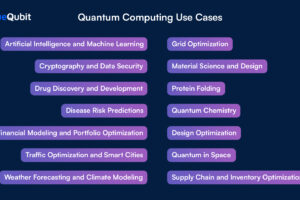
Cryptography and Secure Communication
Quantum computing poses both challenges and solutions in the realm of digital security. It threatens classical encryption methods by efficiently solving problems like integer factorization, which underpin many cryptographic protocols. Conversely, quantum key distribution (QKD) leverages entanglement to create communication channels that are provably secure against eavesdropping, as any interception alters the quantum state and is immediately detectable.
Healthcare and Drug Discovery
The complexity of molecular interactions in biological systems often overwhelms classical computational methods. Quantum computers can simulate these interactions with greater accuracy and speed, accelerating the identification and optimization of new pharmaceuticals. This capability promises to shorten drug development cycles and enhance the precision of medical treatments.
Materials Science and Engineering
Designing advanced materials with tailored electronic, magnetic, or optical properties requires deep insight into quantum-level behaviors. Quantum simulators enable researchers to model these properties with unprecedented fidelity, facilitating breakthroughs in superconductors, nanomaterials, and catalysts that could revolutionize energy efficiency and sustainability.
Artificial Intelligence and Machine Learning
Quantum computing offers potential enhancements to machine learning by addressing the “curse of dimensionality”-the exponential growth of data complexity with added features. Quantum algorithms can process large datasets more efficiently, improving applications in natural language processing, image analysis, and predictive modeling, thereby opening new frontiers in AI capabilities.
Optimization Problems in Industry
Many sectors, including finance, logistics, and supply chain management, face complex optimization challenges. Quantum annealing techniques exploit quantum parallelism to explore numerous potential solutions simultaneously, identifying optimal or near-optimal outcomes faster than classical algorithms. This can lead to improved resource allocation, risk management, and operational efficiency.
Climate Modeling and Environmental Science
Understanding and predicting climate dynamics involves simulating highly intricate systems with numerous interacting variables. Quantum computing can enhance the precision of these models, enabling better forecasts and more effective strategies for climate change mitigation and adaptation.
Challenges and Developmental Hurdles
Despite its transformative potential, quantum computing remains in an early developmental phase. Key obstacles include maintaining qubit coherence over time, minimizing error rates, and scaling systems to practical sizes. Overcoming these challenges requires sustained collaboration among academic researchers, industry leaders, and governmental bodies to foster innovation and translate theoretical advances into real-world applications.
Significance and Future Outlook
Quantum computing stands poised to redefine multiple scientific and technological domains by unlocking computational capabilities unattainable with classical systems. Its impact spans secure communication, healthcare innovation, material design, artificial intelligence, optimization, and environmental science. As research progresses, quantum computing is expected to catalyze a new era of discovery and technological progress, deepening our understanding of the universe and enhancing the quality of life worldwide.
Common Misconceptions About Quantum Computing
Quantum computers will replace classical computers entirely.
Quantum computers are specialized devices designed for particular problem types and will complement rather than replace classical computers.
Quantum computing is already widely available and practical.
The technology is still emerging, with significant technical challenges to overcome before widespread practical use.
Quantum computers can solve all problems instantly.
Quantum advantage applies only to specific classes of problems; many tasks remain better suited to classical computing.
FAQ
What is quantum computing?
Quantum computing is a technology that uses quantum mechanics to process information in ways that classical computers cannot.
What are qubits?
Qubits are the basic units of quantum information, capable of existing in multiple states simultaneously.
How does quantum computing impact cryptography?
Quantum computing can break classical encryption methods while also providing new secure communication techniques.


Leave a Reply