
Short Answer
Definition of the Strong Force
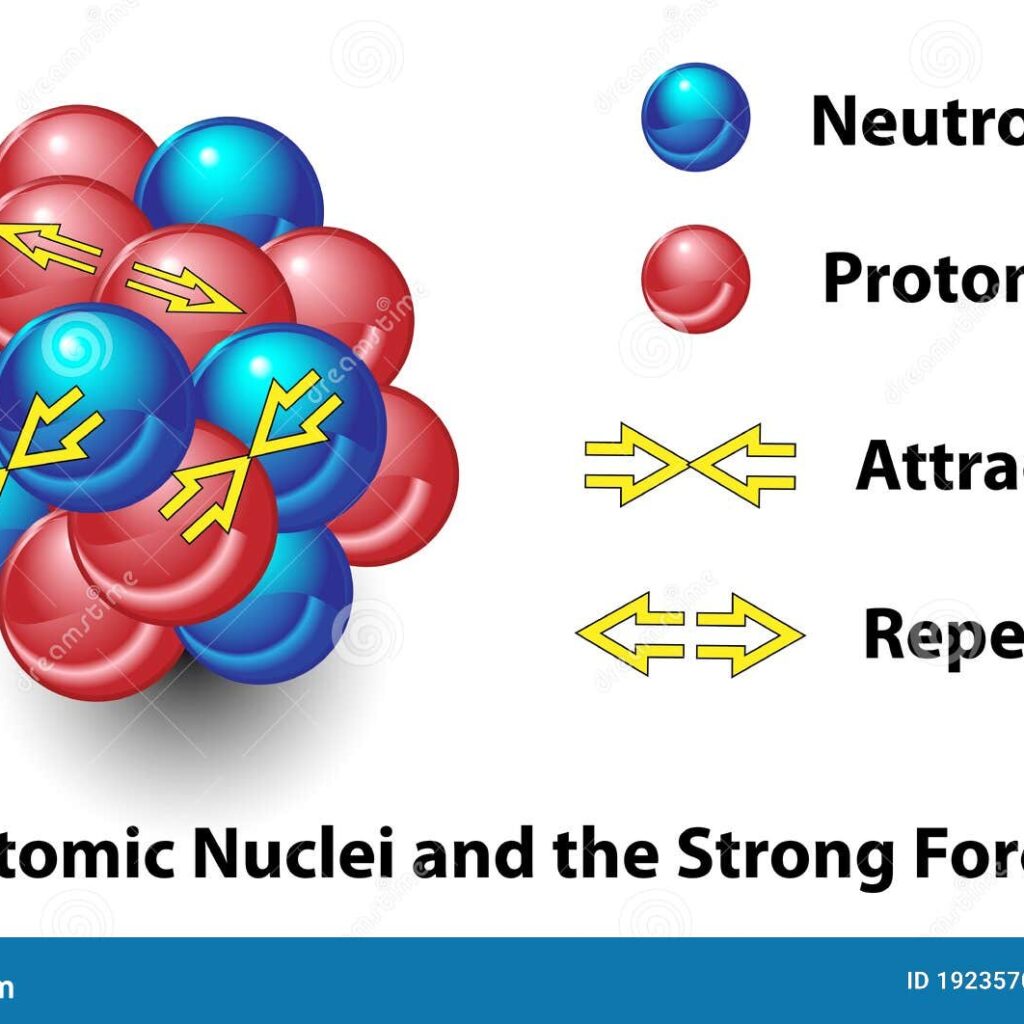
The strong force, also known as the strong nuclear force, is one of the four fundamental interactions in nature. It is the powerful force responsible for holding the components of an atom’s nucleus-protons and neutrons-together. This force counteracts the electromagnetic repulsion between positively charged protons, ensuring the nucleus remains intact. Understanding the strong force is essential for grasping the structure of atoms and the fundamental nature of matter.
Fundamental Particles and Quantum Chromodynamics
The strong force operates at the subatomic level and is best described by the theory of quantum chromodynamics (QCD). QCD explains how quarks, the elementary particles that make up protons and neutrons, interact through the exchange of gluons. Gluons are the mediator particles that carry the strong force, binding quarks tightly within hadrons. This interaction not only maintains the stability of protons and neutrons but also accounts for most of the mass of an atom, as the binding energy from the strong force converts into mass according to Einstein’s equation, E=mc².
Range and Behavior Within the Atomic Nucleus
Within the nucleus, protons and neutrons are densely packed, creating a delicate equilibrium. The strong force is incredibly powerful but acts over a very short range-approximately a few femtometers (10-15 meters), roughly the size of a nucleus. Beyond this distance, its strength rapidly diminishes. This limited range is crucial for nuclear stability, as it allows the strong force to overcome the repulsive electromagnetic force only when nucleons are extremely close.
Confinement: A Unique Property of the Strong Force
A distinctive feature of the strong force is the phenomenon known as confinement. Quarks cannot exist independently; they are perpetually confined within composite particles called hadrons, such as protons and neutrons. This confinement arises because the energy required to separate quarks increases as they move apart, effectively preventing their isolation. This non-linear behavior contrasts with other fundamental forces and highlights the unique nature of the strong interaction.
Role in Astrophysics and Stellar Processes
The strong force plays a pivotal role in astrophysical phenomena, particularly in the life cycle of stars. During nuclear fusion, which powers stars, protons overcome their mutual electrostatic repulsion under extreme temperatures and pressures, allowing the strong force to bind them together. This fusion process releases vast amounts of energy, sustaining stars and influencing the evolution of the universe.
Nuclear Stability and Radioactive Decay
The balance between the strong force and electromagnetic repulsion determines the stability of atomic nuclei. When the strong force is insufficient to counteract repulsive forces in heavy nuclei, these nuclei may become unstable and undergo radioactive decay, emitting alpha or beta particles. This process is fundamental to understanding nuclear reactions, the generation of nuclear energy, and the natural evolution of elements in the cosmos.
Exploration Through Particle Physics Experiments
Research into the strong force extends beyond atomic theory into high-energy particle physics. Particle accelerators recreate conditions similar to those just after the Big Bang by colliding particles at immense energies. These experiments allow scientists to study quark-gluon plasma, a state of matter where quarks and gluons exist freely, providing valuable insights into the early universe and the behavior of matter under extreme conditions.
Ongoing Research and Theoretical Advances
The strong force remains a central focus in both theoretical and experimental physics. Advanced computational models and simulations strive to deepen our understanding of confinement, hadron structure, and matter under extreme environments. These efforts push the boundaries of current knowledge and aim to unravel the complexities of the strong interaction.
Importance of the Strong Force in the Universe
Although often overshadowed by gravity and electromagnetism, the strong force is fundamental to the existence of matter. It underpins the assembly and interaction of atomic nuclei, shaping the very fabric of the universe. Without the strong force, atoms could not form stable nuclei, and the matter that constitutes stars, planets, and life itself would not exist.
Summary
The strong force is a cornerstone of modern physics, essential for understanding atomic and subatomic phenomena. Its unique properties, such as confinement and short-range strength, govern the stability of matter and influence cosmic processes. As scientific inquiry continues, the strong force remains a key to unlocking the deepest secrets of the universe and the nature of existence.
FAQ
What is the strong force?
The strong force is one of the four fundamental forces of nature responsible for holding protons and neutrons together in an atomic nucleus.
How does the strong force work?
The strong force operates through the exchange of gluons between quarks, binding them together within protons and neutrons.
Why is the strong force important in nuclear physics?
It governs the stability of atomic nuclei and plays a critical role in nuclear fusion processes in stars.






Leave a Reply