
Short Answer
Definition of High Voltage in Particle Accelerators
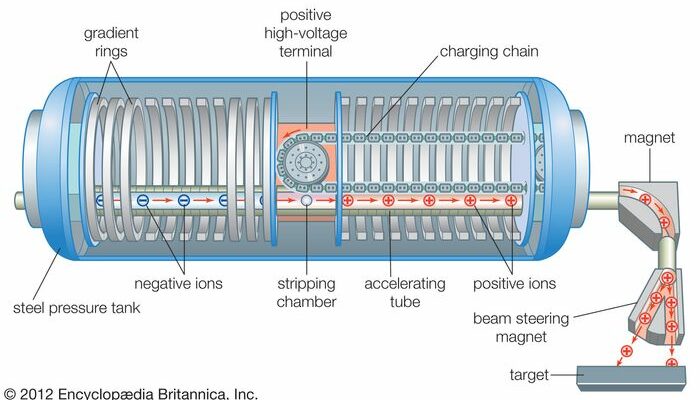
High voltage in particle accelerators refers to the substantial electric potential difference applied to accelerate charged particles such as protons, electrons, or ions. This voltage generates strong electric fields that impart kinetic energy to particles, enabling them to reach velocities close to the speed of light. The application of high voltage is fundamental to the operation of these sophisticated machines, which probe the fundamental constituents of matter and the forces governing the universe.
- Charged Particles:
Particles possessing an electric charge that respond to electric fields, including electrons, protons, and ions. - Electric Potential Difference:
The voltage applied across electrodes that creates an electric field to accelerate particles. - Particle Velocity:
The speed attained by particles as a result of acceleration, often approaching relativistic speeds.
Types of Particle Accelerators and High Voltage Application
Particle accelerators are broadly classified into linear accelerators (linacs) and circular accelerators, each utilizing high voltage in unique ways to energize particles.
Linear Accelerators (Linacs)
In linacs, particles move along a straight trajectory, gaining energy by passing through a sequence of oscillating electric fields. High voltage directly influences the energy increment per segment, allowing rapid acceleration over relatively short distances. The precise timing and magnitude of the voltage pulses are critical to synchronizing with particle motion for efficient energy transfer.
Circular Accelerators
Circular accelerators, such as synchrotrons, propel particles along curved paths using magnetic fields for steering and high voltage to replenish energy lost during each revolution. The voltage is applied at specific points to maintain or increase particle energy, enabling particles to reach extremely high energies through multiple laps around the accelerator ring.
Mechanism of Particle Acceleration via High Voltage
The acceleration process hinges on the interaction between charged particles and electric fields generated by high voltage. When a voltage difference is established between electrodes, an electric field arises, exerting a force on charged particles. This force accelerates the particles, increasing their kinetic energy according to the work done by the electric field.
Mathematically, the kinetic energy (KE) gained by a particle is related to the electric potential difference (V) by the equation:
Formula and Mathematical Explanation
KE = q × V
- KE: Kinetic energy acquired by the particle (in joules or electronvolts)
- q: Electric charge of the particle (in coulombs)
- V: Electric potential difference or high voltage applied (in volts)
This relationship illustrates that the energy imparted to a particle is directly proportional to both its charge and the voltage applied, underscoring the critical role of high voltage in achieving desired particle energies.
Impact of High Voltage on Experimental Outcomes
Increasing the applied high voltage enables particles to reach higher kinetic energies, which in turn leads to more energetic collisions within the accelerator. These high-energy collisions are essential for probing subatomic structures and discovering new particles. For instance, the Large Hadron Collider (LHC) utilizes extremely high voltages to accelerate protons to unprecedented energies, facilitating landmark discoveries such as the Higgs boson.
Role in Beam Dynamics and Stability
Beyond acceleration, high voltage is vital in maintaining the stability and coherence of particle beams. Proper voltage calibration prevents beam dispersion and loss, which can compromise experimental precision. Beam dynamics involves controlling particle trajectories and densities, where voltage adjustments help sustain optimal beam quality throughout the acceleration process.
Applications Beyond Fundamental Physics
High voltage in particle accelerators also influences interactions between accelerated particles and target materials, producing secondary particles and radiation. These phenomena have practical applications in various fields:
- Materials Science:
Investigating material properties through particle bombardment. - Nuclear Physics:
Studying nuclear reactions and structures. - Medical Applications:
Utilizing particle beams for cancer therapy and advanced imaging techniques.
Safety Considerations in High Voltage Operations
The immense energy levels generated by high voltage systems pose significant safety risks, including electrical hazards and radiation exposure. Comprehensive safety protocols, rigorous training, and engineering controls are essential to protect personnel and equipment. These measures ensure that scientific progress proceeds responsibly and ethically.
Philosophical and Scientific Significance
The ability to manipulate particles at extreme energies through high voltage reflects humanity’s relentless curiosity and drive to understand the universe. Each advancement in accelerator technology not only expands scientific knowledge but also raises profound questions about the nature of reality, inspiring ongoing inquiry and innovation.
Summary
High voltage is a fundamental component in particle accelerators, enabling the acceleration of charged particles to high energies, ensuring beam stability, and facilitating groundbreaking discoveries in physics and applied sciences. Its multifaceted role underscores its importance in advancing both theoretical understanding and practical applications, while also demanding careful attention to safety and ethical considerations. The interplay of high voltage, energy, and matter continues to propel scientific exploration and expand the horizons of human knowledge.
FAQ
What is high voltage in particle accelerators?
High voltage refers to the substantial electric potential difference used to accelerate charged particles in particle accelerators.
Why is high voltage important for particle accelerators?
It enables the acceleration of particles to high energies, necessary for significant collisions and discoveries in physics.
What are the types of particle accelerators?
The main types are linear accelerators (linacs) and circular accelerators, each using high voltage in different ways.





Leave a Reply