
Short Answer
Definition of the Large Hadron Collider
The Large Hadron Collider (LHC) is the world’s most powerful particle accelerator, designed to explore the fundamental components and forces of the universe. Situated near Geneva, Switzerland, this colossal scientific instrument enables physicists to investigate the smallest particles by accelerating them to near-light speeds and colliding them at unprecedented energies. The LHC serves as a gateway to understanding the underlying structure of matter and the laws that govern the cosmos.
Historical Background and Infrastructure
Conceived and constructed by the European Organization for Nuclear Research (CERN), the LHC became operational in 2008 after decades of research and engineering innovation. The accelerator is housed within a circular tunnel approximately 27 kilometers (17 miles) in circumference, buried deep underground. This extensive ring allows particles to be propelled in opposite directions before colliding, creating conditions that mimic those just moments after the Big Bang. The scale and sophistication of the LHC make it a landmark achievement in experimental physics.
Operational Principles and Particle Acceleration
The LHC primarily accelerates protons-positively charged particles found in atomic nuclei-along its circular track. These protons are sped up in opposite directions until they reach velocities close to the speed of light. When these high-energy protons collide head-on, they release enormous amounts of energy, producing a shower of subatomic particles. This process is akin to smashing two bullets together at extreme speeds, resulting in a burst of new particles that can reveal hidden aspects of particle physics.
Key Components: Detectors and Data Collection
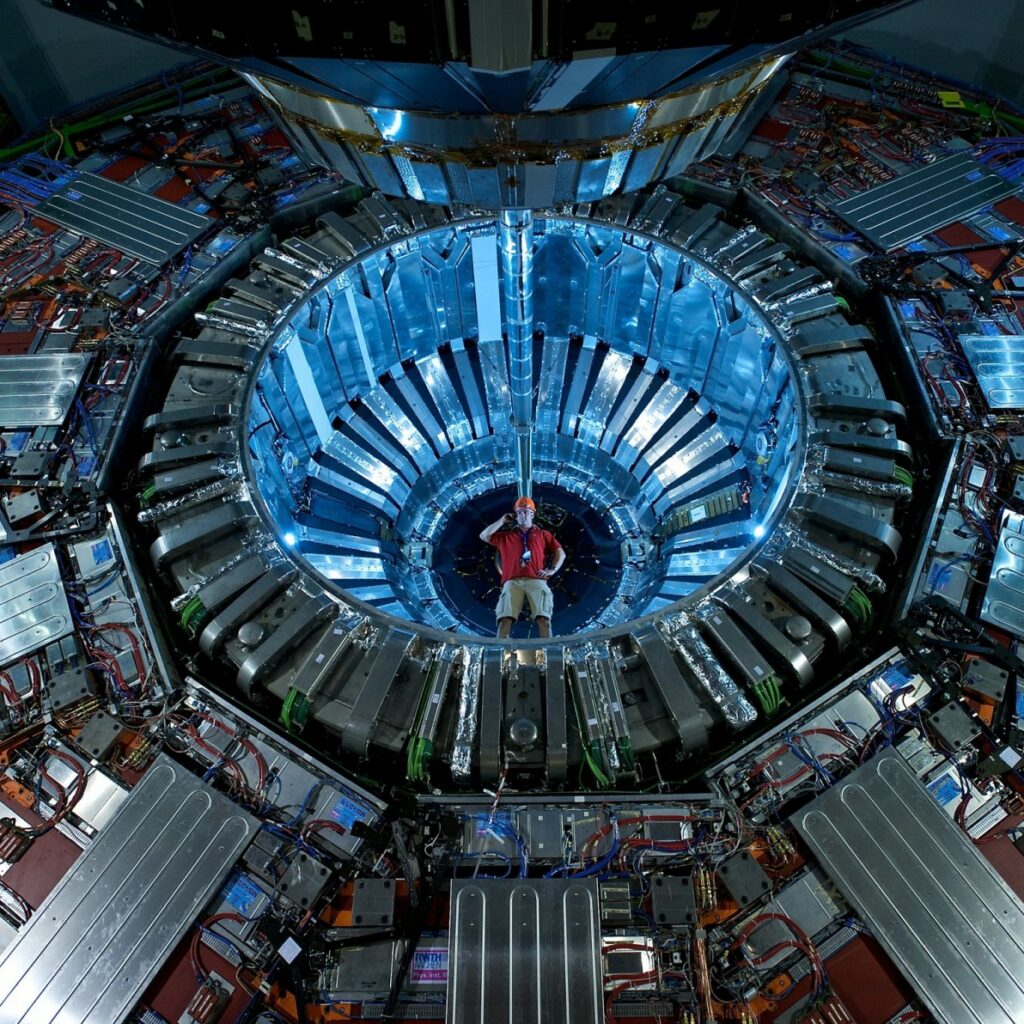
Central to the LHC’s mission are its sophisticated detectors, which capture and analyze the aftermath of particle collisions. Among the most prominent are the ATLAS (A Toroidal LHC ApparatuS) and CMS (Compact Muon Solenoid) detectors. These instruments are engineered to record the trajectories, energies, and types of particles produced, enabling scientists to reconstruct collision events with remarkable precision. The data collected provides invaluable insights into the fundamental forces and particles that compose our universe.
Scientific Milestones: The Discovery of the Higgs Boson
One of the LHC’s most celebrated accomplishments is the 2012 discovery of the Higgs boson, often dubbed the “God particle.” This particle plays a crucial role in the Standard Model of particle physics by explaining how other particles acquire mass. The identification of the Higgs boson not only confirmed long-standing theoretical predictions but also opened new avenues for exploring physics beyond the Standard Model, including the search for unknown particles and forces.
Fundamental Physics Principles Underpinning the LHC
The LHC operates based on core principles from quantum mechanics and Einstein’s theory of relativity. A fundamental concept is the conservation laws, which dictate that quantities such as energy and momentum remain constant during particle interactions. The collider’s precise measurements allow physicists to test these laws under extreme conditions, helping to validate or challenge existing theories. This rigorous scrutiny is essential for advancing our understanding of the universe’s fundamental workings.
Exploring the Early Universe and Extreme Conditions
By recreating the high-energy environment similar to that of the universe fractions of a second after the Big Bang, the LHC offers a unique window into the origins of matter and the evolution of cosmic structures. These experiments prompt profound questions about the nature of space and time, especially in regimes where classical physics breaks down. Investigating these extreme conditions helps refine theoretical models and pushes the boundaries of scientific knowledge.
Addressing Safety Concerns and Public Perception
Despite its groundbreaking achievements, the LHC has faced public scrutiny, particularly regarding fears about the creation of microscopic black holes. Extensive scientific evaluations have shown that any such phenomena would be harmless and consistent with natural cosmic ray interactions that occur regularly in the Earth’s atmosphere. Communicating the complexities and safety of high-energy physics experiments remains a vital challenge for scientists and educators alike.
Technological Innovations and Broader Impacts
The technological advancements developed for the LHC have transcended particle physics, influencing various sectors such as medical imaging, data processing, and materials science. These applications demonstrate how fundamental research can drive innovation with tangible benefits for society. The interplay between cutting-edge science and practical technology underscores the broader significance of the LHC’s contributions.
Why the Large Hadron Collider Matters
The LHC represents a pinnacle of human curiosity and ingenuity, pushing the frontiers of knowledge about the universe’s most basic elements. Its experiments challenge our understanding of reality and inspire new questions about the cosmos. As we continue to analyze the results from high-energy collisions, the LHC fuels an ongoing quest to uncover the universe’s deepest secrets, highlighting the enduring importance of fundamental scientific exploration.
FAQ
What is the Large Hadron Collider?
The Large Hadron Collider (LHC) is the world's most powerful particle accelerator, located near Geneva, Switzerland, designed to study the fundamental components of matter.
How does the LHC operate?
It accelerates protons to near-light speeds and collides them to produce high-energy particle interactions.






Leave a Reply