
Short Answer
Definition of Atom and Mole
In chemistry, the terms “atom” and “mole” are fundamental concepts that provide a framework for understanding and quantifying matter at the microscopic level. Although closely related, these terms describe different aspects of chemical substances and require distinct definitions.
- Atom:
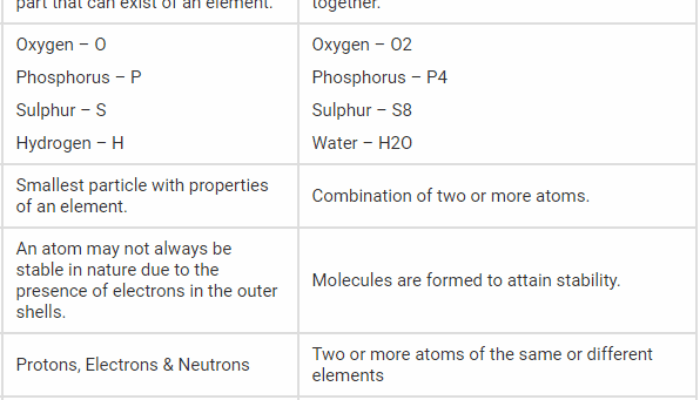
The atom is the smallest unit of matter that retains the properties of an element. It consists of a central nucleus containing protons and neutrons, surrounded by electrons in orbitals. Each element is defined by its unique number of protons, known as the atomic number. Atoms can exist independently or bond with other atoms to form molecules. - Mole:
The mole is a standard unit in the International System of Units (SI) used to measure the amount of substance. It quantifies the number of elementary entities-such as atoms, molecules, or ions-in a sample. One mole corresponds to approximately 6.022 × 10²³ entities, a constant known as Avogadro’s number.
Understanding the Atom
An atom represents the basic building block of all matter. Its nucleus, composed of positively charged protons and neutral neutrons, accounts for nearly all the atom’s mass. Electrons, which carry a negative charge, orbit the nucleus in defined energy levels. The arrangement and number of these subatomic particles determine the chemical behavior and identity of the atom. Atoms can combine through chemical bonds to form molecules, which are the foundation of chemical compounds.
The Concept of the Mole
The mole serves as a bridge between the atomic scale and the quantities encountered in everyday laboratory work. It allows chemists to count vast numbers of atoms or molecules by weighing macroscopic amounts of material. Since individual atoms are extraordinarily small and numerous, the mole provides a practical way to express amounts of substances in terms of countable units.
Role of the Mole in Chemical Calculations
In chemical reactions, the mole is indispensable for stoichiometry-the calculation of reactants and products. Balanced chemical equations use coefficients to represent the ratio of moles of each substance involved. This enables precise predictions of how much of each reactant is needed and how much product will form, facilitating accurate experimental design and analysis.
Molarity and Solution Preparation
Molarity, defined as moles of solute per liter of solution, is a key concentration unit in chemistry. It is essential for preparing solutions with specific concentrations, which is critical in both research and industrial applications. For example, when diluting a concentrated acid, knowing the molarity allows for the calculation of the exact volume required to achieve a desired concentration, ensuring safety and effectiveness.
Atoms, Molecules, and Chemical Bonding
Atoms rarely exist in isolation; they tend to bond with other atoms to form molecules. These molecules can range from simple diatomic gases like hydrogen (H₂) to complex biological macromolecules such as DNA. Both atoms and molecules are quantified using the mole concept, highlighting the interconnectedness of these ideas in chemical science.
Molar Mass: Linking Mass and Quantity
Molar mass is the mass of one mole of a substance, expressed in grams per mole (g/mol). It provides a crucial link between the microscopic world of atoms and the macroscopic world of measurable quantities. For instance, glucose (C₆H₁₂O₆) has a molar mass of approximately 180 g/mol, meaning one mole of glucose weighs 180 grams. This relationship allows chemists to convert between mass and number of particles easily.
Why Understanding Atoms and Moles is Essential
Grasping the concepts of atoms and moles is vital for comprehending chemical phenomena. Atoms form the fundamental units of matter, while moles provide a practical means to quantify and manipulate these units in real-world applications. Together, they enable scientists to explore, predict, and control chemical reactions, driving advancements in science, technology, and industry.
Common Misconceptions
A mole is a type of particle.
A mole is a unit of measurement representing a specific number of particles, not a particle itself.
Atoms and molecules are the same.
An atom is a single unit of an element, while a molecule consists of two or more atoms bonded together.
Summary
In summary, atoms are the elemental units that compose matter, characterized by their unique subatomic structure. The mole, on the other hand, is a counting unit that quantifies these atoms or molecules in large numbers, facilitating practical chemical calculations and experiments. Understanding both concepts is fundamental to the study and application of chemistry, enabling precise measurement, analysis, and manipulation of substances.
FAQ
What is the difference between an atom and a mole?
An atom is a single particle of matter, whereas a mole is a quantity representing 6.022 × 10^23 such particles.
Why is the mole important in chemistry?
The mole allows chemists to measure and work with amounts of substances at a scale that is practical for experiments and calculations.
How does the concept of mole relate to molar mass?
Molar mass connects the amount of substance in moles to mass in grams, enabling conversions between microscopic and macroscopic measures.





Leave a Reply