
Short Answer
Overview of CERN and the LHC
CERN, known as the European Organization for Nuclear Research, and the Large Hadron Collider (LHC) are frequently mentioned together, often causing confusion about their distinct roles. Although closely connected, CERN and the LHC represent different facets of particle physics research. This article clarifies their unique identities and contributions to the scientific community.
Definition and Purpose
CERN: Established in 1954, CERN is an international research organization composed of member states dedicated to advancing the field of particle physics. It functions as a collaborative hub for scientists from over 100 countries, providing access to cutting-edge accelerators and detectors. CERN’s mission extends beyond experimentation to include fostering global scientific cooperation, education, and outreach in high-energy physics.
The LHC: The Large Hadron Collider is a singular, monumental particle accelerator operated under CERN’s umbrella. Launched in 2008, it is the world’s largest and most powerful collider, designed to accelerate protons to velocities near the speed of light and collide them to investigate the fundamental building blocks of matter. The LHC’s primary goals include exploring phenomena such as the Higgs boson, dark matter, and antimatter properties.
Organizational Structure and Facilities
CERN oversees a variety of particle accelerators and research programs, including the Proton Synchrotron and the Super Proton Synchrotron, each serving specific scientific objectives. The LHC is one of these facilities but stands out due to its unprecedented scale and capabilities. It features a 27-kilometer circular tunnel straddling the Swiss-French border, enabling particle collisions at energies never before achieved.
Technological Innovations of the LHC
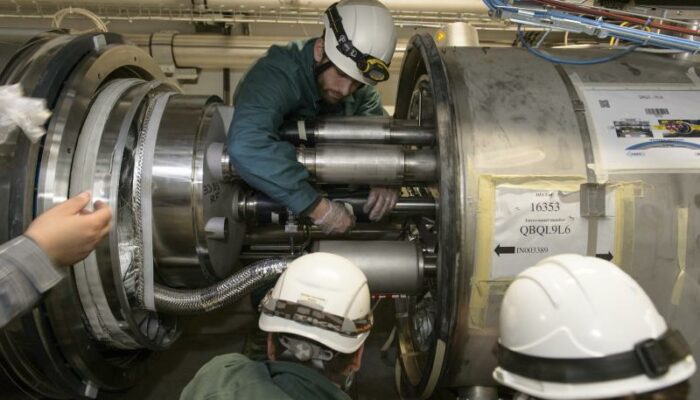
The LHC incorporates state-of-the-art technology, such as superconducting magnets, to maintain the extreme conditions necessary for accelerating and colliding particles. This sophisticated engineering allows the LHC to reach collision energies that facilitate the discovery of new particles and phenomena. While the LHC is a technological marvel, CERN’s scope includes a broad range of projects related to particle acceleration, imaging techniques, and data analysis, ensuring a comprehensive approach to particle physics research.
Collaborative Research Environment at CERN
International cooperation is fundamental to CERN’s operations. Its research teams comprise physicists, engineers, computer scientists, and theorists from diverse backgrounds, fostering interdisciplinary collaboration. This synergy enables the effective interpretation of complex experimental data and situates discoveries within a wider scientific context. CERN’s collaborative framework enhances innovation and knowledge sharing across multiple disciplines.
Significant Scientific Achievements
A landmark achievement resulting from the synergy between CERN and the LHC was the discovery of the Higgs boson in 2012. This breakthrough confirmed the existence of a particle integral to the mechanism that gives mass to other particles, validating a key component of the Standard Model of particle physics. Such milestones underscore the collective effort and infrastructure provided by CERN, with the LHC serving as the experimental centerpiece.
Philosophical and Scientific Impact
Beyond their scientific accomplishments, CERN and the LHC inspire profound questions about the universe and humanity’s role within it. CERN represents a global assembly of intellectual pursuit, while the LHC embodies the ambition to empirically decode the universe’s deepest mysteries. Together, they symbolize the enduring human quest for knowledge and the spirit of scientific inquiry.
Educational Outreach and Public Engagement
CERN actively promotes science education and public understanding through workshops, seminars, and interactive exhibits. These initiatives aim to demystify complex particle physics concepts and engage a wider audience. The LHC, with its impressive scale and technological sophistication, often serves as a captivating focal point for these educational programs, sparking curiosity and inspiring future generations of scientists.
Summary: Distinguishing CERN from the LHC
In essence, CERN and the LHC differ in scope, function, and scale. CERN is a comprehensive international organization dedicated to particle physics research and collaboration, while the LHC is a flagship experimental facility within CERN, representing the forefront of technological and scientific innovation. Together, they drive forward humanity’s understanding of the cosmos and exemplify the power of collective scientific endeavor.
FAQ
What is CERN?
CERN, or the European Organization for Nuclear Research, is an international research organization focused on particle physics.
What is the LHC?
The Large Hadron Collider (LHC) is the world's largest and most powerful particle accelerator, operated by CERN.
How do CERN and the LHC relate to each other?
CERN is the organization that oversees various research facilities, including the LHC, which is a key experimental tool within CERN.
What are the main goals of the LHC?
The LHC aims to investigate fundamental particles, including the Higgs boson and dark matter.






Leave a Reply