
Short Answer
Definition of Atoms and Molecules
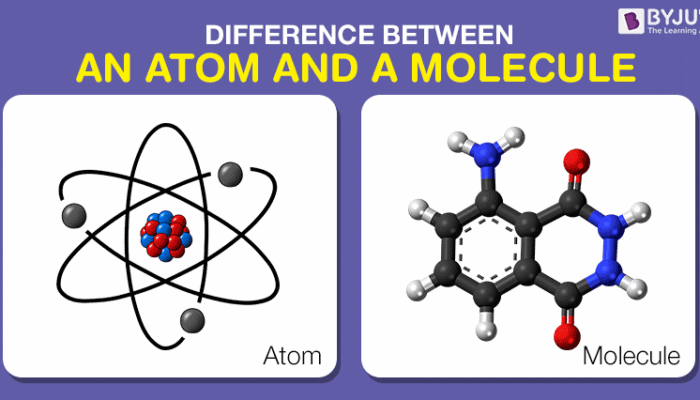
Atoms and molecules are foundational concepts in chemistry and material science, essential for understanding the composition and behavior of matter. Atoms are the smallest units of elements that retain their chemical identity, while molecules are assemblies of two or more atoms bonded together, forming distinct chemical substances.
- Atom:
The fundamental unit of an element, consisting of protons, neutrons, and electrons, which defines the element’s properties. - Molecule:
A chemical entity formed by the bonding of two or more atoms, which can be identical or different, resulting in unique chemical and physical characteristics.
Atomic Structure and Classification
An atom is composed of a nucleus containing protons and neutrons, surrounded by electrons in defined energy levels. The number of protons, known as the atomic number, determines the element’s identity and its position in the periodic table. Neutrons contribute to the atomic mass and can vary among isotopes of the same element, affecting nuclear stability and radioactivity.
- Elements:
Atoms characterized by a specific number of protons. - Isotopes:
Variants of an element with the same proton count but differing neutron numbers, influencing atomic mass and nuclear properties.
Molecular Composition and Types
Molecules arise when atoms chemically bond, forming structures that range from simple diatomic molecules to complex macromolecules. The nature of the atoms involved and the type of bonding determine the molecule’s properties and behavior.
- Homonuclear Molecules:
Composed of identical atoms, such as oxygen (O2) and nitrogen (N2). - Heteronuclear Molecules:
Consist of different atoms bonded together, examples include water (H2O) and carbon dioxide (CO2).
Structural Differences Between Atoms and Molecules
While atoms are singular entities defined by their subatomic particles, molecules exhibit complex three-dimensional arrangements due to the interactions between bonded atoms. The spatial configuration of molecules, including bond angles and molecular geometry, significantly influences their chemical reactivity and physical properties.
Chemical Bonding Mechanisms
The formation of molecules depends on various types of chemical bonds that link atoms together:
- Covalent Bonds:
Involve the sharing of electron pairs between atoms, creating stable molecular structures. - Ionic Bonds:
Result from the transfer of electrons, producing oppositely charged ions that attract each other. - Metallic Bonds:
Characterized by a ‘sea’ of delocalized electrons shared among metal atoms, contributing to conductivity and malleability.
Within atoms themselves, protons and neutrons form the nucleus, while electrons occupy orbitals, but these internal bonds differ fundamentally from the interatomic bonds that create molecules.
Physical Properties and States of Matter
Atoms generally exist as individual particles, often in gaseous form under standard conditions, with limited interaction due to their small size. Molecules, however, can exist in various states-solid, liquid, or gas-depending on intermolecular forces such as hydrogen bonding, van der Waals forces, and dipole interactions.
These intermolecular forces influence key physical properties of substances, including melting and boiling points, solubility, and chemical reactivity, which are critical for applications in chemistry and materials science.
Significance in Scientific and Technological Fields
Understanding the distinctions between atoms and molecules is vital across multiple scientific disciplines. In chemistry, this knowledge facilitates the synthesis of new compounds and the prediction of reaction outcomes. Physics relies on atomic theory to explain phenomena in thermodynamics and quantum mechanics.
Moreover, nanotechnology exploits atomic and molecular principles to engineer materials with novel properties, while biochemistry depends on molecular interactions to develop pharmaceuticals and biotechnological solutions, impacting healthcare and medicine profoundly.
Summary
Atoms serve as the elemental building blocks of matter, while molecules represent the chemical unions of these atoms, forming substances with diverse properties. Grasping their differences, structures, and bonding types enriches our understanding of the material universe and drives innovation in science and technology.
Frequently Asked Questions (FAQ)
What defines an atom?
An atom is the smallest unit of an element that maintains its chemical characteristics, composed of protons, neutrons, and electrons.
How is a molecule characterized?
A molecule consists of two or more atoms chemically bonded, which can be either identical (homonuclear) or different (heteronuclear).
In what ways do atoms differ from molecules?
Atoms are single elemental units, whereas molecules are combinations of atoms bonded together, forming compounds with distinct properties.
What types of bonds hold molecules together?
Molecules are stabilized by covalent, ionic, or metallic bonds, depending on the nature of the atoms involved.
Why is knowledge of atoms and molecules important?
Understanding atoms and molecules is crucial for fields such as chemistry, physics, materials science, and biotechnology, as it underpins the behavior and properties of all matter.
FAQ
What is an atom?
An atom is the smallest unit of an element that retains the chemical properties of that element, consisting of protons, neutrons, and electrons.
What is a molecule?
A molecule is a group of two or more atoms chemically bonded together, which can be either homonuclear or heteronuclear.
How do atoms differ from molecules?
Atoms are single units of elements, while molecules are combinations of atoms bonded together forming compounds with unique properties.
What types of chemical bonds hold molecules together?
Molecules are held together by covalent, ionic, or metallic bonds, depending on the nature of the atoms involved.
Why is understanding atoms and molecules important?
Understanding atoms and molecules is essential for fields like chemistry, physics, materials science, and biotechnology, as it underpins the behavior and properties of matter.






Leave a Reply