
Short Answer
Definition of Sensors and Instruments
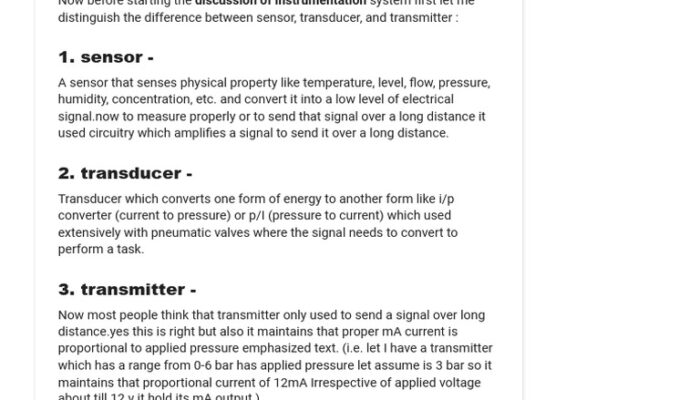
Measurement technology encompasses a variety of devices, often categorized as sensors and instruments. Although these terms are sometimes used interchangeably, they represent distinct concepts with unique roles in data acquisition and analysis.
- Sensor:
A sensor is a device that detects changes in physical, chemical, or biological parameters and converts these changes into electrical signals. It acts as the technological equivalent of sensory organs, responding to stimuli such as temperature, light, pressure, or chemical composition. - Instrument:
An instrument is a more comprehensive device designed to measure, analyze, or manipulate physical quantities. Instruments often incorporate multiple sensors and additional components to provide processed, actionable information rather than just raw data.
Functional Differences Between Sensors and Instruments
The primary distinction lies in their operational roles within measurement systems. Sensors function as the initial data collectors, transforming environmental stimuli into measurable electrical signals. For example, a temperature sensor might output a voltage proportional to the ambient temperature, providing unprocessed data.
In contrast, instruments take these raw signals and apply various mechanisms-mechanical, electronic, or digital-to refine and interpret the data. They often include components such as analog-to-digital converters, display interfaces, and processing algorithms. A digital multimeter exemplifies this by integrating sensors to detect electrical parameters and circuitry to convert these signals into user-friendly readings.
Data Processing and Usability
Sensors deliver raw, unprocessed data that typically require further interpretation or calibration. For instance, a thermocouple sensor outputs a voltage that must be converted and calibrated to determine an accurate temperature. Instruments streamline this process by embedding data processing capabilities, enabling users to access clear, actionable information without needing specialized expertise.
Environmental Adaptability
Sensors are often engineered to operate reliably in challenging environments, such as extreme temperatures, corrosive atmospheres, or high-pressure conditions, making them suitable for continuous monitoring in industrial settings. Instruments, due to their complex electronic components, generally require more controlled environments to maintain accuracy and avoid interference from factors like electromagnetic fields or mechanical vibrations.
Technological Evolution and Integration
The rapid advancement of the Internet of Things (IoT) and smart technologies has accelerated the development of sensors capable of seamless communication and data sharing. Sensor networks now enable real-time collaboration among multiple devices, enhancing situational awareness and data richness.
Simultaneously, instruments are evolving to incorporate these advanced sensory inputs, resulting in sophisticated systems that leverage large datasets for more precise and nuanced measurements. This convergence is reshaping the traditional boundaries between sensors and instruments, fostering innovative measurement solutions.
Applications Across Industries
Different sectors utilize sensors and instruments according to their specific needs:
- Automotive:
Sensors monitor engine temperature, pressure, and other critical parameters, while instruments analyze and display this data for diagnostics and control. - Healthcare:
Sensors detect physiological signals such as blood glucose levels, whereas instruments interpret these signals to assist in medical decision-making. - Manufacturing:
Sensors continuously track environmental conditions, and instruments provide comprehensive analysis for quality control and process optimization.
Importance in Scientific Research
In academic and research contexts, distinguishing between sensors and instruments is essential for experimental design, data collection, and analysis. Precise definitions ensure clarity in methodology and enhance the reliability of scientific findings. Understanding these differences also encourages the development of innovative measurement techniques that advance knowledge across various disciplines.
Summary: Roles and Future Prospects
While sensors and instruments are both vital to measurement and analysis, they fulfill complementary but distinct functions. Sensors act as the primary data collectors, detecting and converting environmental stimuli into electrical signals. Instruments build upon this foundation by processing, analyzing, and presenting data in accessible formats.
Emerging technologies continue to blur the lines between these components, promising enhanced measurement capabilities and new opportunities for technological exploration. This ongoing evolution underscores the dynamic nature of measurement technology and its critical role in understanding and interacting with the world.
FAQ
What is the main difference between a sensor and an instrument?
A sensor detects and converts environmental changes into signals, while an instrument processes these signals to provide meaningful measurement results.
Are sensors used independently or within instruments?
Sensors can be used independently but are often integrated into instruments for enhanced functionality.
Why are instruments more sensitive to environmental interference than sensors?
Instruments contain additional electronic components and processing units that can be affected by electromagnetic interference and vibrations.
How do sensors contribute to the Internet of Things (IoT)?
Sensors collect real-time data enabling IoT devices to communicate and share information, facilitating smarter and connected systems.


Leave a Reply